How Can Osteopathy Help Sciatica?
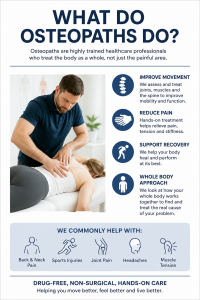
Osteopathy is a gentle manual therapy that has been around a long time. At Buxton Osteopathy Clinic we have all been qualified for at least 20 years and we come with a lot of experience. As osteopaths we specialise in treating soft tissue and joint injuries.
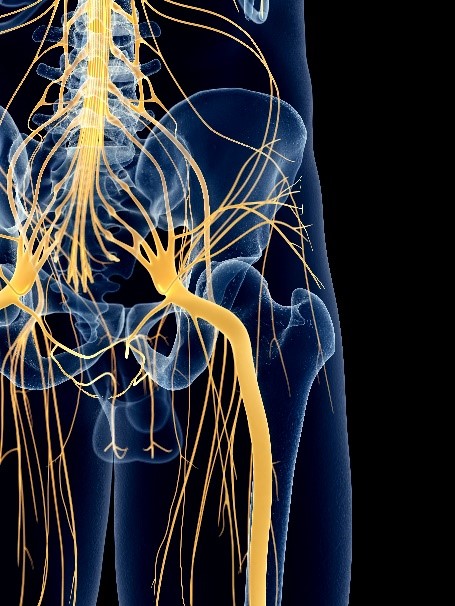
Experience matters when it comes to sciatica. There are many nerves that are involved in forming the largest nerve in our body (the sciatic nerve) any of which can be pinched and compressed.
There are overall between 15-20 common reasons for having sciatica and these make up roughly 90% of cases.
Telling the difference between these reasons is not always easy as they all present in a very similar way. So how do we know?
This comes down to a detailed careful case history and clinical examination. Sciatica can also be very different in severity of symptoms. It can range from just a mild ache in the buttock or leg to severe and disabling nerve pain that travels all the way down to the leg.
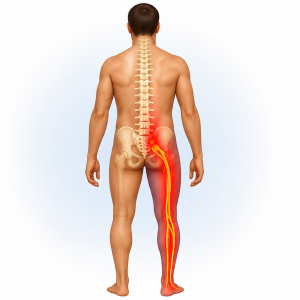
At Buxton & Bakewell Osteopathy Clinic, osteopathy can form an important part of the management of sciatica to help with muscle spams and stiff spinal joints..
For some people who have had a very recent onset of sciatic that is not complex or too severe osteopathy works very well as a conservative form of management.
For people with more persistent symptoms, or where examination indicates that imaging is a good idea, osteopathy may instead form one part of a broader treatment program in combination with IDD Therapy, rehabilitation and, where clinically appropriate, other treatment options.
The important point is that there is no single treatment that is right for every person with sciatica.
Treatment should begin by establishing what is causing the symptoms and whether there are any signs that further investigation or medical referral is required.
What Is Sciatica?
Sciatica describes symptoms associated with irritation or compression of the nerves that eventually form the sciatic nerve.
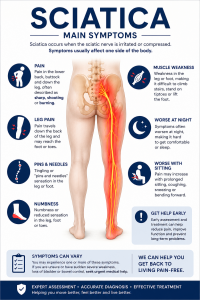
Where Does Osteopathy Fit Into Sciatica Treatment?
As we mentioned in the introduction osteopathy is a form of manual therapy that uses techniques to move your joints and treat your soft tissue, alongside advice about movement, exercise and rehabilitation.
Importantly, manual treatment should not be viewed as something that simply “puts the spine back into place.”
Modern management of sciatica is generally much broader.
NICE recommends considering manual therapy, mobilisation and soft-tissue techniques, for low back pain with or without sciatica as part of a treatment package that includes exercise. (Nice)
This fits particularly well with an osteopathic approach in which treatment is combined with:
- Clinical assessment
- Advice and reassurance
- Appropriate modification of aggravating activities
- Gradual return to normal movement
- Exercise and rehabilitation
- Monitoring neurological symptoms
- Referral for imaging or further medical assessment when clinically indicated
The aim is therefore not simply to provide temporary pain relief.
The objective is to help the patient move more comfortably, progressively restore normal function and create an environment in which recovery can take place.
Osteopathy for Recent-Onset Sciatica
Osteopathy can be particularly useful to consider when sciatica has started recently and there are no concerning neurological or medical findings.
A typical example might be someone who develops back and leg pain after:
- Lifting
- Gardening
- Bending awkwardly
- A sudden twisting movement
- Prolonged sitting
- A long car journey
- An unfamiliar physical activity
The lower back may become painful and stiff, muscles may tighten considerably and movement can become guarded.
This does not necessarily mean that the spine has been seriously damaged.
Indeed, many episodes of sciatica improve over time with appropriate conservative management. Current NHS advice encourages people with sciatica to remain active where possible and introduce gentle movement rather than spending prolonged periods sitting or lying down. (nhs.uk)
In suitable cases, osteopathic treatment may help someone through this early phase.
1. Reducing Protective Muscle Spasm
When the lower back becomes painful, the surrounding muscles may tighten considerably.
This is partly a protective response.
However, excessive muscular guarding can make movement increasingly difficult.
Patients can enter a cycle of:
Pain → muscle guarding → reduced movement → stiffness → more discomfort
Gentle soft-tissue and mobilisation techniques may be used to reduce some of this muscular tension and make movement easier.
The treatment should be adapted to the individual.
A patient experiencing acute leg pain may require a considerably gentler approach than someone with straightforward mechanical lower back stiffness.
2. Improving Movement in the Lower Back
People with sciatica frequently begin moving differently because certain movements provoke their symptoms.
They may:
- Lean to one side
- Avoid bending
- Walk stiffly
- Take shorter steps
- Struggle to straighten after sitting
- Avoid rotating the lower back
- Guard the painful side
Osteopathic mobilisation may be used to help restore comfortable movement where appropriate.
The aim is not to force movement through pain.
Instead, treatment is usually progressively adapted according to the patient’s symptoms and response.
3. Treating the Hips, Pelvis and Surrounding Muscles
Sciatica assessment should not stop at the lumbar spine.
The hips, pelvis, sacroiliac region and surrounding musculature can influence how someone moves when their back is painful.
An osteopathic examination may therefore assess:
- Lumbar spinal movement
- Hip mobility
- Pelvic movement
- Sacroiliac region
- Gluteal muscles
- Hamstrings
- Hip flexors
- Deep muscles around the hip and pelvis
Treating relevant restrictions may make everyday movements such as walking, standing and getting out of a chair more comfortable.
Neurological Examination Is Important
Before deciding that manual treatment is appropriate, neurological examination can be particularly important in someone with suspected sciatica.
Depending upon the symptoms, this may include testing:
- Muscle strength
- Reflexes
- Sensation
- Nerve tension
- Walking
- Heel walking
- Toe walking
These findings can help identify whether a particular lumbar nerve root may be affected.
They also provide useful baseline measurements.
If strength or neurological function subsequently deteriorates, the treatment plan can be reconsidered promptly.
When Osteopathy May Be Used as a Stand-Alone Treatment
For some patients with very recent-onset sciatica, osteopathy combined with appropriate exercise and advice may be sufficient.
This is more likely to be considered when:
- Symptoms have only recently developed
- Leg pain is relatively mild or moderate
- There is no progressive neurological deficit
- There is no significant muscle weakness
- Symptoms are already showing signs of improvement
- Movement appears to influence symptoms
- There are significant associated muscular or joint restrictions
- There are no red flags suggesting serious pathology
The patient can then be monitored over the following days and weeks.
If symptoms steadily improve, more intensive intervention may not be necessary.
This is important because not every episode of sciatica requires IDD Therapy, injections, surgery or an MRI scan.
Treatment should be proportionate to the problem.
Osteopathy and Exercise
Osteopathy should rarely be considered in isolation from movement and rehabilitation.
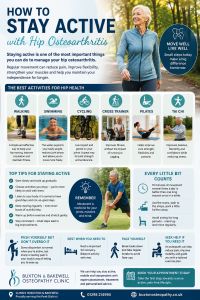
NICE recommends manual therapy only as part of a treatment package that includes exercise, and advises encouraging people with low back pain and sciatica to continue normal activities where possible. (Nice)
Exercise does not necessarily mean strenuous gym-based rehabilitation.
During the early stages it may simply involve:
- Regular short walks
- Gentle mobility exercises
- Changing position frequently
- Avoiding prolonged bed rest
- Gradually increasing normal daily activity
As symptoms settle, rehabilitation can progress towards improving:
- Lumbar mobility
- Hip mobility
- Core and trunk strength
- Leg strength
- General fitness
- Lifting tolerance
- Confidence in movement
This progression can be just as important as the hands-on treatment itself.
When Osteopathy May Not Be Enough
This is an important distinction.
Some cases of sciatica are relatively straightforward and recover quickly.
Others are associated with more substantial structural or neurological problems.
For example, persistent sciatica can be associated with:
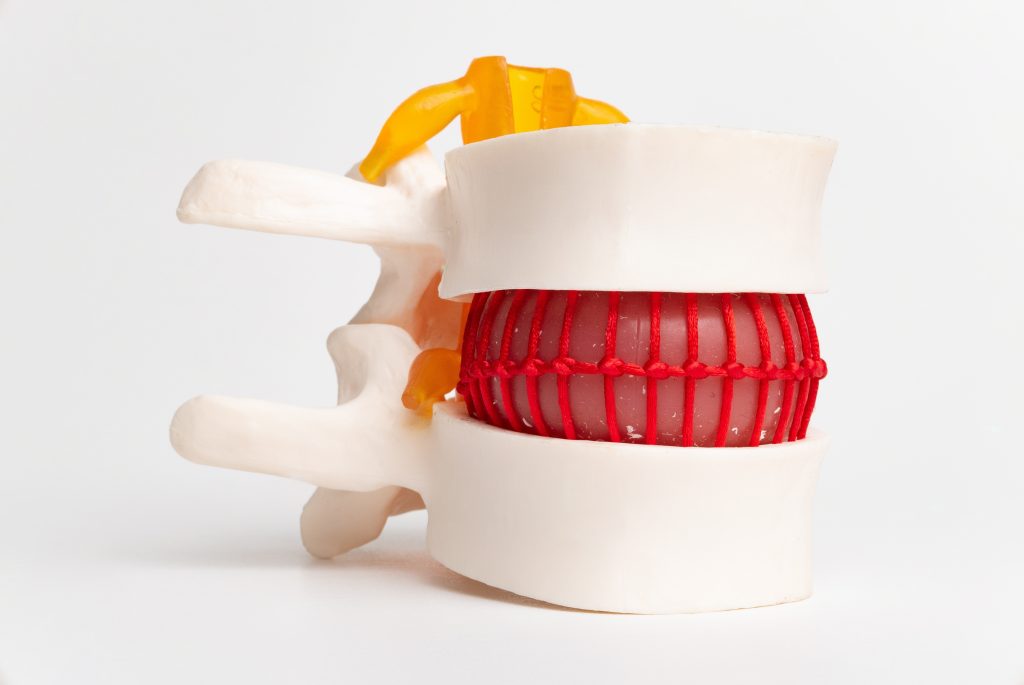
- Lumbar disc herniation
- Degenerative disc disease
- Spinal stenosis
- Spondylolisthesis
- Significant nerve-root compression
In these situations, manual treatment alone may not provide sufficient improvement.
That does not necessarily mean osteopathy becomes irrelevant.
Instead, its role may change.
Combining Osteopathy With IDD Therapy
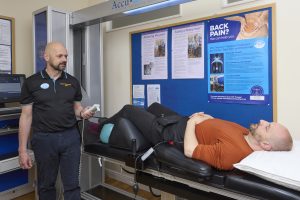
At Buxton & Bakewell Osteopathy Clinic, osteopathy may be incorporated into a broader programme for suitable patients undergoing IDD Therapy .
IDD Therapy is generally considered for more persistent spinal problems where reducing mechanical stress around an affected spinal segment is one of the treatment objectives.
Rather than seeing osteopathy and IDD Therapy as competing treatments, they can have different roles within an individual treatment programme.
Osteopathy may concentrate on areas such as:
Mobility + muscular tension + movement + rehabilitation
while IDD Therapy may be selected to provide a controlled spinal decompression intervention.
The precise combination depends upon the diagnosis, examination findings and response to treatment.
Where Does Shockwave Therapy Fit In?
Shockwave Therapy is not normally used to treat nerve-root compression itself.
However, some people with persistent back and leg problems can develop secondary musculoskeletal pain.
For example, altered walking and movement may contribute to problems affecting muscles or tendons around the hip and lower limb.
Where a separate soft-tissue or tendon problem has been identified, Focused or Radial Shockwave Therapy may sometimes be incorporated into the overall treatment programme where clinically appropriate.
The key is that each treatment should have a clear purpose.
We do not believe in simply applying multiple treatments to every patient.
The treatment programme should reflect what has actually been found during assessment.
Acute Sciatica Versus Persistent Sciatica
A useful way of understanding our approach is to consider two broad clinical scenarios.
Recent-onset sciatica
Assessment → establish likely cause → rule out concerning features → gentle osteopathic treatment where appropriate → advice and exercise → monitor recovery.
For many straightforward cases, this may be all that is required.
Persistent or more complicated sciatica
Detailed assessment → neurological examination → consider whether imaging is required → identify underlying pathology → develop a personalised treatment programme.
This may potentially include:
Osteopathy + IDD Therapy + rehabilitation
and treatment of any relevant secondary musculoskeletal problems.
This stepped approach helps avoid both undertreating and overtreating sciatica.
Do You Need an MRI Before Osteopathic Treatment?
Usually not.
However, an MRI (we offer fast and affordable MRI scans) can become more useful when symptoms are:
- Persistent
- Severe
- Unexplained
- Associated with neurological changes (weakness in your foot abd loss of sensation)
- Not responding as expected
- Being considered for more specialist treatment
MRI can help identify problems such as disc herniation, nerve compression or spinal stenosis. If you want to know more about what an MRI scan please click here.
The decision should therefore be based on the clinical situation rather than automatically scanning every patient with sciatica.
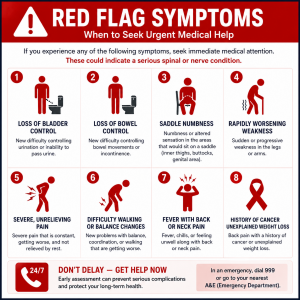
When Sciatica Requires Urgent Medical Assessment
Most sciatica is not a medical emergency.
However, certain symptoms require urgent assessment.
Particular concern exists if someone develops symptoms suggestive of cauda equina syndrome, including
Choosing the Right Treatment for Sciatica
One of the most important principles of our Sciatica Hub is that sciatica is a symptom, not a single diagnosis.
Two people can both describe “sciatica” while having very different underlying problems.
One person may have recently irritated a nerve following lifting and improve quickly with conservative treatment.
Another may have a significant lumbar disc herniation.
Another may have narrowing around the nerve caused by spinal stenosis.
Another may have symptoms that resemble sciatica but actually originate from the hip or another structure.
This is why assessment comes first.
Our Approach to Sciatica at Buxton & Bakewell Osteopathy Clinic
Our approach can be summarised simply:
1. Identify the likely cause
We start with the history, physical examination and neurological testing where appropriate.
2. Decide whether further investigation is necessary
Not everyone needs imaging, but MRI or medical referral may be appropriate when the findings justify it.
3. Match treatment to the problem
For recent and uncomplicated symptoms, osteopathy, movement advice and rehabilitation may be appropriate.
For more persistent or complex spinal problems, treatment may involve a broader programme incorporating IDD Therapy and rehabilitation.
4. Monitor neurological function
Changes in strength, sensation and other neurological findings can be important when managing sciatica.
5. Progress towards recovery
Reducing pain is important, but ultimately we want patients to regain movement, confidence, strength and normal activity.
Osteopathy for Sciatica in Buxton and the Peak District
At Buxton & Bakewell Osteopathy Clinic, we assess and treat patients with lower back pain, sciatica, disc problems and trapped nerves from across Buxton, Bakewell, the High Peak, Peak District and surrounding areas of Derbyshire.
Osteopathy remains an important part of our approach because it gives us a conservative treatment option that can be adapted to the individual.
For someone with a recent uncomplicated episode, it may form the main hands-on element of treatment alongside exercise and advice.
For someone with persistent sciatica, it may form one part of a more comprehensive programme incorporating IDD Therapy spinal decompression and rehabilitation.
The important question is therefore not simply:
“Does osteopathy help sciatica?”
A better question is:
“What is causing your sciatica, and which treatment approach is most appropriate for that particular cause?”
That is where a thorough clinical assessment becomes so important.