If you’ve been diagnosed with a herniated disc or you’re suffering from severe back pain, sciatica or a trapped nerve, you’ll know how quickly everyday life can become difficult.
Even simple tasks such as walking around Buxton town centre, climbing the hills around Bakewell, enjoying a walk on the Monsal Trail or driving to work can become extremely painful.
At Buxton & Bakewell Osteopathy Clinic, we specialise in assessing and treating herniated discs, prolapsed discs, trapped nerves and sciatica for patients from across Buxton, Bakewell, Matlock, Chapel-en-le-Frith, Whaley Bridge, New Mills, Glossop, Ashbourne, Leek, Macclesfield and the wider Peak District.
Our clinic has become one of the region’s leading centres for conservative spinal care by combining detailed clinical assessment with advanced treatments including IDD Therapy Spinal Decompression, expert osteopathy and personalised rehabilitation programmes.
Our aim is simple—to help you avoid unnecessary injections or surgery wherever possible and get back to enjoying everything the Peak District has to offer. You can also check out our Buxton Sciatica Program which is dedicated to resolving your painful issue.
What Is a Herniated Disc?
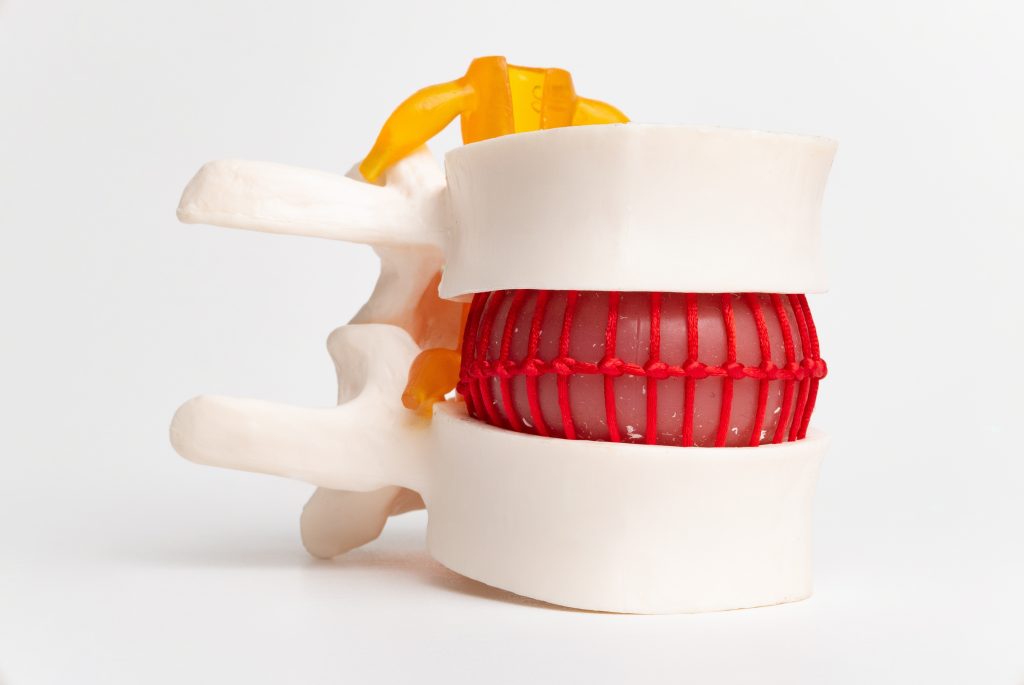
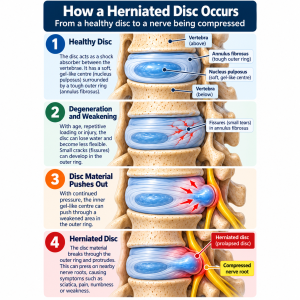
Your spine is made up of intervertebral discs that sit between the bones (vertebrae). These discs act as shock absorbers, allowing your back to bend, twist and absorb everyday forces.
Each disc has two main parts:
- Annulus fibrosus; a strong outer ring of fibrous tissue.
- Nucleus pulposus; a soft, gel-like centre that distributes pressure evenly.
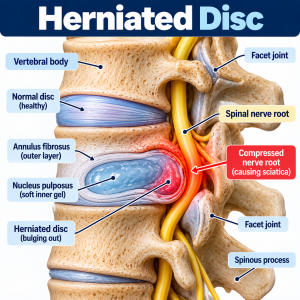
A herniated disc occurs when the outer ring develops a tear and some of the inner gel pushes outward.
| Term | What it means |
|---|---|
| 💿 Slipped disc | A common informal term. The disc does not actually slip out of place. |
| 💿 Prolapsed disc | Commonly used to describe disc material extending beyond its normal boundary. |
| 💿 Ruptured disc | Usually describes inner disc material pushing through a tear in the outer layer. |
| 💿 Disc prolapse | Another way of saying “prolapsed disc”. |
| 💿 Herniated lumbar disc | A disc herniation located in the lower back. |
How Does a Herniated Disc Cause Sciatica?
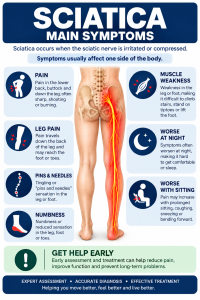
Many disc injuries are painless. Problems occur when the disc bulge or herniation irritates or compresses one of the spinal nerves.
This can cause:
- Sciatica
- Burning leg pain
- Pins and needles
- Numbness
- Muscle weakness
- Back pain
- Difficulty walking
The larger the herniation and the more inflamed the nerve becomes, the greater the symptoms may be.
This is why two people with similar MRI scans can have completely different pain levels.
How Is a Herniated Disc Diagnosed?
At Buxton & Bakewell Osteopathy Clinic, diagnosis begins with a comprehensive assessment.
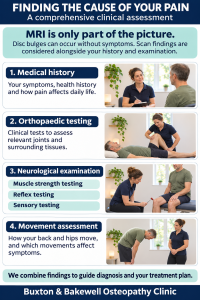
Where necessary we may recommend our private MRI imaging service to confirm the diagnosis and guide treatment planning.
When Should You Seek Urgent Medical Attention?
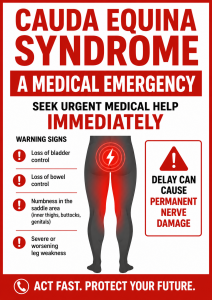
These symptoms may indicate Cauda Equina Syndrome, which requires emergency treatment. This is very uncommon but it does need pointing out as there can be irreversible damage to the nerves that depart the spinal cord if the spinal cord is severely compressed.
Non-Surgical Treatment for Herniated Discs
Most patients do not require surgery.
Evidence-based conservative care often provides excellent outcomes.
Treatment may include:
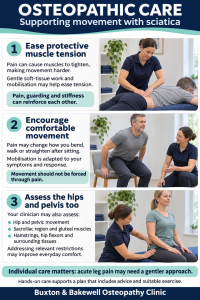
Osteopathy
Gentle hands-on treatment can help improve spinal movement, reduce muscle tension and restore normal mechanics without placing excessive stress on the injured disc.
IDD Therapy Spinal Decompression
For suitable patients, IDD Therapy is one of the most advanced non-surgical treatments available for persistent disc-related pain.
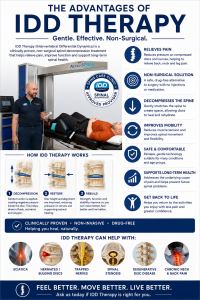
Many patients with chronic sciatica and disc injuries find this treatment particularly helpful when conventional therapies have not provided lasting improvement.
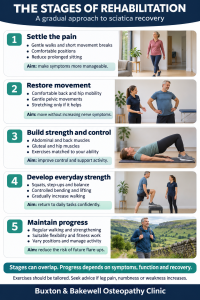
Rehabilitation Exercises
Exercise is an essential part of recovery.
Do Herniated Discs Need Surgery?
No.
Only a relatively small percentage of patients require surgery.
Surgery may be considered if:
- Progressive neurological weakness develops
- Severe symptoms fail to improve after appropriate conservative care
- Cauda Equina Syndrome is suspected
- Pain remains disabling despite comprehensive treatment
For many patients, high-quality conservative management remains the preferred first-line approach
Why Choose Buxton & Bakewell Osteopathy Clinic?
Choosing the right clinic is about more than simply relieving pain.
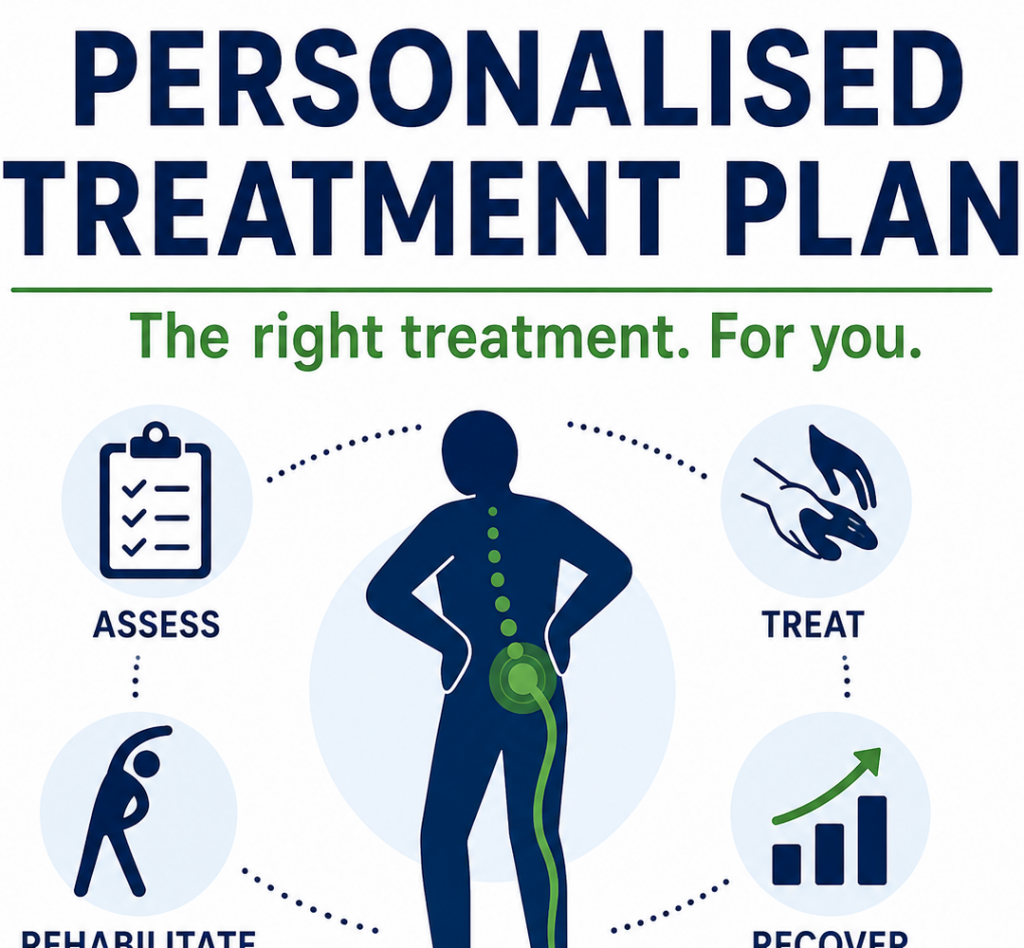
Our goal is to identify why your symptoms developed and create a personalised recovery programme.
Patients choose our clinic because we offer:
- Extensive experience managing spinal conditions
- Specialist assessment of disc injuries and sciatica
- Advanced IDD Therapy spinal decompression
- Individual rehabilitation programmes
- Clear explanations without confusing jargon
- Longer appointment times
- Evidence-informed treatment
- Ongoing support throughout recovery
Our focus is not simply treating today’s pain but helping reduce the likelihood of future episodes.
Frequently Asked Questions
Is walking good for a herniated disc?
For many patients, gentle walking is one of the best early exercises. Walking helps maintain mobility, improves circulation and reduces stiffness. However, distances should be increased gradually depending on symptoms.
Can a herniated disc heal without surgery?
Yes. Many herniated discs improve naturally with appropriate conservative care, rehabilitation and activity modification. Surgery is only required in a minority of cases.
Is a herniated disc the same as sciatica?
No. A herniated disc is the structural problem. Sciatica describes symptoms caused by irritation of the sciatic nerve. A herniated disc is one of the most common causes of sciatica.
What is IDD Therapy?
IDD Therapy is an advanced, computer-controlled spinal decompression treatment designed to gently reduce pressure on injured discs and irritated nerves. It is often used as part of a structured rehabilitation programme for suitable patients with persistent disc-related pain.
When should I have an MRI scan?
MRI may be recommended if symptoms persist, neurological signs are present, or if imaging is required to guide treatment decisions. We can advise whether private MRI scanning is appropriate based on your assessment. Please refer to our MRI service that we offer.
Start Your Recovery Today
Living with a herniated disc can affect every aspect of daily life—from work and sleep to walking the dog or playing with your grandchildren. The good news is that most people improve with the right diagnosis, the right treatment and a structured rehabilitation plan.
At Buxton & Bakewell Osteopathy Clinic, we are committed to helping people across Buxton, Bakewell and the Peak District recover from herniated discs, sciatica and trapped nerves using evidence-informed, non-surgical care tailored to each individual.
If you have persistent back pain, leg pain, numbness or sciatica, don’t ignore the problem or simply hope it will disappear. Early assessment can help identify the underlying cause, guide the most appropriate treatment and give you the best opportunity for a full recovery.
Book an assessment today and discover why so many patients across Derbyshire and the Peak District trust our team for expert care of herniated discs and spinal nerve pain.