Physical Examination for Sciatica
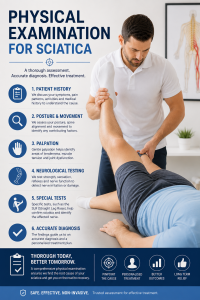
A physical examination is essential for an accurate diagnosis. A physical examination will allow us to correlate your symptoms to a particular nerve that is causing your problems.
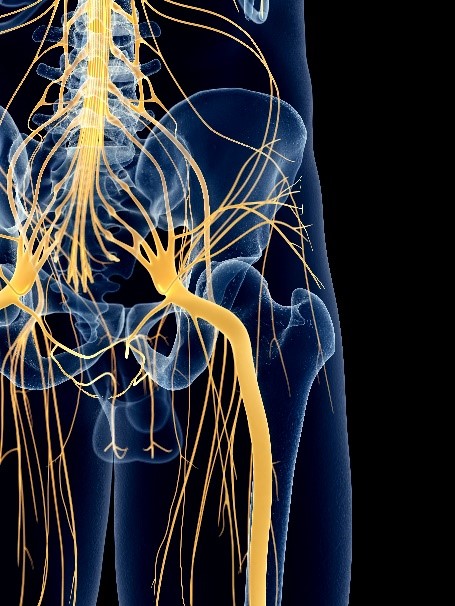
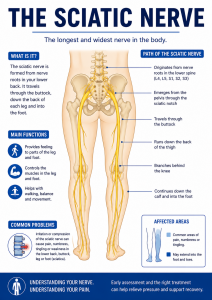
Think of the sciatic nerve as a river made up of many different streams.
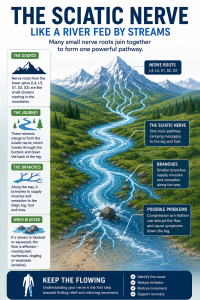
Anything that blocks or narrows that contributing nerve has a downstream effect. We need to identify where this restriction is so we can target our treatment. It will also allow us to assess how profound your issue is and whether it merits further investigation such as an MRI scan.
We can organise private MRI scans very quickly and at an affordable price.
While an MRI scan does produce clear pictures of all the spinal anatomy it can often show changes that are harmless and asymptomatic. These changes may not be related to your physical pain. The value of a physical examination is that it does allow us to match our examination with imaging if necessary.
Our physical examination involves basic neurological tests. By checking your reflexes in your knee and ankle (elbow and wrist in the arm) we can check your nerve function. We’d also check your muscle strength as sometimes muscles can become weak because of trapped nerves.
This also gives us an indication of which nerves are impinged. We also checked the sensation of your skin in your legs as well and this also allows us to form a clinical correlation
At Sciatica Hub, understanding why your symptoms are occurring is critical so we can decide the best treatment plan for you. We can identify the likely cause of your sciatica through a detailed history but it is important that this is combined with a comprehensiv physical examination.
At our clinic in Buxton, we assess patients from across the Peak District, Bakewell, High Peak and North Derbyshire, helping identify whether symptoms are caused by a herniated disc, spinal stenosis, piriformis syndrome, degenerative disc disease or another condition affecting the sciatic nerve.
Why Is a Physical Examination Important?
Sciatica is not a diagnosis in itself.
It is a symptom caused by irritation or compression of one or more nerves that make up the sciatic nerve. Think of the sciatic nerve as a river made up of many different streams. Anything that blocks or narrows that contributing nerve has a downstream effect. We need to identify where this restriction is.
A physical examination helps determine:
- Which nerve is affected
- Where the nerve is being irritated
- How severe the compression may be
- Whether muscles have become weak
- Whether sensation has changed
- Whether urgent treatment is needed
Most importantly, it helps distinguish sciatica from other causes of leg pain. Leg pain be also generated from the hip or knee. This is not as striaght forward as it sounds….believe me!!!
Your Assessment Starts Before You Are Examined
We begin assessing you the moment you walk into the room.
This tells us more than you think. We would look at;
- Your posture
- How you walk
- Whether you are limping
- Whether you struggle to sit down
- Whether you lean to one side
- Whether you can stand upright
These observations often provide valuable clues even before we do any tests.
Taking Your Medical History
Before any physical examination, we will ask detailed questions about your symptoms.
Typical questions include:
- Did your pain begin with a trip or a fall or lifting or for no apparant reason
- How far down the leg does the pain travel?
- Is one leg affected or both?
- Does coughing or sneezing increase the pain?
- Is sitting worse than walking?
- Do you have numbness?
- Do you have pins and needles?
- Have you noticed weakness?
- Have you experienced changes in bladder or bowel function?
These answers help narrow down the possible causes.
Looking at Your Spine
We will look at your lower back.
We assess:
- Spinal alignment
- Curvature
- Muscle spasm
- Where it hurts
- Protective muscle guarding
- Pelvic position
Many patients with acute sciatica lean away from the painful side because their body is attempting to reduce pressure on the irritated nerve. We call this an ‘antalgic position’ and we see it alot. Often patients see this when they look in the mirror.
Assessing Your Movement
You will usually be asked to perform several movements if you are comfortable enough to do them.
These include:
- Bending forwards
- Leaning backwards
- Side bending
- Twisting
- Standing on one leg
Each movement provides useful diagnostic information.
For example:
Pain when bending forwards often suggests disc involvement.
Pain during extension may point towards spinal stenosis or facet joint irritation.
Palpation (Feeling the Spine)
We will gently feel the muscles and joints around your spine.
We assess:
- Muscle tightness
- Tenderness
- Swelling
- Joint stiffness
- Muscle guarding
Although touching the spine cannot diagnose a disc problem directly, it helps identify structures contributing to your symptoms.
Neurological Examination
One of the most important parts of a sciatica assessment is examining how well the nerves are functioning.
This usually includes:
- Muscle strength
- Reflexes
- Sensation
- Nerve tension tests
Together, these provide valuable information about nerve health.
Muscle Strength Testing
Compressed nerves may not simply cause pain.
They can also reduce muscle strength sometimes causing a weak foot.
Your clinician will test muscles supplied by different spinal nerves.
Examples include:
| Movement Tested | Nerve Commonly Assessed |
|---|---|
| Lifting the big toe | L5 |
| Pulling the foot upwards | L4-L5 |
| Standing on heels | L4-L5 |
| Standing on tiptoes | S1 |
| Pushing the foot down | S1 |
| Knee extension | L3-L4 |
Weakness can indicate that a nerve is under significant pressure.
Reflex Testing
Reflexes help determine whether nerve signals are travelling normally.
Common reflexes tested include:
| Reflex | Main Nerve Root |
|---|---|
| Knee jerk | L3-L4 |
| Ankle jerk | S1 |
Reduced or absent reflexes can suggest nerve root compression.
Sensory Testing
We will gently assess sensation in your leg using light touch.
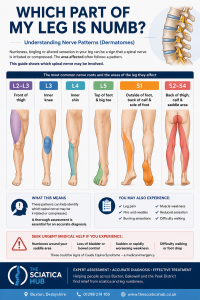
Different areas of skin correspond to different spinal nerves.
They may ask whether one side feels:
- Numb
- Less sensitive
- More sensitive
- Tingly
- Different compared to the opposite leg
This helps identify which nerve root may be affected.
Straight Leg Raise Test
One of the best-known tests for sciatica is the Straight Leg Raise (SLR).
During this test:
- You lie on your back.
- The clinician slowly raises your straight leg.
- This gently stretches the sciatic nerve.
If your familiar leg pain is reproduced between approximately 30 and 70 degrees, this may indicate irritation of the sciatic nerve, often caused by a herniated lumbar disc.
Importantly, the test is not simply positive because your hamstrings feel tight—it is the reproduction of your typical sciatic pain that is significant.
Crossed Straight Leg Raise
Sometimes the unaffected leg is lifted instead.
If this causes pain down the opposite affected leg, it is known as a Crossed Straight Leg Raise.
Although less common, this finding is highly suggestive of significant nerve root irritation, particularly from a lumbar disc prolapse.
Slump Test
The Slump Test is another important nerve tension assessment.
You will be asked to:
- Sit upright.
- Bend your back forwards.
- Lower your head.
- Straighten one knee.
- Pull your foot upwards.
This places gentle tension on the nervous system.
If your familiar symptoms are reproduced and then relieved by changing head position, this supports nerve involvement.
Walking Tests
Walking provides valuable information.
Your clinician may ask you to:
- Walk normally
- Walk on your heels
- Walk on your toes
- Squat
- Rise from a squat
Difficulty with these movements can indicate weakness affecting specific nerves.
Balance Testing
Simple balance tests may reveal subtle muscle weakness or nerve dysfunction.
Examples include:
- Standing on one leg
- Heel-to-toe walking
- Single leg squat
These tests help assess overall function.
Screening for Red Flags
Every physical examination should include assessment for serious conditions that require urgent medical attention.
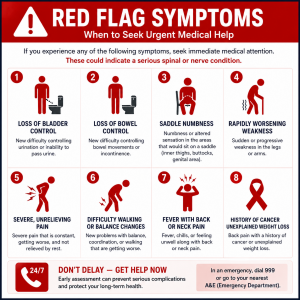
These include:
- Cauda equina syndrome
- Progressive muscle weakness
- Severe neurological deficit
- Infection
- Fracture
- Cancer affecting the spine
Symptoms such as loss of bladder or bowel control, numbness around the saddle area or rapidly worsening leg weakness require immediate emergency assessment.
Will I Need an MRI?
Not everyone requires an MRI scan.
Many people who come to see us improve with appropriate treatment following a thorough clinical assessment.
However, imaging may be recommended if:
- Symptoms are severe.
- Weakness is developing.
- Symptoms persist despite treatment.
- Surgery is being considered.
- Serious pathology is suspected.
We offer affordable and fast private MRI scans
MRI findings are interpreted alongside your examination because many people without pain have abnormal scans.
What Happens After the Examination?
Once the examination is complete, we will tell you
- The likely diagnosis
- Which nerve is affected
- The probable cause
- Whether further investigations are needed
- Your treatment options
- Expected recovery times
This allows treatment to be tailored specifically to your condition rather than simply treating symptoms.
Why Expert Assessment Matters
Many different conditions can produce symptoms that resemble sciatica.
These include:
- Herniated discs
- Spinal stenosis
- Piriformis syndrome
- Hip joint problems
- Sacroiliac joint dysfunction
- Peripheral nerve entrapment
- Vascular conditions
A careful physical examination helps distinguish between these conditions and guides the most appropriate treatment.
At our Buxton clinic, we combine detailed clinical assessment with advanced diagnostic reasoning to identify the underlying cause of sciatic nerve pain. Patients travel from Bakewell, the Peak District, High Peak and surrounding areas for specialist assessment of sciatica, trapped nerves, lumbar disc injuries and spinal stenosis.
Frequently Asked Questions
Is a physical examination painful?
Most of the examination is gentle. Some tests may briefly reproduce your familiar symptoms, which can help identify the affected nerve, but your clinician will stop if discomfort becomes excessive.
Can a physical examination diagnose sciatica?
A detailed history and examination can strongly indicate sciatica and often identify the affected nerve root. An MRI may be recommended if symptoms are severe, persistent or if serious pathology is suspected.
Which test is most accurate?
No single test is definitive. Clinicians use a combination of neurological testing, movement assessment, and nerve tension tests to build an accurate diagnosis.
Do I always need an MRI?
No. Many patients can be diagnosed and treated successfully without imaging. MRI is generally reserved for specific clinical situations.
Can weakness in my leg be caused by sciatica?
Yes. Compression of certain lumbar nerve roots can reduce muscle strength, making it difficult to lift the foot, stand on tiptoes or control the leg. Progressive weakness should always be assessed promptly.
Key Takeaway
A thorough physical examination is one of the most valuable tools for diagnosing sciatica. By assessing movement, muscle strength, sensation, reflexes and nerve tension, an experienced clinician can often identify the underlying cause of your symptoms and develop a personalised treatment plan. Early assessment not only helps direct the right treatment but also identifies serious conditions that require urgent care, giving you the best chance of a safe and successful recovery.