Build Good Habits
Little things we do every day make a real difference. Some things will exacerbate sciatica, and other things will support recovery.
It is important to remember that good habits that work for some of us may not work for others.
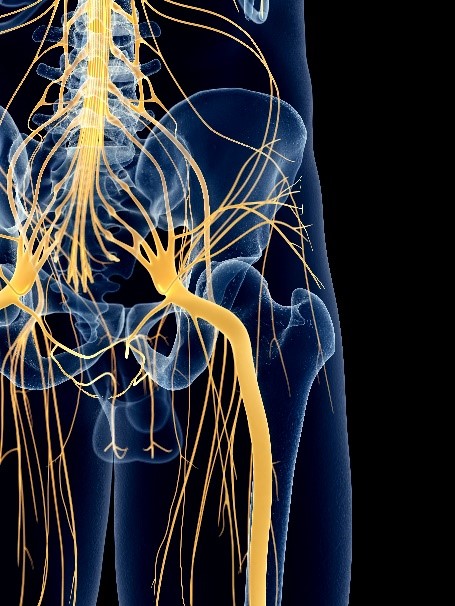
Sciatica can be caused by anything that comes into contact with the nerves which join together to form the largest nerve in the body….you’ve guessed it! The sciatic nerve!
There is no fixed number of causes for sciatica but there are roughly 15-20 common reasons that make up 90% of cases.
Although two people may both have pain travelling down the leg, the underlying cause, the severity of the nerve irritation and best treatment for that presentation can be very different indeed.
This comes down to understanding your diganosis and what is causing your sciatcica.
NICE (National Institute of Clinical Excellence) guidance suggests that if we have low-back pain—with or without sciatica—we should be encouraged to maintain normal activities. NICE also recommends considering exercise programmes based on our needs, abilities and preferences.
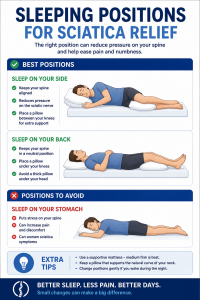
Movement breaks matter even if they are just for a few minutes every hour or half hour. Having a standing desk adds dynamic movements and recruits your postural muscles. Prolonged sitting on the other hand is likely to increase your pain. Your sleeping postion helps you find a postion of ease. The wrong position only serves to aggravate your sciatic nerve.
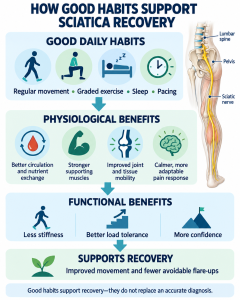
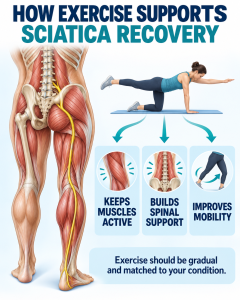
Low impact-movement such as short walks will keep your spine mobile and reduce stiffness by keeping the tissues around the sciatica nerve mobile and flexible.
Muscles will also be activated in your torso and hips which will help scaffold your spinal stability. This will in turn minimises the burden on interverbal discs.
Activating all your muscles groups in the spine will spread the load and tension and this can only be a good thing. This activation also relieves the dependency on muscles that are busy compensating or are too tight.
Moreover, just the act of even contracting and relaxing muscles will promote circulation. This will help wash away inflammatory mediators at the focal point of your pain while delivering fresh blood, oxygen and nutrients.
What you body will not benefit from is little or no movement.
Habits That Can Slow Sciatica Recovery
| Habit to avoid | Why it may be unhelpful |
|---|---|
| 🛋️ Prolonged bed rest | Can increase stiffness, weakness and fear of movement. |
| 🪑 Sitting for too long | May aggravate back or leg symptoms in some people. |
| 🏃 Doing too much too soon | Sudden increases in activity can trigger a flare-up. |
| 🔁 Repeated bending and twisting | May repeatedly irritate a sensitive back or nerve. |
| 🏋️ Lifting beyond your capacity | Can place more demand on tissues before they are ready. |
| ❌ Avoiding all movement | Can reduce mobility, strength and confidence over time. |
| 📆 Performing exercises inconsistently | Makes it harder to build strength and measure progress. |
| ⚠️ Exercising through worsening nerve symptoms | Increasing leg pain, numbness or weakness may require reassessment. |
| 💻 Working without regular breaks | Staying in one position can allow discomfort and stiffness to build. |
| 🌙 Having an irregular sleep routine | Poor sleep may increase fatigue and sensitivity to pain. |
| 🚬 Smoking | Can negatively affect circulation and general tissue health. |
| 😟 Assuming every flare-up means damage | May increase anxiety and lead to unnecessary activity avoidance. |
| 💊 Relying only on short-term symptom relief | May overlook rehabilitation, strength and contributing factors. |
| 🚩 Ignoring worsening weakness or numbness | Could delay assessment of increasing nerve compression. |
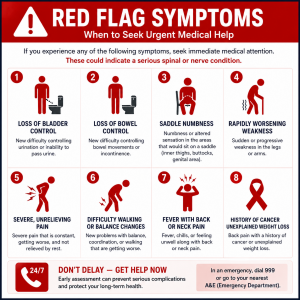
Important: Seek urgent medical help for new bladder or bowel problems, numbness around the saddle area, or rapidly worsening leg weakness.
Why daily habits matter
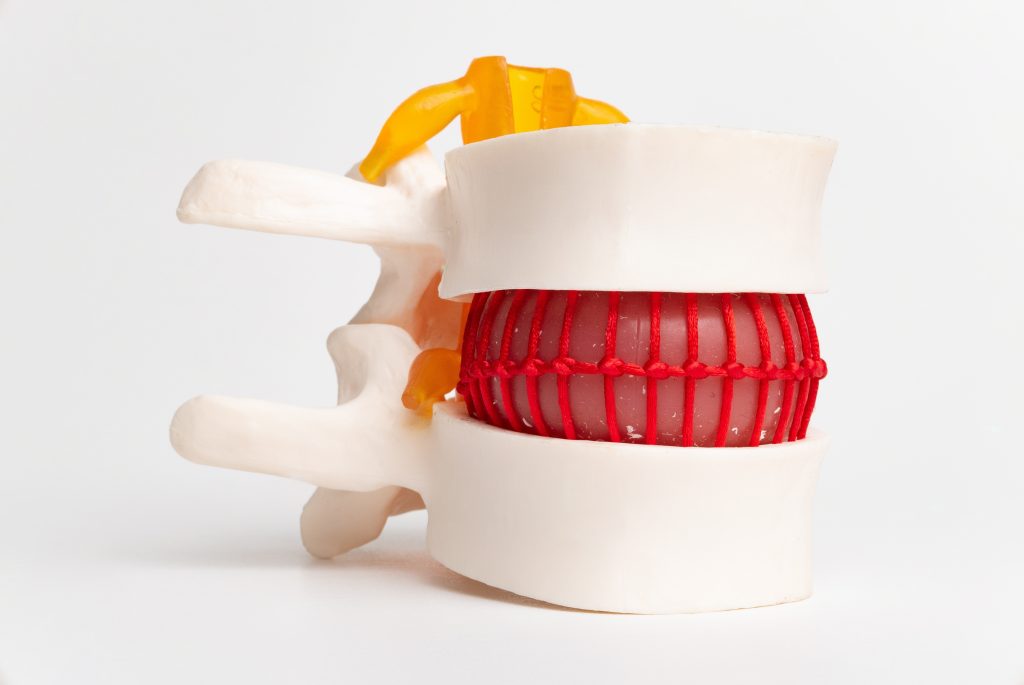
Sciatica often develops when a nerve in the lower back becomes irritated or compressed. This may be associated with a disc problem, spinal stenosis, inflammation or another condition affecting the nerve.
Treatment can help address the underlying problem, but repeatedly aggravating the area may make recovery more difficult. For example, prolonged sitting, poor lifting technique or doing too much activity too quickly can keep symptoms unsettled.
Good habits create a more supportive environment for recovery.
Avoid staying in one position for too long
Even a good posture can become uncomfortable when it is maintained for a prolonged period.
If you work at a desk, drive regularly or spend time sitting at home, try to change position every 30–45 minutes. Stand up, walk briefly or perform a gentle movement recommended by your practitioner.
A supportive chair and well-arranged workspace may help, but regular movement is usually more important than trying to maintain one “perfect” posture all day.
Pace your activities
When symptoms begin to improve, it can be tempting to catch up on gardening, housework, exercise or other missed activities. Doing too much on a good day may cause a flare-up and leave you needing several days to recover.
Pacing means dividing demanding activities into manageable amounts. It may help to:
- Plan more strenuous jobs in advance
- Take breaks before symptoms become severe
- Alternate heavier and lighter tasks
- Increase activity gradually
- Avoid the cycle of doing too much and then needing prolonged rest
A steady and repeatable routine is usually more helpful than occasional bursts of intense activity.
Use sensible lifting habits
Lifting does not automatically damage the spine, but heavy, repetitive or awkward lifting may aggravate an already sensitive lower back or nerve.
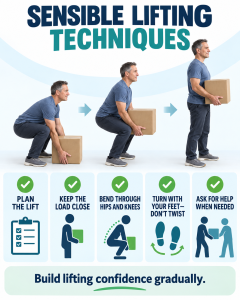
When lifting:
- Keep the object close to your body
- Use your hips and knees when appropriate
- Avoid twisting while carrying a load
- Turn your feet rather than rotating suddenly
- Ask for help with heavy or awkward objects
- Build your strength gradually before returning to demanding tasks
There is no single lifting technique that suits every person or situation. The aim is to move confidently while keeping the load manageable.
Follow your exercise plan
Exercises are most effective when they are performed regularly and correctly. Your programme may include movements to improve mobility, strength, balance, nerve tolerance or general fitness.
More exercise is not always better. An exercise that is helpful for one type of sciatica may aggravate another. Follow the frequency and intensity recommended for you, and report any significant or lasting increase in leg pain, numbness or weakness.
Your programme can be adjusted as your symptoms and abilities change.
Support healthy sleep
Pain can make it difficult to fall asleep or remain comfortable during the night. A regular sleep routine may help your body recover and make symptoms easier to manage.
Try to:
- Keep reasonably consistent sleep and waking times
- Use pillows to support a comfortable position
- Avoid remaining in bed for long periods during the day
- Reduce caffeine later in the day
- Create a calm routine before bedtime
There is no universally correct sleeping position for sciatica. The best position is usually the one that allows you to rest comfortably without significantly increasing your symptoms.
Look after your general health
Your nerves, muscles and joints are part of your whole body. General health habits can therefore influence recovery.
Helpful habits may include:
- Eating a balanced diet
- Drinking enough water
- Maintaining an appropriate body weight
- Reducing or stopping smoking
- Managing stress
- Gradually improving cardiovascular fitness
- Getting enough rest without becoming inactive
Stress does not mean that your pain is imaginary. However, prolonged stress can increase muscle tension, disturb sleep and make the nervous system more sensitive to pain.
Do not be discouraged by occasional flare-ups
Recovery is not always a straight line. You may have several good days followed by a temporary increase in symptoms.
A flare-up does not necessarily mean that you have caused further damage or returned to the beginning. Consider what may have contributed, reduce aggravating activities temporarily and return to your usual routine gradually.
If your symptoms change significantly or continue to worsen, arrange a reassessment.
Know when to seek help
Contact a healthcare professional if you develop increasing leg weakness, worsening numbness, difficulty walking or symptoms that are not improving as expected.
Small changes can produce meaningful progress
You do not need to transform every part of your routine at once. Choose one or two manageable changes and practise them consistently. Once they feel natural, another habit can be added.
At Buxton & Bakewell Osteopathy Clinic, we help patients understand which activities may be contributing to their symptoms and develop realistic recovery plans. Depending on the diagnosis, this may include osteopathy, exercise rehabilitation, IDD Therapy or other appropriate treatment.
The goal is not simply to reduce pain. It is to help you move confidently, regain function and develop habits that support your spine in the future.
To arrange an assessment, call Buxton & Bakewell Osteopathy Clinic on 01298 214994.
Why Choose Buxton & Bakewell Osteopathy Clinic?
We specialise in assessing and managing spinal conditions that commonly cause night-time sciatica, including herniated discs, spinal stenosis, degenerative disc disease and trapped nerves.
Every patient receives a detailed assessment to determine the source of their symptoms. Where appropriate, we can arrange private MRI referrals, explain the findings clearly and discuss suitable treatment options, including rehabilitation and IDD Therapy for carefully selected patients.
Patients travel to our clinic from Buxton, Bakewell, Matlock, Chapel-en-le-Frith, Whaley Bridge, Ashbourne, Macclesfield, High Peak and across the Peak District for expert assessment of persistent sciatica and nerve-related leg pain.