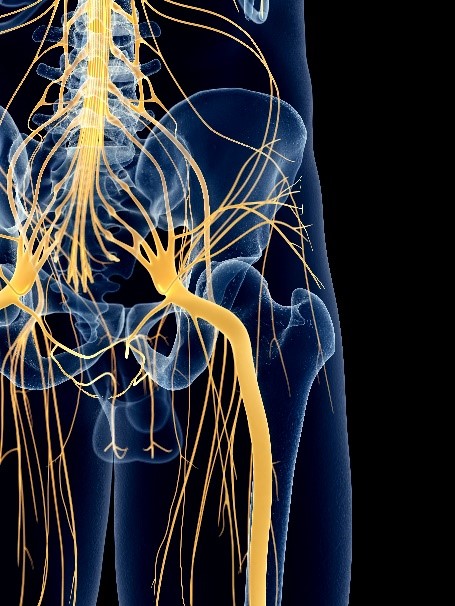
Experience matters when it come to sciatica. There are many nerves that are involved in forming the largest nerve in our body (the sciatic nerve) any of which can be pinched and compressed.
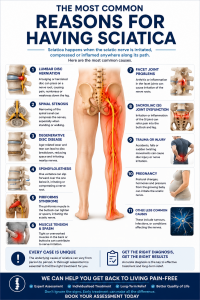
There are overall between 15-20 common reasons for having sciatica and these make up roughly 90% of cases. A herniated disc is probably one of the top five reasons.
If you’ve been diagnosed with a herniated disc you will know about it. It usually involves back and hip pain and pain running down the back of your leg. Everyday life can become difficult with simple tasks like sitting and standing or even sleeping a night becoming a challenge. A stroll around Buxton town centre, enjoying a walk on the Monsal Trail or driving to work can become extremely painful.
At Buxton & Bakewell Osteopathy Clinic, we specialise in assessing and treating herniated discs, prolapsed discs, trapped nerves and sciatica for patients from across Buxton, Bakewell, Matlock, Chapel-en-le-Frith, Whaley Bridge, New Mills, Glossop, Ashbourne, Leek, Macclesfield and the wider Peak District.
Our clinic has become one of the region’s leading centres for conservative spinal care by combining detailed clinical assessment with advanced treatments including IDD Therapy, expert osteopathy and personalised rehabilitation programs.
Our aim is simple. We want to offer you effective conservative treatment that helps you avoid unnecessary injections or surgery and get you back to enjoying everything the Peak District has to offer. You can also check out our Buxton Sciatica Program which is dedicated to resolving your painful issue.
Many of our patients tell us they first noticed their symptoms after lifting in the garden (usually a pot), walking the hills around Buxton or after a long commute to Manchester or Sheffield. Others wake with severe leg pain after what initially seemed like a simple episode of back stiffness. A herniated disc can manifest in different ways that might seem confusing.
Whatever the cause, persistent leg pain should never simply be accepted as “just back pain.” An accurate diagnosis is essential because different spinal conditions require different treatment approaches.
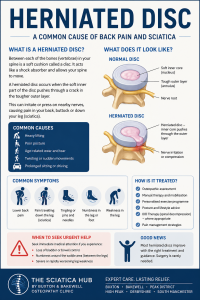
What Is a Herniated Disc?
Our spines are complex. We have 24 vertebra, 23 spongy discs, 31 pairs of nerves, 96 spinal joints, 120 individual muscles and about 220 ligaments!
Our 23 discs act as shock absorbers, allowing your back to bend, twist and absorb everyday forces.
Each disc has two main parts:
- Annulus fibrosus; a strong outer ring of fibrous tissue.
- Nucleus pulposus; a soft, gel-like centre that distributes pressure evenly.

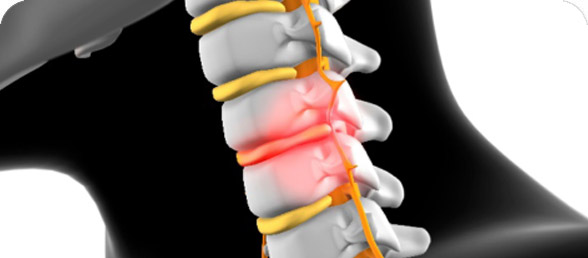
A herniated disc occurs when the outer ring develops a tear and some of the inner gel pushes outward.
There are several different terms for this;
- Slipped disc
- Prolapsed disc
- Ruptured disc
- Disc prolapse
- Herniated lumbar disc
Although people often say a disc has “slipped,” the disc does not actually move out of place (this was an old myth often perpetuated in days gone by). Instead, the inner material protrudes through a weakness in the outer wall which is made up of thick rings of fibrocartilage.
How Does a Herniated Disc Cause Sciatica?
Many disc injuries are painless.
Problems occur when the disc bulge or herniation irritates or compresses one of the spinal nerves. The sciatica nerve is like a big mains cable that supplies power to the muscles and sensation to your skin, so there are a variety of differnet symptoms.
These include;
- Sciatica
- Burning leg pain
- Tingling
- Pins and needles
- Numbness
- Muscle weakness
- Reduced reflexes
- Difficulty walking
The larger the herniation and the more inflamed the nerve becomes, the greater the symptoms may be.
How Is a Herniated Disc Diagnosed?
At Buxton & Bakewell Osteopathy Clinic, diagnosis begins with a comprehensive assessment.
We don’t rely solely on MRI findings because many people have disc bulges without symptoms.
Instead, we combine:
- Medical history
- Orthopaedic testing
- Neurological examination
- Muscle strength testing
- Reflex testing
- Sensory testing
- Movement assessment
Where necessary we may recommend our private MRI imaging service to confirm the diagnosis and guide treatment planning.
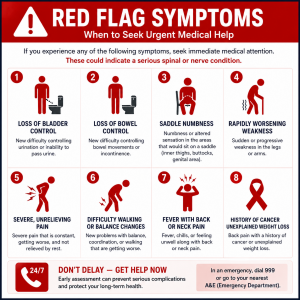
When Should You Seek Urgent Medical Attention?
Although uncommon, some symptoms require immediate medical assessment.
These symptoms may indicate Cauda Equina Syndrome, which requires emergency treatment.
Can a Herniated Disc Heal Naturally?
Recovery varies considerably.
Some people recover within weeks.
Others continue experiencing pain for many months because:
- The nerve remains compressed
- Inflammation persists
- Muscles become weak
- Movement patterns change
- Fear of movement develops
The aim of treatment is to support natural healing while reducing nerve irritation and restoring normal function.
Non-Surgical Treatment for Herniated Discs
Most patients do not require surgery.
Evidence-based conservative care often provides excellent outcomes.
Treatment may include:
Osteopathy
Gentle hands-on osteopathy can help improve spinal movement, reduce muscle tension and restore normal mechanics without placing excessive stress on the injured disc.
IDD Therapy Spinal Decompression
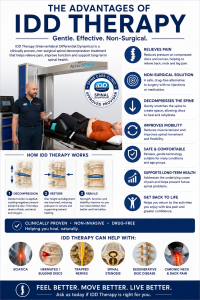
For suitable patients, IDD Therapy is one of the most advanced non-surgical treatments available for persistent disc-related pain.
Unlike simple traction, IDD Therapy uses computer-controlled spinal decompression to precisely target the affected spinal level.
The treatment aims to:
- Reduce pressure within the disc
- Create gentle decompression around the affected nerve
- Improve nutrient exchange within the disc
- Reduce muscle guarding
- Encourage healing
Many patients with chronic sciatica and disc injuries find this treatment particularly helpful when conventional therapies have not provided lasting improvement.
Rehabilitation Exercises
Exercise is an essential part of recovery.
Your rehabilitation programme may include:
- Core stability
- Walking progression
- Nerve mobility exercises
- Hip strengthening
- Glute activation
- Flexibility work
- Functional lifting retraining
Exercises are progressed gradually according to your symptoms.
Lifestyle Advice
Recovery is often accelerated by:
- Weight management
- Smoking cessation
- Improved lifting techniques
- Better workstation ergonomics
- Regular movement
- Improved sleep positioning
Do All Herniated Discs Need Surgery?
No.
Only a relatively small percentage of patients require surgery.
Surgery may be considered if:
- Progressive neurological weakness develops
- Severe symptoms fail to improve after appropriate conservative care
- Cauda Equina Syndrome is suspected
- Pain remains disabling despite comprehensive treatment
For many patients, high-quality conservative management remains the preferred first-line approach.
Why Choose Buxton & Bakewell Osteopathy Clinic?
Choosing the right clinic is about more than simply relieving pain.
Our goal is to identify why your symptoms developed and create a personalised recovery programme.
Patients choose our clinic because we offer:
- Extensive experience managing spinal conditions
- Specialist assessment of disc injuries and sciatica
- Advanced IDD Therapy spinal decompression
- Individual rehabilitation programmes
- Clear explanations without confusing jargon
- Longer appointment times
- Evidence-informed treatment
- Ongoing support throughout recovery
Our focus is not simply treating today’s pain but helping reduce the likelihood of future episodes.
Frequently Asked Questions
Is walking good for a herniated disc?
For many patients, gentle walking is one of the best early exercises. Walking helps maintain mobility, improves circulation and reduces stiffness. However, distances should be increased gradually depending on symptoms.
Can a herniated disc heal without surgery?
Yes. Many herniated discs improve naturally with appropriate conservative care, rehabilitation and activity modification. Surgery is only required in a minority of cases.
Is a herniated disc the same as sciatica?
No. A herniated disc is the structural problem. Sciatica describes symptoms caused by irritation of the sciatic nerve. A herniated disc is one of the most common causes of sciatica.
What is IDD Therapy?
IDD Therapy is an advanced, computer-controlled spinal decompression treatment designed to gently reduce pressure on injured discs and irritated nerves. It is often used as part of a structured rehabilitation programme for suitable patients with persistent disc-related pain.
When should I have an MRI scan?
MRI may be recommended if symptoms persist, neurological signs are present, or if imaging is required to guide treatment decisions. We can advise whether private MRI scanning is appropriate based on your assessment. Please refer to our MRI service that we offer.
Start Your Recovery Today
Living with a herniated disc can affect every aspect of daily life—from work and sleep to walking the dog or playing with your grandchildren. The good news is that most people improve with the right diagnosis, the right treatment and a structured rehabilitation plan.
At Buxton & Bakewell Osteopathy Clinic, we are committed to helping people across Buxton, Bakewell and the Peak District recover from herniated discs, sciatica and trapped nerves using evidence-informed, non-surgical care tailored to each individual.
If you have persistent back pain, leg pain, numbness or sciatica, don’t ignore the problem or simply hope it will disappear. Early assessment can help identify the underlying cause, guide the most appropriate treatment and give you the best opportunity for a full recovery.
Book an assessment today and discover why so many patients across Derbyshire and the Peak District trust our team for expert care of herniated discs and spinal nerve pain.