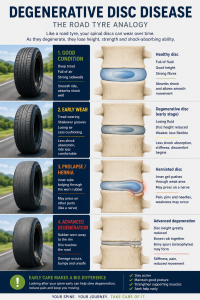
A good metaphor for a degenerative disc is a car tyre! Not the first thing that springs to mind! I am sure!
But it works.
What is Degenerative Disc Disease?
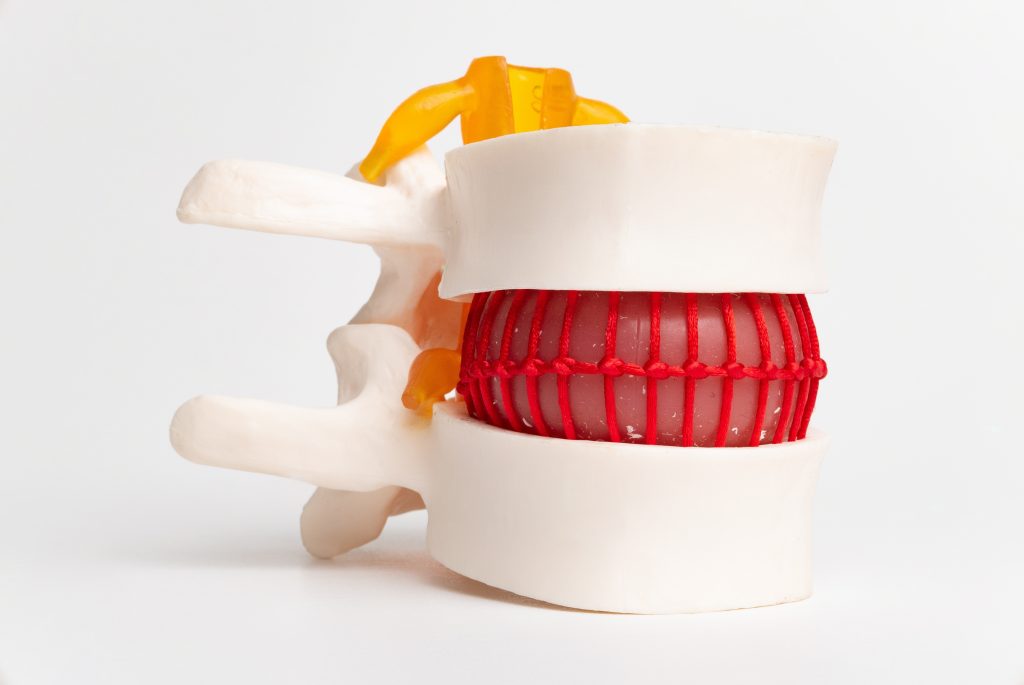
Our 23 intervertebral discs are roughly circular with a nucleus that is surrounded by rings of tough fibrocartilage called annulus fibrosis (although they do not come with a tread pattern!)
An intervertebral disc is analogous to a car tyre that loses air and its tread over time.
When we are young our spinal discs are like well inflated just like new thick tyres that act as perfect shock absorbers that give us a smooth ride.
As the thousands of miles roll on, our tyres naturally lose a bit of air in the same way our 23 discs slowly lose their ability to hold water. Our discs slowly shrink, flatten out, become more brittle and do not absorb shocks as well as they used to.
Constant driving (hard work and materials handling, lifting, doing repetitive tasks, bad posture) wears down the outer rubber on the tyres causing tiny micro-tears in the annulus fibrosis.
At some point our tyre may hit an unexpected large pothole (not difficult these days!) and the inner tube can bulge through (herniated disc). If the tyre goes completely flat the metal rims begin to contact the road surface and this is when the spine grows bony spurs to protect itself from friction. This causes pain and stiffness.
Living with degenerative disc disease can be frightening. Persistent lower back pain, sciatica, numbness, tingling or weakness in your legs can make everyday activities feel impossible. Many people worry that disc degeneration automatically means they will eventually need surgery.
The good news is that this is rarely the case.

Why Do Discs Degenerate?
Disc degeneration is influenced by many factors rather than one single cause.
Common contributing factors include:
Ageing
The biggest factor.
Almost everyone develops some disc degeneration eventually.
Genetics
Some people inherit discs that age faster than others.
Previous Injury
Heavy lifting, sporting injuries or accidents may accelerate wear.
Smoking
Smoking reduces blood supply and oxygen reaching spinal tissues.
Poor Posture
Long periods sitting with poor posture increase pressure inside discs.
Repetitive Heavy Work
Construction, farming, nursing and manual labour place repeated stress on spinal discs.
Obesity
Extra body weight increases loading through the lower back.
Lack of Exercise
Weak spinal muscles provide less support for ageing discs.
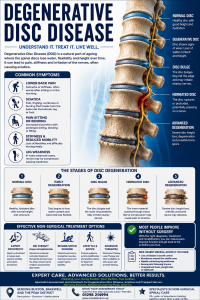
Common Symptoms of Degenerative Disc Disease
Symptoms vary greatly between individuals.
Some experience only mild stiffness.
Others develop severe nerve pain.
Common symptoms include:
Persistent Lower Back Pain
Usually worse after prolonged sitting.
Many patients report stiffness first thing in the morning.
Sciatica
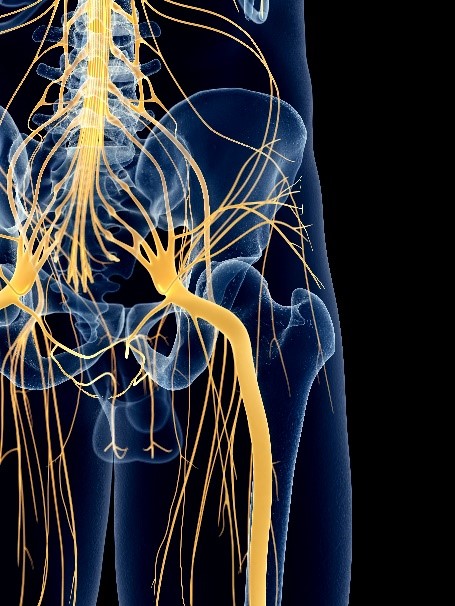
As discs lose height they may irritate or compress the sciatic nerve.
Pain may travel into:
- Buttock
- Hip
- Thigh
- Calf
- Foot
Sciatica may feel:
- Burning
- Electric shocks
- Tingling
- Pins and needles
- Deep aching
- Sharp stabbing pain
Pain Sitting
Many patients feel better walking than sitting.
This occurs because sitting places almost twice the pressure through lumbar discs compared to standing.
Difficulty Standing Upright
After sitting for long periods the spine may feel locked or stiff.
Muscle Spasm
Protective muscle guarding often develops around irritated spinal joints.
Leg Weakness
If nerve compression becomes significant, weakness may develop.
This requires prompt assessment.
Reduced Mobility
Simple activities such as gardening, walking or lifting grandchildren become increasingly difficult.
Can Degenerative Disc Disease Cause Sciatica?
Absolutely.
This is one of the commonest reasons patients attend our clinic.
As discs lose height several things happen:
- Disc bulging
- Reduced foraminal space
- Increased facet joint loading
- Thickening of spinal ligaments
- Narrowing around nerve roots
All these changes can compress or irritate the sciatic nerve.
The result is pain travelling into the leg rather than simply back pain.
Is Degenerative Disc Disease Serious?
For most people, no.
Although painful, it is usually manageable without surgery.
However, symptoms should always be assessed properly because similar symptoms can occur with:
- Herniated discs
- Spinal stenosis
- Spondylolisthesis
- Fractures
- Tumours
- Infections
A thorough examination helps identify the true cause.
How Is Degenerative Disc Disease Diagnosed?
At Buxton & Bakewell Osteopathy Clinic we perform a comprehensive spinal assessment.
This includes:
Detailed History
Understanding:
- When symptoms started
- What makes pain worse
- Previous injuries
- Night pain
- Numbness
- Weakness
Physical Examination
We assess:
- Posture
- Walking pattern
- Spinal movement
- Muscle strength
- Reflexes
- Sensation
- Nerve tension tests
MRI Referral
Where appropriate we may recommend MRI scanning.
Our MRI referral service provides detailed images showing:
- Disc dehydration
- Disc height loss
- Disc bulges
- Herniated discs
- Nerve compression
- Spinal stenosis
- Arthritic changes
MRI helps ensure treatment is accurately targeted.
Can Degenerative Discs Heal?
Age-related changes cannot be completely reversed.
However, pain often improves significantly.
Many patients mistakenly believe the disc itself is the source of pain.
In reality pain often comes from:
- Inflamed joints
- Irritated nerves
- Muscle spasm
- Poor movement patterns
- Reduced spinal stability
Treating these factors frequently produces excellent improvements.
The Best Non-Surgical Treatments
Successful treatment usually combines several approaches.
Expert Osteopathy
Hands-on osteopathic treatment aims to restore movement throughout the spine.
Treatment may include:
- Gentle mobilisation
- Soft tissue techniques
- Joint articulation
- Muscle stretching
- Postural correction
Improving spinal movement often reduces stress placed on damaged discs.
IDD Therapy Spinal Decompression
One of the treatments that makes our clinic different is IDD Therapy.
IDD Therapy is an advanced computer-controlled spinal decompression treatment designed specifically for:
- Degenerative disc disease
- Disc bulges
- Herniated discs
- Sciatica
- Trapped nerves
- Spinal stenosis
Unlike simple traction, IDD Therapy precisely targets the affected spinal level.
The treatment gently distracts the spine while allowing surrounding muscles to relax.
This may help:
- Reduce pressure inside the disc
- Improve nutrient exchange
- Reduce nerve irritation
- Increase disc hydration
- Improve spinal mobility
- Reduce muscle guarding
Many patients report gradual improvements over a structured treatment programme.
Rehabilitation Exercises
Exercise is essential.
Our rehabilitation programmes are individually tailored.
They commonly include:
Core strengthening
Hip mobility
Glute strengthening
Walking programmes
Flexibility exercises
Postural training
Movement education
Lifestyle Advice
Small daily changes often produce significant long-term benefits.
We advise patients regarding:
- Sitting posture
- Lifting techniques
- Home working
- Mattress advice
- Walking
- Weight management
- Exercise progression
Will I Need Surgery?
Fortunately, most people do not.
Surgery is usually reserved for:
- Severe weakness
- Progressive nerve damage
- Cauda Equina Syndrome
- Pain that has failed comprehensive conservative care
Even patients who have been advised surgery may benefit from a specialist assessment first.
Can Exercise Make Disc Degeneration Worse?
This is one of the biggest myths.
Appropriate exercise is one of the best treatments available.
The key is choosing the right exercises.
Complete rest often makes symptoms worse.
Movement helps:
- Improve circulation
- Strengthen muscles
- Support joints
- Improve confidence
- Reduce stiffness
Can You Prevent Degenerative Disc Disease?
Ageing cannot be prevented.
However, progression may be slowed through:
Regular exercise
Maintaining healthy weight
Stopping smoking
Good posture
Core strengthening
Avoiding prolonged sitting
Remaining active
Why Choose Buxton & Bakewell Osteopathy Clinic?
Patients travel to us from across:
- Buxton
- Bakewell
- Matlock
- Chapel-en-le-Frith
- Whaley Bridge
- Glossop
- Ashbourne
- Macclesfield
- Stockport
- Derbyshire
- Staffordshire
- Cheshire
- The Peak District
because of our specialist approach to complex spinal pain.
We don’t simply treat symptoms.
We identify why your pain developed.
Every patient receives a comprehensive assessment, allowing us to create an individual treatment plan tailored to their diagnosis, lifestyle and goals. Our clinic combines expert osteopathic care with advanced technologies, including IDD Therapy spinal decompression, to offer treatment options that are not widely available in the region. We place a strong emphasis on education and rehabilitation so you understand your condition and gain the confidence to manage it effectively.
Many of our patients come to us after months—or even years—of unsuccessful treatment elsewhere. They often tell us they appreciate our thorough assessments, clear explanations and evidence-informed approach. Our aim is not only to relieve pain but to help you regain mobility, return to work, enjoy hobbies and improve your long-term quality of life.
Frequently Asked Questions
Can degenerative disc disease cause permanent nerve damage?
Most cases do not. However, prolonged or severe nerve compression can sometimes lead to lasting weakness or altered sensation. Early assessment improves the chances of successful treatment.
Is walking good for degenerative disc disease?
Yes. Walking is one of the safest and most effective forms of exercise for many people with degenerative disc disease. It encourages circulation, reduces stiffness and supports spinal health without placing excessive strain on the discs.
Is degenerative disc disease a normal part of ageing?
Yes. Disc degeneration is very common as we get older, and many people have changes visible on MRI without experiencing any pain. Treatment focuses on the symptoms and how the condition affects your daily life rather than the scan alone.
Can IDD Therapy help degenerative disc disease?
IDD Therapy may be suitable for people with disc degeneration, disc bulges, trapped nerves and sciatica. Following a full assessment, we will advise whether it is an appropriate treatment option for your specific diagnosis.
When should I seek urgent medical advice?
Seek immediate medical attention if you develop:
- Loss of bladder or bowel control
- Numbness around the saddle area
- Rapidly worsening leg weakness
- Severe pain following significant trauma
- Unexplained fever, weight loss or night pain associated with back pain
These symptoms require urgent assessment.
Book a Specialist Assessment
If persistent lower back pain, sciatica or a trapped nerve is affecting your quality of life, don’t wait for it to become worse.
At Buxton & Bakewell Osteopathy Clinic, we provide expert assessment and personalised treatment for degenerative disc disease using a combination of advanced osteopathy, rehabilitation and IDD Therapy.
Whether you live in Buxton, Bakewell, Matlock, Glossop, Chapel-en-le-Frith, Macclesfield, Stockport or anywhere in the Peak District, our experienced team is here to help you understand your condition, relieve your pain and get you back to doing the things you enjoy.
Arrange your assessment today and discover why so many patients across Derbyshire and the Peak District trust us for specialist non-surgical spinal care.
At Buxton & Bakewell Osteopathy Clinic, we specialise in diagnosing and treating degenerative disc disease using evidence-informed, non-surgical treatments designed to reduce pain, improve movement and help you return to the activities you enjoy.
Our clinic has become recognised throughout Buxton, Bakewell, the Peak District and Derbyshire for treating complex spinal conditions including:
- Degenerative Disc Disease
- Sciatica
- Trapped Nerves
- Disc Bulges
- Herniated Discs
- Spinal Stenosis
- Chronic Lower Back Pain
As one of the few clinics in the region offering IDD Therapy, alongside expert osteopathy and rehabilitation, we regularly help people who have been told that “nothing more can be done.”