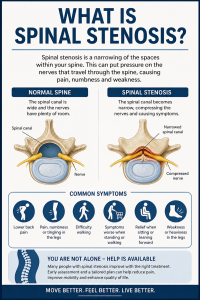
A great metaphor for spinal stenosis is the scenario of the shrinking tunnel.
The road running through the tunnel is your spinal cord and actual the tunnel is made up of all spinal architecture that surrounds it.
The traffic running through the tunnel comprises the signals that run down the spinal cord from the central nervous system (or our brain). Normally, in a healthy spine, the tunnel is wide and the traffic runs freely.
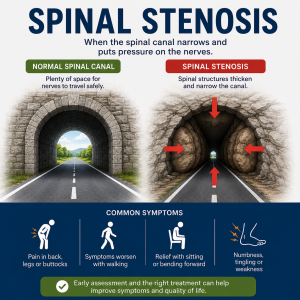
If there are road works in the tunnel however traffic struggles to get through or is delayed (this describes Buxton quite nicely!)
Our metaphorical road works are caused by bony spurs developing on the joints and vertebra, thickening ligaments and bulging discs. This causes the space in the tunnel to shrink and as it narrows it squeezes the road. This compression can cause pain, tingling and numbness in your arms or legs.
If you’ve been diagnosed with spinal stenosis, you’re probably familiar with the frustration of persistent back pain, tingling or maybe you have difficulty walking even short distances. We are told that spinal stenosis is simply “wear and tear” and our options are limited. If this is the case you might be interested in our Buxton Spinal Stenosis Program. For many people with spinal stenosis we can help alleviate your symptoms.
If spinal stenosis is affecting your quality of life, understanding your condition is the first step towards recovery.
What Causes Spinal Stenosis?
Spinal stenosis rarely develops because of one single problem.
Instead, it usually develops gradually over many years as several age-related changes combine.
Common causes include:
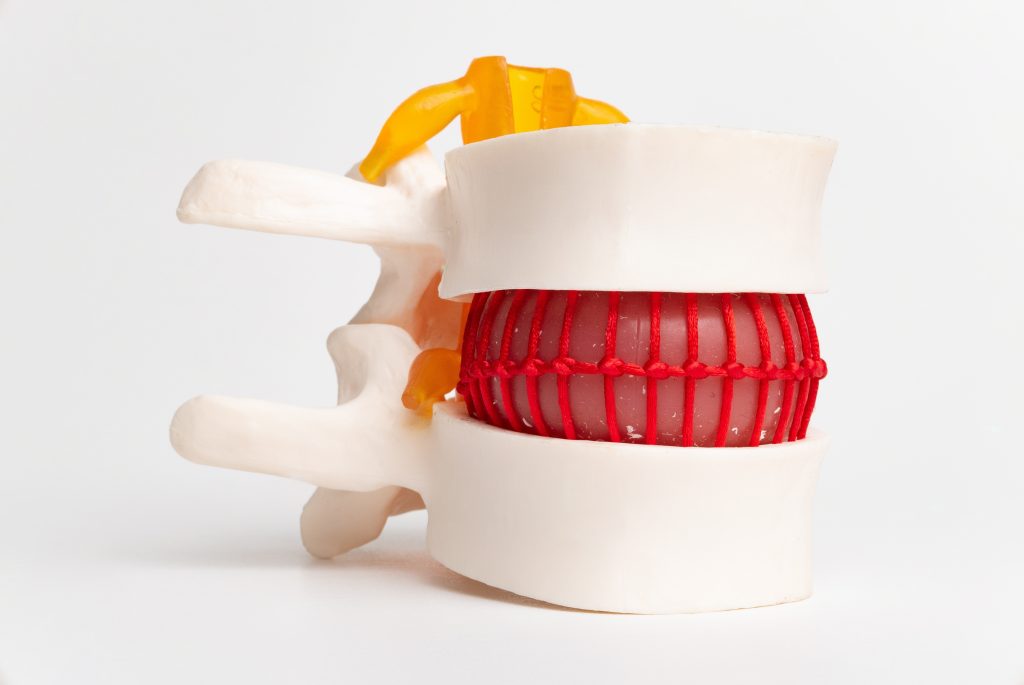
As discs lose water content with age, they become thinner and bulge out at the sides.
Reduced disc height decreases the available space for nerves and places extra stress on the joints.
The small joints at the back of the spine become enlarged through arthritis.
These enlarged joints can protrude into the spinal canal.
The ligamentum flavum normally helps stabilise the spine. It runs down and lines the spinal canal like a rubber sock. If the spine shrinks (which the discs do over our life time) this sock buckles and thickens.
Over time it may thicken and buckle into the spinal canal, reducing the space available for nerves.
Bone Spurs (Osteophytes)
The body attempts to stabilise arthritic joints by producing extra bone.
Unfortunately, these bone spurs can narrow the openings where nerves leave the spine.
A disc bulge can combine with existing narrowing, producing symptoms that were previously absent.
One vertebra may gradually slip forward over another, further reducing the available space.
Types of Spinal Stenosis
Lumbar Spinal Stenosis
This is by far the most common form.
It affects the lower back and commonly produces:
- Lower back pain
- Buttock and leg pain
- Sciatica
- Leg numbness
- Pins and Needles
- Cramping
- Weakness
- Difficulty walking
Cervical Spinal Stenosis
Occurs in the neck.
Symptoms may include:
- Neck pain
- Shoulder pain
- Arm pain
- Pins and needles
- Reduced grip strength
- Hand numbness
- Poor balance
- Loss of dexterity
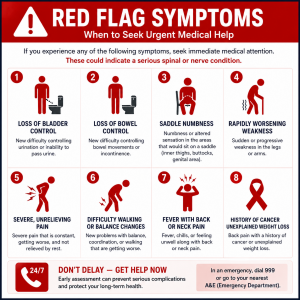
More severe cases require urgent medical assessment because spinal cord compression can develop.
What Does Spinal Stenosis Feel Like?
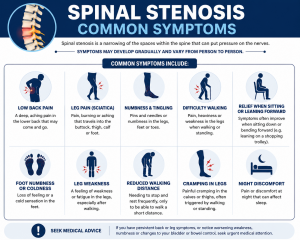
Patients often describe symptoms such as:
“I can only walk a few hundred yards before I need to stop.”
“My legs feel heavy.”
“My feet go numb.”
“My pain eases when I sit down.”
“I find myself leaning over the shopping trolley.”
These symptoms occur because bending forwards temporarily increases the space around the nerves.
This is one of the classic features of lumbar spinal stenosis.
Common Symptoms
These include the most symptoms that are xplained below;
Why Walking Makes Symptoms Worse
Walking naturally extends the lumbar spine.
Extension slightly narrows the spinal canal.
If the available space is already limited, this extra narrowing can irritate the nerves.
Many patients notice they can:
✔ Walk further uphill
✔ Cycle comfortably
✔ Lean over a trolley
✔ Sit down for relief
These clues help experienced clinicians identify spinal stenosis.
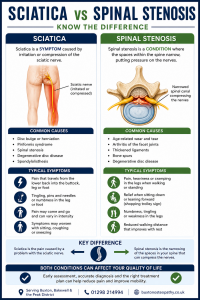
Is Spinal Stenosis the Same as Sciatica?
No.
Sciatica is a symptom.
Spinal stenosis is a diagnosis.
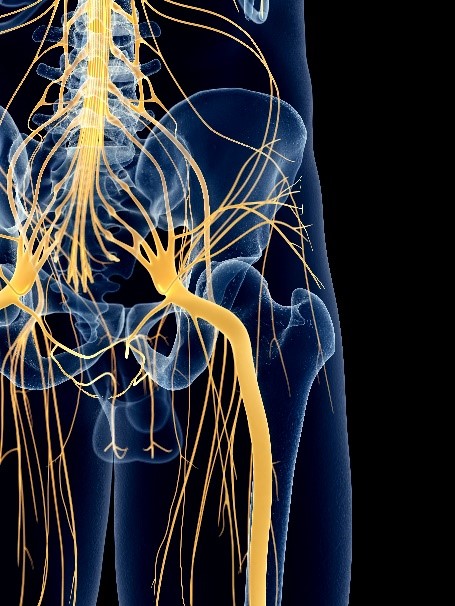
Spinal stenosis frequently causes sciatica because compressed nerves create pain travelling down the leg.
However, sciatica can also be caused by:
- Trapped nerves
- Herniated and bulging discs
- Degenerative disc disease
- Piriformis syndrome
- Foraminal narrowing
- Spondylolisthesis
Correct diagnosis is therefore essential.
How Is Spinal Stenosis Diagnosed?
A detailed assessment is the most important step.
At Buxton & Bakewell Osteopathy Clinic we begin by understanding:
- Your symptoms
- Walking tolerance
- Previous treatments
- Medical history
- Lifestyle
- Functional limitations
We then perform a comprehensive physical examination assessing:
- Movement
- Posture
- Muscle strength
- Reflexes
- Sensation
- Balance
- Nerve tension
- Walking pattern
If required, MRI scanning provides the clearest picture of:
- Disc health
- Nerve compression
- Ligament thickening
- Arthritis
- Foraminal narrowing
- Central canal narrowing
We only recommend imaging when it is clinically appropriate.
Can Spinal Stenosis Improve Without Surgery?
Yes.
Many patients improve significantly with conservative treatment.
Research consistently supports starting with non-surgical management unless serious neurological problems are present.
Treatment may include:
- Education
- Manual therapy
- Exercise rehabilitation
- Walking programmes
- Core strengthening
- Flexibility work
- Weight management
- Activity modification
- Advanced spinal decompression
The earlier treatment begins, the greater the opportunity to improve mobility and reduce pain.
Our Specialist Approach
Every patient receives an individual treatment programme.
This may include:
Expert Osteopathy
Hands-on treatment can help improve spinal mobility, reduce muscular tension and optimise movement.
Treatment is always tailored to your diagnosis.
Personalised Rehabilitation
Strengthening the muscles that support the spine can reduce mechanical stress.
Exercises are progressed carefully according to your symptoms.
Lifestyle Advice
Small changes often produce meaningful improvements.
We advise on:
- Walking strategies
- Sitting posture
- Sleeping positions
- Lifting techniques
- Home exercises
- Long-term prevention
IDD Therapy®
For selected patients with spinal stenosis, disc injuries or nerve compression, IDD Therapy may form part of a comprehensive treatment programme.
IDD Therapy is an advanced computer-controlled spinal decompression treatment designed to gently distract targeted spinal segments while reducing muscle guarding.
Unlike simple traction, treatment parameters are carefully controlled to improve comfort and precision.
Patients suitable for IDD Therapy are identified following a comprehensive assessment, and treatment is only recommended when clinically appropriate.
When Is Surgery Necessary?
Although many patients respond well to conservative care, surgery may be recommended if:
- Walking becomes severely restricted
- Progressive muscle weakness develops
- Bowel or bladder symptoms occur
- Significant spinal cord compression is present
- Conservative treatment has failed
Urgent medical assessment is essential if symptoms suddenly deteriorate.
Can Exercise Help?
Yes.
The correct exercises are often one of the most effective treatments.
Common goals include:
- Improving spinal flexibility
- Increasing walking tolerance
- Strengthening the core
- Improving hip mobility
- Enhancing balance
- Maintaining independence
Exercises should always be matched to the individual.
Incorrect exercises can aggravate symptoms.
Why Early Diagnosis Matters
Many patients struggle with symptoms for months—or even years—before receiving the correct diagnosis.
Early assessment can help:
- Reduce nerve irritation
- Improve mobility
- Prevent unnecessary deterioration
- Identify serious conditions promptly
- Guide appropriate treatment choices
Why Choose Buxton & Bakewell Osteopathy Clinic?
Patients travel to us from across:
- Buxton
- Bakewell
- Matlock
- Chapel-en-le-Frith
- Whaley Bridge
- New Mills
- Glossop
- Leek
- Ashbourne
- High Peak
- Derbyshire
- Staffordshire
- Cheshire
- The Peak District
Frequently Asked Questions
Can spinal stenosis heal?
The structural narrowing usually remains, but symptoms often improve significantly with appropriate treatment and rehabilitation.
Is walking good for spinal stenosis?
Usually yes, although walking programmes often need to be modified initially to avoid symptom flare-ups.
Can spinal stenosis cause sciatica?
Yes. It is one of the most common causes of sciatica in older adults.
Is surgery always required?
No. Most people should initially explore evidence-based conservative treatment unless urgent neurological symptoms are present.
Can osteopathy help spinal stenosis?
Osteopathy may help improve mobility, reduce muscular tension and support function as part of a broader treatment plan. Treatment should always be based on a thorough assessment and individual diagnosis.
Is IDD Therapy suitable for everyone?
No. IDD Therapy is not appropriate for every patient. Following assessment, we will advise whether it is a suitable option based on your diagnosis, imaging (where available), symptoms and medical history.
Take the First Step Towards Moving More Comfortably
If spinal stenosis is limiting your walking, affecting your sleep or stopping you enjoying everyday life, you don’t have to face it alone.
At Buxton & Bakewell Osteopathy Clinic, we provide detailed assessments and personalised, evidence-informed treatment programmes for people with spinal stenosis, sciatica, trapped nerves and other complex spinal conditions.
Whether your symptoms are recent or you’ve been living with them for years, our goal is to help you understand your condition, explore the most appropriate treatment options and support you on the path back to better mobility and improved quality of life.
Serving Buxton, Bakewell, the High Peak and the wider Peak District with specialist non-surgical spinal care.
At Buxton & Bakewell Osteopathy Clinic, we specialise in the assessment and non-surgical treatment of spinal conditions including:
- Spinal stenosis
- Sciatica
- Trapped nerves
- Herniated and bulging discs
- Degenerative disc disease
- Chronic neck and back pain
Our clinic has become one of the Peak District’s leading centres for advanced conservative spinal care, combining expert osteopathic assessment with evidence-informed rehabilitation and advanced technologies including IDD Therapy® (Intervertebral Differential Dynamics Therapy) where clinically appropriate.