Your Sciatica Is Unique
One of the biggest misconceptions about sciatica is that everyone experiences the same condition. In reality, no two cases of sciatica are exactly alike because sciatica is not a condition in it’s own right. It is a symptom.
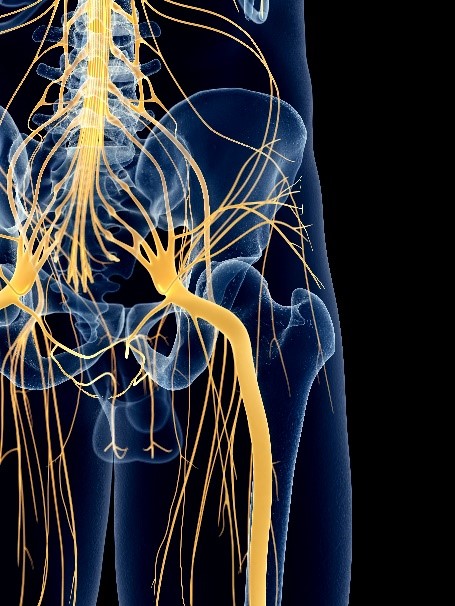
Sciatica can be caused by anything that comes into contact with the nerves which join together to form the largest nerve in the body….you’ve guessed it! The sciatic nerve!
There is no fixed number of causes for sciatica but there are roughly 15-20 common reasons that make up 90% of cases.
Although two people may both have pain travelling down the leg, the underlying cause, the severity of the nerve irritation and best treatment for that presentation can be very different indeed.
That is why successful treatment begins with your personal diagnosis. A one-size-fits-all approach does not exist.
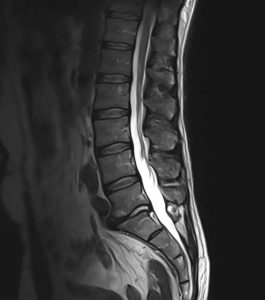
Both of these people below had sciatica.
Both had different reasons. One had a large disc bulge which is easy to see (the black bulge pushing into the white descending strip. the spinal cord, near the bottom of the spine).
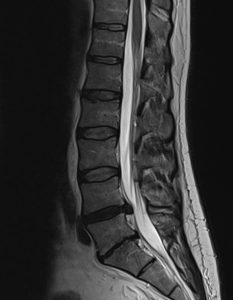
The other person below had a worn degenerative disc pressing on an exiting nerve that is more discreet and difficult to see from this angle.
At Sciatica Hub in Buxton, we believe understanding your individual condition is the first step towards reducing pain, improving mobility and helping you return to the activities you enjoy.

Sciatica Is a Symptom, Not the Diagnosis
Sciatica describes pain caused by irritation or compression of the sciatic nerve or one of the spinal nerve roots that forms it.
However, sciatica itself does not tell us why the nerve is irritated.
Your symptoms may be caused by:
- A herniated disc
- Spinal stenosis
- Degenerative disc disease
- Spondylolisthesis
- Piriformis syndrome
- Facet joint arthritis
- Trauma or injury
- Inflammation around the nerve
- Another spinal condition
Each of these conditions requires a different management plan.
Why a Personal Diagnosis Matters
Many treatments advertised online claim to work for “sciatica.”
The reality is that treatment should always be based on the underlying cause.
For example:
- A patient with a herniated disc may benefit from a different rehabilitation programme than someone with spinal stenosis.
- Exercises that help one person may aggravate another.
- The most appropriate manual therapy techniques vary according to the diagnosis.
- Some patients may benefit from advanced treatments such as IDD Therapy, while others may not require it.
Without an accurate diagnosis, treatment can become a matter of trial and error.
Listening to Your Story
Every diagnosis starts with understanding your symptoms.
Your clinician will ask detailed questions, including:
- When did your symptoms begin?
- Did they start after an injury?
- Where exactly is your pain?
- Does the pain travel below the knee?
- Do you have numbness or tingling?
- Have you noticed weakness?
- What activities make your symptoms worse?
- What helps relieve the pain?
- Have you experienced similar symptoms before?
Your answers often provide valuable clues about the source of your sciatica.
A Thorough Physical Examination
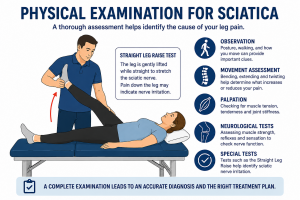
Your history is followed by a detailed physical examination.
This may include:
- Postural assessment
- Walking analysis
- Spinal movement testing
- Hip examination
- Muscle strength testing
- Reflex testing
- Sensation testing
- Neurological examination
- Straight Leg Raise Test
- Slump Test
These tests help identify which nerve is affected and whether the symptoms are most likely to be coming from your spine or another structure.
Looking Beyond the Pain
The area where you feel pain is not always the source of the problem.
For example:
- Pain in the calf may originate from the lower back.
- Foot numbness may be caused by compression of a spinal nerve.
- Buttock pain may originate from a disc injury.
- Knee pain may actually be referred from the hip or spine.
This is why we examine your entire movement system rather than simply focusing on where it hurts.
Do You Need an MRI?
Many people assume they need an MRI scan before treatment can begin.
In reality, many cases of sciatica can be accurately diagnosed through a combination of your history and physical examination.
However, MRI may be recommended if:
- Symptoms are severe.
- Significant weakness is present.
- Symptoms persist despite treatment.
- Surgery is being considered.
- The diagnosis remains uncertain.
MRI scans can identify conditions such as:
- Herniated discs
- Bulging discs
- Spinal stenosis
- Degenerative disc disease
- Nerve compression
When appropriate, imaging helps confirm the diagnosis and guide treatment. We offer rapid and affordable private MRI referrals
Creating Your Personal Treatment Plan
Once the cause of your sciatica has been identified, we can develop a treatment plan tailored to your needs.
Depending on your diagnosis, this may include:
- Osteopathic treatment
- Rehabilitation exercises
- Advice on activity modification
- Lifestyle recommendations
- Pain management strategies
- IDD Therapy for suitable disc-related conditions
- Referral for imaging or specialist opinion when appropriate
No two treatment plans are identical because no two patients are the same.
Monitoring Your Progress
Your diagnosis is only the beginning.
As your symptoms improve, your treatment programme should evolve.
Regular reassessment allows us to:
- Monitor your recovery.
- Measure improvements in movement.
- Reassess muscle strength.
- Adjust your exercises.
- Progress your rehabilitation.
- Help reduce the risk of recurrence.
Recovery is a journey, and your treatment should adapt as your condition changes.
Why Personalised Care Is So Important
Successful treatment isn’t about following a generic programme downloaded from the internet.
It is about understanding:
- What is causing your symptoms.
- Which nerve is affected.
- How severe the irritation is.
- What treatments are most appropriate.
- How your lifestyle influences your recovery.
This personalised approach often leads to better outcomes and greater confidence throughout the recovery process.
Why Choose Sciatica Hub in Buxton?
At Sciatica Hub in Buxton, every patient receives an individual assessment because we recognise that every case of sciatica is different.
Rather than simply treating symptoms, we work to identify the underlying cause of your pain and explain your diagnosis in clear, straightforward language. We then create a personalised treatment programme designed around your condition, your goals and your lifestyle.
Whether your sciatica is caused by a herniated disc, spinal stenosis, degenerative disc disease or another spinal condition, our aim is to help you understand your diagnosis, reduce your pain and support your recovery with evidence-informed care.
Key Takeaways
- Every case of sciatica is unique.
- Sciatica is a symptom, not the diagnosis.
- Finding the underlying cause is essential for effective treatment.
- A detailed history and physical examination provide the foundation of an accurate diagnosis.
- MRI scans are useful in selected cases but are not always required.
- Personalised treatment plans offer the best opportunity for recovery.
- Ongoing reassessment helps ensure your treatment continues to meet your needs
Your Journey Starts With the Right Diagnosis
If you’re experiencing pain travelling down your leg, don’t settle for a generic approach. Understanding your personal diagnosis allows treatment to be tailored specifically to your condition, helping you recover more confidently and reducing the risk of future problems.
At Sciatica Hub in Buxton, we’re committed to helping you understand your condition and guiding you towards the most appropriate treatment for your individual needs.