Pain Down the Leg: Is It Sciatica or Something Else?
Normally if we stub our toe we know precisely where it hurts because it throbs. Quite a bit if you have done it properly!
Whether we have hit our funny bone on our elbow, or had a papercut on a finger, our pain perception is accurate and location precise.
But there is one common condition that completely tears up the biological rulebook and does not obey the rules.
That is nerve pain and of course this includes the sciatic nerve.
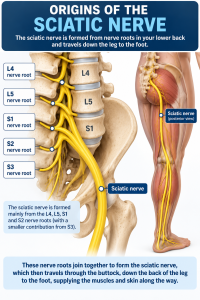
Sciatica is much more than just lower back pain.
If you have had sciatica or are unfortunate enough to be experiencing it right now you will be familiar with that deep, unremittent throb and toothache in your leg.
It feels very deep and almost like bone pain. This isn’t a muscle pain that you can just stretch out, it is a very irritated nerve that lies deep in the tissue in your leg.
Pain travelling down the leg often prompts people to seek our help.
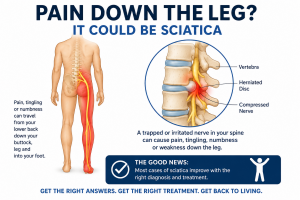
At Buxton Sciatica Hub, we help people throughout the Peak District understand why they are experiencing pain down the leg is important. Correct diagnosis often prevents months of ineffective treatment and helps patients recover more quickly.
What Does “Pain Down the Leg” Mean?
Pain down the leg describes discomfort that begins somewhere higher in the body—usually the lower back, buttock or hip—and then travels into the thigh, calf or foot.
The pain may:
- Travel down one leg
- Affect both legs (less commonly)
- Be constant or intermittent
- Feel sharp, burning or electric
- Cause numbness or tingling
- Be accompanied by weakness
Some people notice pain only when walking.
Others feel it while sitting.
Some wake with severe morning pain before it gradually eases.
The exact pattern often provides valuable clues about the underlying condition.
Is Pain Down the Leg Always Sciatica?
No.
Sciatica is one of the most common causes, but it is far from the only explanation.
Pain down the leg may result from:
- Sciatica
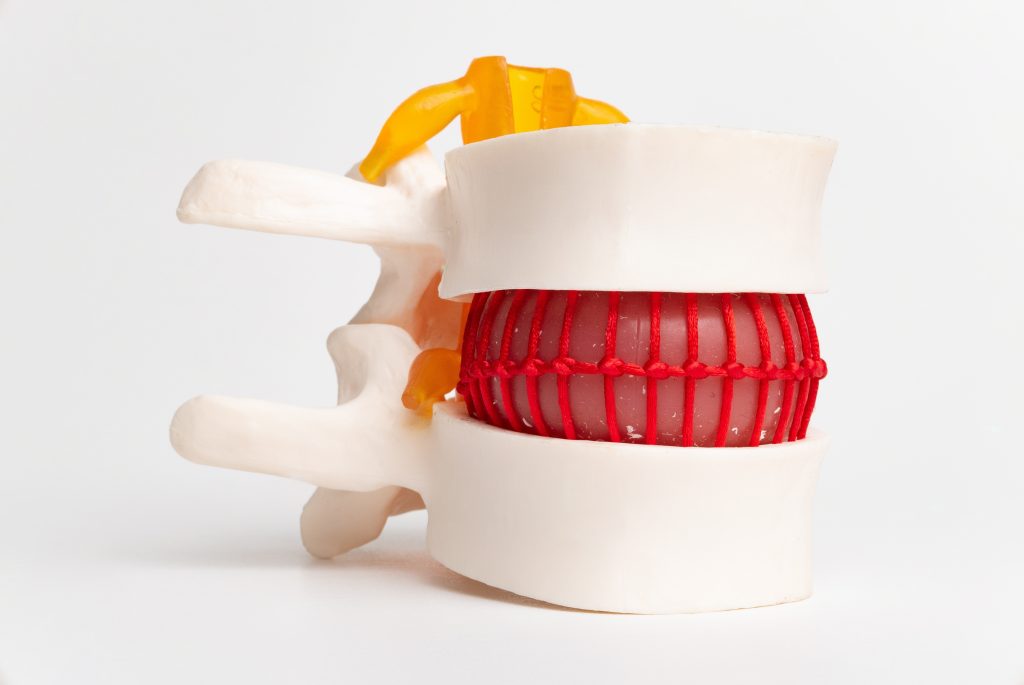
- Herniated (slipped) disc
- Spinal stenosis
- Degenerative disc disease
- Spondylolisthesis
- Piriformis syndrome
- Sacroiliac joint dysfunction
- Hip arthritis
- Muscle injuries
- Peripheral nerve entrapment
- Vascular conditions
- Inflammatory disorders
This is why a thorough assessment is so important before beginning treatment.
What Is Sciatica?
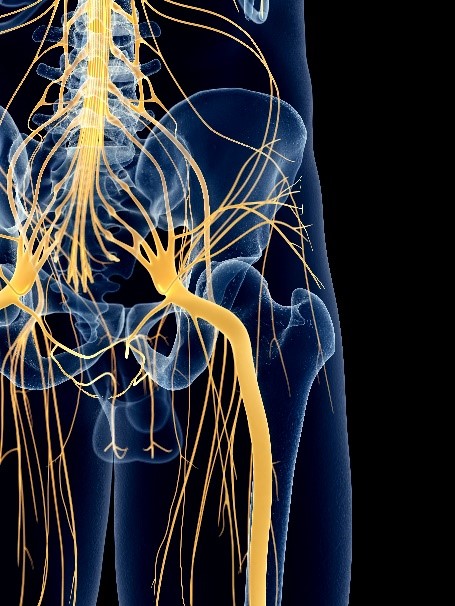
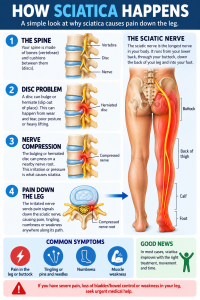
Sciatica describes irritation or compression of the sciatic nerve or one of the spinal nerve roots that form it.
The sciatic nerve is the largest nerve in the body.
It begins in the lower spine before travelling through the buttock, down the back of the thigh and into the lower leg and foot.
When irritated, pain follows the course of the nerve.
Common Causes of Pain Down the Leg
| Cause | Typical Symptoms | Common Treatment |
|---|---|---|
| 🟡 Sciatica | Pain from buttock down the leg; tingling or numbness | Osteopathy, exercise, pain management, IDD Therapy* |
| 💿 Herniated Disc | Leg pain; numbness or weakness; often worse sitting, coughing or sneezing | Conservative care, IDD Therapy*, rehab; sometimes surgery |
| 🔵 Bulging Disc | Back pain with aching or pain into the leg | Exercise, manual therapy, decompression* |
| 🦴 Spinal Stenosis | Leg pain or heaviness when walking; often better sitting or bending forward | Rehab, pain management, IDD Therapy*; sometimes surgery |
| 🦴 Degenerative Discs | Back stiffness, aching legs, intermittent nerve pain | Exercise, manual therapy, lifestyle changes, IDD Therapy* |
| ↪️ Spondylolisthesis | Back and leg pain, numbness, tight hamstrings | Rehab and stabilisation; selected cases may require specialist treatment |
| 🍑 Piriformis Syndrome | Buttock pain, worse sitting; pain down back of leg | Stretching, manual therapy, rehabilitation |
| 🦴 SI Joint Dysfunction | Buttock pain that may spread into the thigh | Osteopathy, mobilisation, strengthening |
| 🦵 Hip Osteoarthritis | Groin or thigh pain, stiffness, difficulty walking | Exercise, weight management, manual therapy; surgery if severe |
| 💪 Hamstring Injury | Sudden back-of-thigh pain, bruising or weakness | Rehabilitation and progressive strengthening |
| ⚡ Peripheral Nerve Entrapment | Localised burning, tingling or numbness | Activity modification, rehabilitation, nerve mobilisation |
| 🍑 Deep Gluteal Syndrome | Buttock pain when sitting with possible leg pain | Exercise, stretching and manual therapy |
| 🩸 Peripheral Artery Disease | Cramping with walking that improves with rest | Medical assessment, exercise and vascular treatment |
| 🦶 Diabetic Neuropathy | Burning feet, tingling, numbness or balance problems | Diabetes management, medication and foot care |
| 💪 Muscle Trigger Points | Deep aching, tenderness and muscle tightness | Soft-tissue therapy, stretching and strengthening |
| 🚨 Cauda Equina Syndrome | Saddle numbness, bladder/bowel changes, severe or progressive leg weakness | Emergency hospital assessment |
*Where clinically appropriate.
🚨 Important
New bladder or bowel problems, numbness around the saddle/genital area, or severe or rapidly worsening leg weakness require urgent medical assessment
Symptoms Associated with Pain Down the Leg
Patients describe symptoms differently.
Common descriptions include:
| Symptom | Possible Cause |
|---|---|
| Burning pain | Sciatica |
| Electric shock pain | Nerve compression |
| Deep aching | Muscle or joint pain |
| Pins and needles | Nerve irritation |
| Numbness | Nerve compression |
| Weakness | Significant nerve involvement |
| Cramping | Muscle fatigue or nerve irritation |
| Heaviness | Spinal stenosis |
Warning Signs That Need Urgent Medical Assessment
Although most cases improve with appropriate treatment, some symptoms require immediate medical attention.
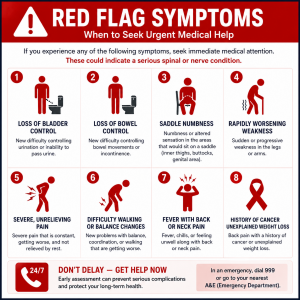
These symptoms may indicate serious conditions such as Cauda Equina Syndrome, spinal infection or fracture and should never be ignored.
How Is Pain Down the Leg Diagnosed?
Accurate diagnosis begins with a detailed clinical history.
Questions often include:
- Where does the pain begin?
- How far does it travel?
- When did it start?
- What makes it worse?
- What makes it better?
- Is there numbness?
- Is there weakness?
- Has bladder or bowel function changed?
These answers provide valuable clues before any examination begins.
Physical Examination
A comprehensive assessment may include:
Posture Assessment
Looking for:
- Pelvic imbalance
- Curvature
- Protective posture
Walking Assessment
Observing:
- Limping
- Foot drop
- Reduced stride
- Protective movements
Neurological Examination
Testing:
- Muscle strength
- Reflexes
- Sensation
- Balance
- Coordination
Straight Leg Raise Test
One of the most recognised tests for sciatica.
The clinician gently lifts the leg while monitoring symptoms.
Reproduction of familiar pain can indicate nerve irritation.
Slump Test
This gently places tension through the nervous system.
It helps identify nerve sensitivity.
Hip Examination
Many patients believed to have sciatica actually have hip pathology.
Hip movement testing helps distinguish between spinal and hip causes.
When Is MRI Recommended?
Many people recover without imaging.
However, MRI can be valuable when:
- Symptoms persist beyond several weeks despite appropriate treatment
- Significant leg weakness develops
- Surgery is being considered
- Serious pathology is suspected
- Symptoms are severe or progressively worsening
MRI provides detailed images of:
- Herniated discs
- Spinal stenosis
- Nerve compression
- Degenerative disc disease
- Spondylolisthesis
- Other structural abnormalities
Why Correct Diagnosis Matters
Pain down the leg can look remarkably similar across different conditions.
For example:
A herniated disc may produce almost identical symptoms to piriformis syndrome.
Spinal stenosis can resemble vascular disease.
Hip arthritis may mimic sciatica.
Treating the wrong condition can delay recovery and prolong unnecessary discomfort.
A precise diagnosis allows treatment to be tailored to the actual source of the problem.
Treatment Depends on the Cause
Once the underlying cause has been identified, treatment can be directed appropriately.
Depending on the diagnosis, this may include:
- Education and reassurance
- Activity modification
- Manual therapy
- Targeted rehabilitation exercises
- Postural advice
- Strengthening programmes
- Pain management strategies
- IDD Therapy (for appropriate spinal conditions)
- Referral for MRI where indicated
- Medical or surgical opinion when necessary
The goal is always to address the root cause rather than simply masking symptoms.
Can Pain Down the Leg Improve Without Surgery?
Yes.
The majority of people with leg pain caused by spinal conditions improve with conservative management.
Research consistently shows that many cases of sciatica and nerve-related leg pain settle over time with appropriate treatment, exercise, and careful management.
Surgery is usually reserved for:
- Progressive neurological weakness
- Cauda Equina Syndrome
- Severe, persistent symptoms that do not respond to appropriate conservative care
- Significant structural problems causing ongoing disability
For most patients, non-surgical management remains the first-line approach.
Can IDD Therapy Help?
Yes.
If pain down the leg is caused by conditions such as:
- Herniated disc
- Degenerative disc disease
- Nerve root compression
- Certain cases of spinal stenosis
IDD Therapy (Intervertebral Differential Dynamics Therapy) may form part of a comprehensive treatment programme.
By applying gentle, computer-controlled spinal decompression, IDD Therapy aims to reduce pressure on affected spinal discs and nerve roots while encouraging improved movement within the spine. Suitability depends on an individual assessment and diagnosis, and it is not appropriate for every cause of leg pain.
Why Choose The Sciatica Hub?
At The Sciatica Hub, we focus on identifying the true source of pain rather than simply treating symptoms.
Our assessment process considers:
- The spine
- Nerves
- Hips
- Muscles
- Walking pattern
- Neurological function
This comprehensive approach helps ensure that treatment is tailored to the underlying cause of your pain.
We support patients across the Peak District with expert assessment, evidence-informed care, and personalised treatment plans designed to help them return to normal activities with greater confidence.
Frequently Asked Questions
Can sciatica cause pain all the way to the foot?
Yes. Sciatica commonly follows the course of the sciatic nerve and may extend into the calf, ankle or foot.
Is leg pain always caused by a trapped nerve?
No. Muscle injuries, hip arthritis, vascular conditions and referred pain can all mimic nerve-related leg pain.
Can you have sciatica without back pain?
Yes. Some people experience pain mainly in the buttock, thigh, calf or foot with little or no lower back discomfort.
When should I worry about pain down the leg?
Seek urgent medical assessment if you develop bladder or bowel changes, saddle numbness, rapidly worsening weakness, or severe symptoms following significant trauma.
Do I always need an MRI?
No. MRI is generally recommended when symptoms are severe, progressive, persistent despite appropriate care, or when serious pathology is suspected.
Can pain down the leg improve without surgery?
Yes. Most people improve with appropriate conservative management, including education, rehabilitation and targeted treatment.
Conclusion
Pain down the leg is a symptom and not a diagnosis. While sciatica is a common cause, many other conditions can produce similar symptoms, making an accurate assessment essential. Understanding whether the source of your pain is a herniated disc, spinal stenosis, piriformis syndrome, hip pathology or another condition allows treatment to be tailored to your specific needs.
If you are experiencing persistent pain down the leg, early assessment can help identify the underlying cause, guide appropriate treatment and reduce the risk of long-term problems. At The Sciatica Hub, we are committed to helping people across the Peak District find clear answers and evidence-based solutions so they can return to the activities they enjoy.