Sciatica Worse at Night? Understanding Night-Time Leg Pain
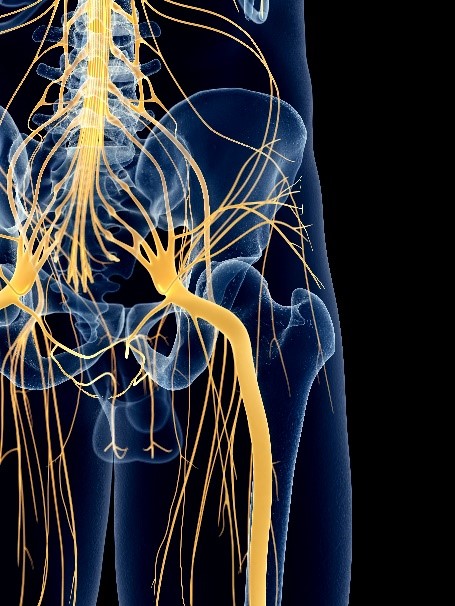
Many people with sciatica notice that their symptoms become significantly worse once they go to bed.
Our body enjoys dynamic movement when we are awake as we go about the day.
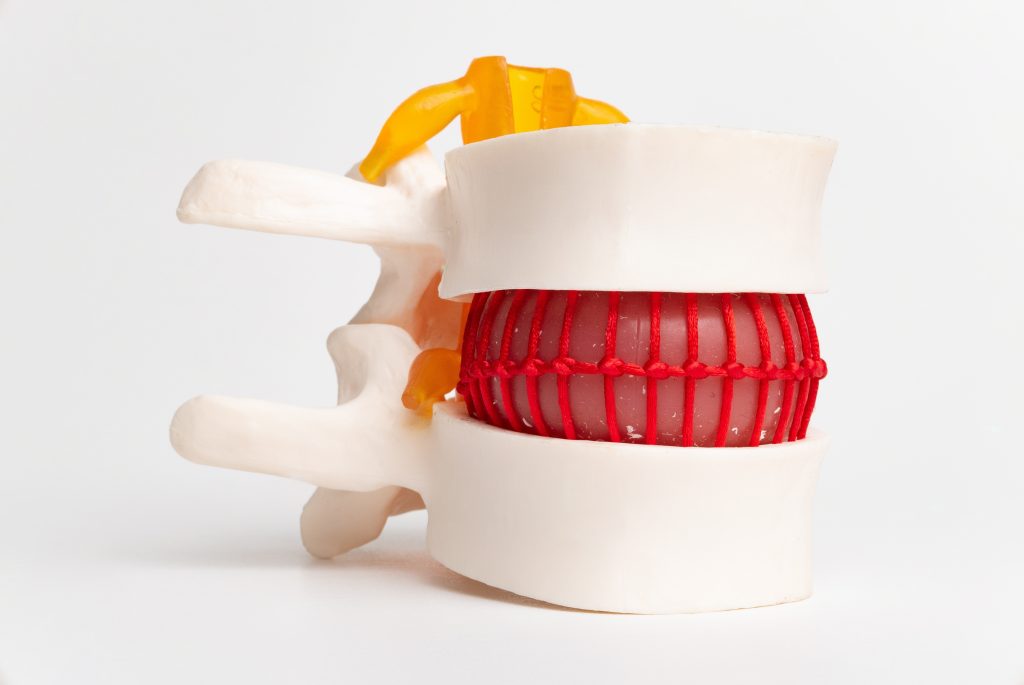
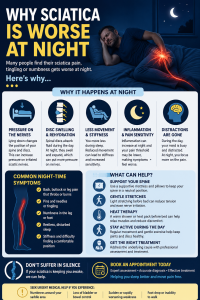
When night comes we are relatively or very static. We are also non-weightbearing and in the absence of gravity exerting a constant downwards pressure our intervertebral discs naturally relax and absorb fluid and nutrients.

They quite literally become turgid like a sponge and make less space for delicate structures like nerves. If a disc is already herniated or bulging this will exacerbate your symptoms as it gently absorbs fluid.
Also as heart rate drops as we sleep and our circulation decreases, there is less fluid exchange and blood flow to wash away inflammatory chemicals. Beyond all this we do not have distractions of the day to shift our focus elsewhere.
At Buxton & Bakewell Osteopathy Clinic, we regularly assess patients from Buxton, Bakewell, the Peak District, High Peak, North Derbyshire and South Manchester who experience worsening sciatica symptoms during the night. Identifying the underlying cause is the first step towards effective treatment.
Why Does Sciatica Feel Worse at Night?
There is no single reason why sciatica becomes more painful after dark. Instead, several factors often work together.
Common reasons include:
🌙 Common Reasons Spinal Pain Feels Worse at Night
| Possible explanation | Why it may increase pain |
|---|---|
| 🛏️ Staying in one position | Remaining still for several hours can make spinal joints and muscles stiff. |
| 🔄 Reduced movement | The spine receives fewer regular changes of position than it does during the day. |
| 🦴 Sleeping position | Certain positions may place additional pressure on an irritated disc, joint, muscle or nerve. |
| 💧 Disc rehydration | Spinal discs absorb fluid during rest and become slightly fuller, which may increase sensitivity. |
| 🔥 Inflammation | Inflammatory conditions can cause night pain and morning stiffness that improve with movement. |
| ⚡ Nerve irritation | Particular positions may increase tension or pressure around an irritated spinal nerve. |
| 🧠 Greater pain awareness | Pain can seem more noticeable at night when there are fewer distractions. |
| 😴 Poor-quality sleep | Disturbed sleep can increase the nervous system’s sensitivity to pain. |
| 🛌 Mattress support | A sagging, excessively soft or uncomfortable mattress may leave the spine poorly supported. |
Persistent or worsening night pain—particularly with fever, unexplained weight loss, weakness, numbness or bladder and bowel changes—should be medically assessed.
Understanding these factors can help explain why symptoms often seem much worse once you get into bed.
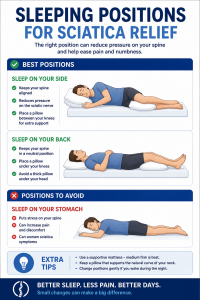
Sleeping Position Matters
Your sleeping posture can have a significant effect on sciatica symptoms.
Your Mattress May Be Contributing
A mattress rarely causes sciatica by itself.
However, an unsuitable mattress may make existing symptoms worse.
A mattress that is:
- Too soft
- Sagging
- Uneven
- No longer supportive
may allow the spine to remain in awkward positions for several hours.
The ideal mattress is usually one that supports the natural curves of the spine while remaining comfortable.
🌙 Symptoms You May Notice at Night
| Night-time symptom | What it may feel like |
|---|---|
| ⚡ Shooting leg pain | Sudden pain travelling from the back or buttock into the leg |
| 🔥 Burning pain | A hot or intense burning sensation |
| ✨ Pins and needles | Tingling, prickling or buzzing in the leg or foot |
| 🧊 Numbness | Reduced or altered sensation |
| 🦵 Cramping | Sudden tightening of the leg or calf muscles |
| 💓 Throbbing pain | Rhythmic or pulsing discomfort |
| ⚡ Electric-shock sensations | Brief, sharp bursts of pain along the nerve |
| 🍑 Buttock pain | Deep aching, burning or sharp pain |
| 🦵 Calf pain | Aching, tightness, cramping or burning |
| 🦶 Foot pain | Pain, burning or tingling reaching the foot |
| 🛏️ Difficulty getting comfortable | Frequent position changes without lasting relief |
| 😴 Repeated waking | Pain interrupting sleep several times during the night |
New or worsening numbness, significant leg weakness, foot drop, saddle numbness, or bladder and bowel changes require urgent medical assessment.
Is Night Pain Always Sciatica?
No.
Although sciatica commonly becomes worse at night, other conditions can produce similar symptoms.
These include:
- Hip arthritis
- Sacroiliac joint pain
- Peripheral neuropathy
- Vascular problems
- Muscle injuries
- Restless legs syndrome
- Greater trochanteric pain syndrome
A thorough assessment is important to establish the correct diagnosis.
When Should You Seek Urgent Medical Advice?
While night pain is common, certain symptoms require immediate assessment.
Seek urgent medical attention if you develop:

These symptoms could indicate Cauda Equina Syndrome, which requires emergency medical treatment.
How Is Night-Time Sciatica Diagnosed?
We will usually assess:
- Your medical history
- The pattern of your symptoms
- Neurological function
- Muscle strength
- Reflexes
- Sensation
- Walking pattern
- Spinal movement
If nerve compression is suspected, an MRI scan may be recommended to identify the underlying cause.
Treatment for Sciatica That Is Worse at Night
Treatment depends on the diagnosis and severity of symptoms.
Options may include:
Education and Activity Modification
Simple changes to sleeping posture, movement habits and daily activities can sometimes reduce irritation of the sciatic nerve.
Osteopathy
Hands-on Osteopathy may help improve spinal mobility, reduce muscle tension and support recovery when appropriate.
Exercise Rehabilitation
Specific exercises may help improve flexibility, strength and movement while reducing stress on the affected spinal structures.
IDD Therapy
For selected patients with conditions such as:
- Herniated discs
- Degenerative disc disease
- Foraminal stenosis
- Some cases of spinal stenosis
IDD Therapy gently distracts the affected spinal segment with the aim of reducing pressure on compressed nerve roots. Suitability depends on the underlying diagnosis and should be determined after a full assessment.
Medical Management
Some patients may benefit from medication prescribed by their GP or specialist to help control inflammation or pain while the nerve recovers.
Practical Tips for Sleeping With Sciatica
Many patients find the following helpful:
- Sleep on your side with a pillow between your knees.
- If sleeping on your back, place a pillow under your knees.
- Avoid lying in one position for prolonged periods if it increases symptoms.
- Get up and move gently if pain wakes you.
- Maintain regular daytime activity within your comfort limits.
- Ensure your mattress provides adequate support.
- Follow the advice of your healthcare professional regarding exercises and activity.
These measures may improve comfort but should not replace assessment if symptoms are severe or worsening.
Why Choose Buxton & Bakewell Osteopathy Clinic?
We specialise in assessing and managing spinal conditions that commonly cause night-time sciatica, including herniated discs, spinal stenosis, degenerative disc disease and trapped nerves.
Every patient receives a detailed assessment to determine the source of their symptoms. Where appropriate, we can arrange private MRI referrals, explain the findings clearly and discuss suitable treatment options, including rehabilitation and IDD Therapy for carefully selected patients.
Patients travel to our clinic from Buxton, Bakewell, Matlock, Chapel-en-le-Frith, Whaley Bridge, Ashbourne, Macclesfield, High Peak and across the Peak District for expert assessment of persistent sciatica and nerve-related leg pain.
Frequently Asked Questions
Why is my sciatica only bad at night?
Reduced movement, changes in spinal posture, increased awareness of pain and disc rehydration overnight can all contribute to symptoms becoming more noticeable after dark.
Does lying down make sciatica worse?
It can. Some people experience increased nerve irritation in certain positions, while others find lying down relieves their symptoms. The effect depends on the underlying cause.
Can a mattress cause sciatica?
A mattress is unlikely to cause sciatica on its own, but an unsupportive or worn mattress may aggravate existing symptoms.
Should I keep moving if my sciatica wakes me?
Gentle movement may help some people. If symptoms are severe, persistent or associated with weakness or numbness, seek professional advice.
When should I worry about sciatica at night?
You should seek urgent medical assessment if night pain is accompanied by new or worsening leg weakness, foot drop, numbness around the saddle area, or changes in bladder or bowel function.
Key Takeaway
Sciatica that becomes worse at night is a common complaint and is often related to prolonged positions, disc changes, nerve sensitivity and reduced movement. Although simple measures such as improving your sleeping position may ease symptoms, persistent or worsening night pain—especially if accompanied by weakness, numbness or foot drop—should be professionally assessed. Early diagnosis allows the underlying cause to be identified and the most appropriate treatment to begin, helping you sleep better and recover more quickly.