Sacroiliac Joint Dysfunction: A Common Cause of Buttock Pain
Many people assume that pain in the buttock or down the leg must be sciatica. While sciatica is one of the most common causes of leg pain, it is far from the only explanation. One frequently overlooked condition is sacroiliac (SI) joint dysfunction, which can closely mimic the symptoms of a trapped nerve.
The sacroiliac joints sit where the base of the spine joins the pelvis. These joints play an essential role in transferring forces between the upper body and the legs. When they become irritated or move abnormally, they can produce pain that closely resembles sciatica.
At Buxton & Bakewell Osteopathy Clinic, we regularly assess patients who have been told they have sciatica but are actually suffering from sacroiliac joint dysfunction. A careful clinical assessment helps distinguish between these conditions and ensures the most appropriate treatment is recommended.
What Is the Sacroiliac Joint?
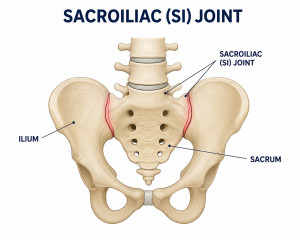
T
he sacroiliac joints connect:
- The sacrum (the triangular bone at the base of the spine)
- The ilium (the large pelvic bones)
Everyone has:
- One left SI joint
- One right SI joint
Although these joints only move a few degrees, they absorb considerable forces whenever we:
- Walk
- Run
- Bend
- Lift
- Climb stairs
- Turn in bed
Because of the stresses placed upon them, they can become painful if inflamed, strained, or mechanically dysfunctional.
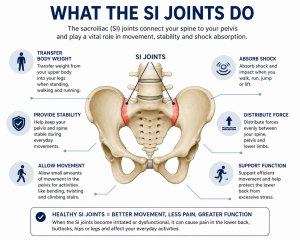
What Does the Sacroiliac Joint Do?
The SI joints have several important functions:
- Transfer body weight into the legs
- Provide stability during standing and walking
- Absorb shock
- Allow small pelvic movements
- Protect the lumbar spine from excessive loading
Even minor changes in SI joint movement can lead to significant discomfort.
What Is Sacroiliac Joint Dysfunction?
Sacroiliac joint dysfunction is a term used to describe pain arising from the SI joint due to abnormal movement, inflammation, or irritation of the supporting ligaments.
The joint may become:
- Too stiff (hypomobile)
- Too mobile (hypermobile)
- Inflamed
- Mechanically irritated following injury
Unlike sciatica, SI joint dysfunction does not usually involve compression of a spinal nerve root.
What Causes Sacroiliac Joint Dysfunction?
Several factors may contribute, including:
Minor trauma
Examples include:
- Slipping
- Falling
- Landing awkwardly
- Sporting injuries
Pregnancy
Hormonal changes loosen the pelvic ligaments, increasing SI joint movement.
Repetitive loading
Repeated twisting or lifting may gradually irritate the joint.
Leg length differences
Uneven loading through the pelvis can place additional stress on one SI joint.
Osteoarthritis
Like other joints, the SI joints can develop age-related degeneration.
Previous lumbar spine surgery
Changes in spinal mechanics may increase forces through the SI joints.
Altered walking patterns
Pain from the hip, knee, ankle, or foot can affect pelvic movement and contribute to SI joint irritation.
Symptoms of Sacroiliac Joint Dysfunction
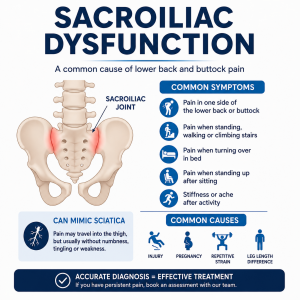
Patients commonly report:
- Pain over one buttock
- Pain beside the tailbone
- Pain when standing from sitting
- Pain climbing stairs
- Pain turning in bed
- Pain getting out of a car
- Pain standing on one leg
- Pain after prolonged standing
- Pain after walking
- Lower back stiffness
Some people also experience pain extending into:
- The back of the thigh
- The groin
- The outer hip
This is why SI joint dysfunction is frequently mistaken for sciatica.
Can SI Joint Dysfunction Cause Leg Pain?
Yes.
The SI joint can refer pain into the:
- Buttock
- Hamstring
- Groin
- Outer thigh
- Occasionally below the knee
However, unlike true sciatica, SI joint pain rarely follows the exact course of a spinal nerve and is less likely to cause numbness, tingling, muscle weakness, or altered reflexes.
Sacroiliac Joint Pain vs Sciatica
| Sacroiliac Joint Dysfunction | Sciatica |
|---|---|
| Pain usually centred over one buttock | Pain starts in lower back or buttock |
| Pain worse standing from sitting | Pain often worse sitting for long periods |
| Usually no numbness | Numbness common |
| Usually no muscle weakness | Weakness may occur |
| Normal reflexes | Reflexes may be reduced |
| Pain often eased by changing position | Leg pain often follows a nerve distribution |
| Usually no neurological symptoms | Neurological signs may be present |
What Does SI Joint Pain Feel Like?
Patients often describe:
- A deep ache
- Sharp pain
- Catching sensation
- Feeling “locked”
- Pain when rolling over
- Difficulty standing after sitting
- Local tenderness
Many point with one finger directly over the SI joint, a feature known as the Fortin finger sign.
How Is Sacroiliac Joint Dysfunction Diagnosed?
There is no single test that confirms SI joint dysfunction.
Diagnosis is based on:
Medical history
Your clinician will ask about:
- Where the pain started
- Activities that aggravate it
- Previous injuries
- Pregnancy history
- Sporting activities
Physical examination
The assessment may include:
- Observation of posture
- Walking analysis
- Lumbar spine movement
- Hip examination
- Neurological testing
- Palpation of the SI joints
- A series of SI joint provocation tests
These tests are most reliable when several reproduce your familiar pain.
Neurological examination
A normal neurological examination helps distinguish SI joint dysfunction from lumbar nerve root compression.
Imaging
X-rays and MRI scans are not always required but may be used to rule out:
- Fractures
- Arthritis
- Infection
- Inflammatory conditions
- Lumbar disc problems
How Is Sacroiliac Joint Dysfunction Treated?
Treatment depends on the underlying cause and severity of symptoms.
At Buxton & Bakewell Osteopathy Clinic, treatment may include:
- Osteopathic joint mobilisation
- Gentle manipulation (where appropriate)
- Soft tissue therapy
- Muscle energy techniques
- Exercise rehabilitation
- Core stability exercises
- Hip strengthening
- Postural advice
- Activity modification
Treatment aims to restore normal movement, reduce irritation, and improve pelvic stability.
Exercises for SI Joint Dysfunction
Many people benefit from exercises that improve the strength and control of the muscles supporting the pelvis, including the gluteal muscles, abdominal muscles, and hip stabilisers. Stretching tight hip flexors and hamstrings may also help reduce strain on the SI joint.
It is important that exercises are tailored to the individual, as performing the wrong exercises can aggravate symptoms.
Can SI Joint Dysfunction Be Prevented?
While not all cases are preventable, you can reduce your risk by:
- Maintaining good core strength
- Staying active
- Avoiding sudden increases in lifting or twisting
- Using proper lifting techniques
- Addressing leg length differences if significant
- Treating hip or spinal problems early
When Should You Seek Medical Advice?
Arrange an assessment if you have:
- Persistent buttock pain
- Pain radiating into the thigh
- Difficulty walking
- Pain affecting sleep
- Symptoms lasting more than a few weeks
- Recurrent episodes of pelvic pain
Seek urgent medical attention if you develop:

These symptoms are not typical of SI joint dysfunction and may indicate Cauda Equina Syndrome, which requires emergency assessment.
Why Choose Buxton & Bakewell Osteopathy Clinic?
At Buxton & Bakewell Osteopathy Clinic, we understand that not all buttock or leg pain is caused by sciatica. Our experienced clinicians carry out a detailed assessment of the lumbar spine, hips, pelvis, and sacroiliac joints to identify the true source of your symptoms.
Where appropriate, we can arrange private MRI referrals to investigate spinal conditions further and ensure you receive the correct diagnosis. Whether your pain is due to sacroiliac joint dysfunction, a herniated disc, spinal stenosis, or another musculoskeletal condition, we provide personalised treatment plans designed to reduce pain, restore movement, and help you return to normal activities as quickly as possible.
Frequently Asked Questions
Can SI joint dysfunction cause sciatica-like pain?
Yes. Pain from the sacroiliac joint can spread into the buttock, thigh, and occasionally below the knee, making it one of the most common conditions confused with sciatica.
Can an MRI diagnose SI joint dysfunction?
MRI can identify inflammation or other joint problems in some cases, but most diagnoses are based on a detailed history and physical examination.
Is SI joint dysfunction permanent?
No. Many people recover well with appropriate treatment, exercise, and activity modification.
Can osteopathy help SI joint dysfunction?
Many patients benefit from osteopathic treatment aimed at improving joint movement, reducing muscle tension, and restoring normal pelvic mechanics.
Can SI joint pain come back?
It can recur, particularly if underlying biomechanical issues are not addressed. Strengthening exercises and good movement habits can help reduce the risk.