Long-Term Pain Relief and Prevention After Sciatica
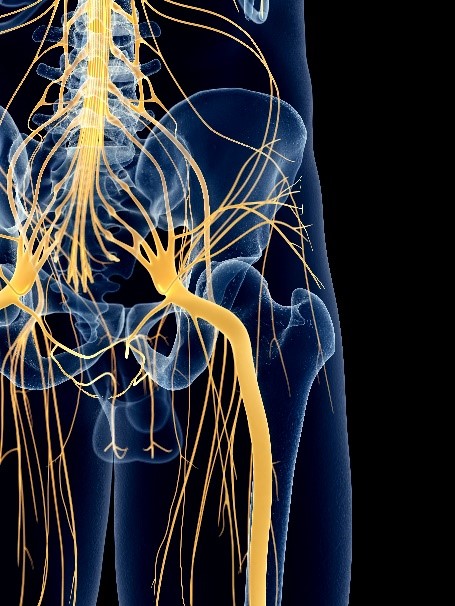
Long-term relief from sciatica is about more than the restoration of a trapped nerve (the treatment we offer can be considered as the emergency response team). For prevention you have to invest in making yourself more robust by building core strength and making a few lifestyle changes.
It is important to understand that no treatment or exercise programme can guarantee that sciatica will never return. However, learning how to care for your back, improving your physical capacity and responding appropriately to early warning signs may help you manage future flare-ups more effectively.
Why can sciatica return?
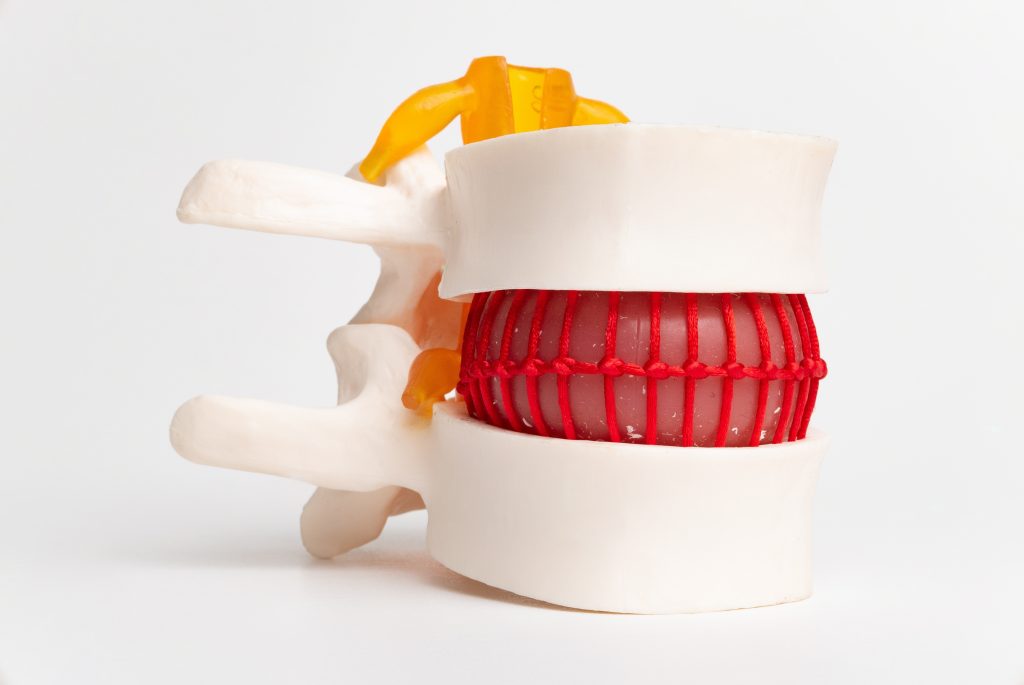
Many different spinal conditions can cause sciatica, some of these have a greater chance of retuning than others.
- A herniated disc
- Spinal stenosis
- Degenerative disc disease
- Spondylolisthesis
- Piriformis syndrome
- Facet joint arthritis
- Trauma or injury
- Inflammation around the nerve
- Another spinal condition
Each of these conditions requires a different management plan.
| Cause | Chance of returning | Why it may return |
|---|---|---|
| 💿 Herniated disc | 🟠 Moderate | The disc may remain vulnerable, or another disc may become irritated. |
| 🟡 Bulging disc | 🟠 Moderate | The bulge may remain present and irritate the nerve during a flare-up. |
| 🕰️ Degenerative disc disease | 🔴 Moderate to high | Age-related disc changes remain, so symptoms may come and go. |
| 🚇 Spinal stenosis | 🔴 High | The spinal canal remains narrowed, so walking or standing symptoms may return. |
| 🚪 Foraminal stenosis | 🔴 High | The opening through which the spinal nerve passes remains narrow. |
| 🧱 Spondylolisthesis | 🔴 Moderate to high | The slipped vertebra and associated narrowing usually remain present. |
| 🦴 Spinal arthritis | 🔴 Moderate to high | Arthritic changes can cause recurring inflammation, stiffness and nerve irritation. |
| 🤕 Injury-related sciatica | 🟡 Variable | Symptoms may return if strength and tolerance for activity have not fully recovered. |
| 🤰 Pregnancy-related symptoms | 🟢 Usually low after delivery | Symptoms may return during a future pregnancy or another back-pain episode. |
| 🏥 Following disc surgery | 🟡 Low to moderate | A disc can occasionally herniate again, or another spinal level may become affected. |
| 🍑 Piriformis syndrome | 🟡 Variable | Buttock muscle irritation may return with prolonged sitting or changes in activity. |
| ❓ No clearly identified cause | 🟡 Variable | Symptoms can flare even when no single structural cause has been identified. |
Simple likelihood guide
- 🟢 Low: less likely to return
- 🟠 Moderate: may return in some people
- 🔴 High: the underlying condition remains and symptoms may recur
— 🟡 Variable: depends heavily on the individual circumstances
These categories are general guides, not precise predictions for an individual patient.
Long-term relief begins with the correct diagnosis
Sciatica is a symptom rather than a single condition and your personal diagnosis is key. Effective long-term management therefore begins by identifying what is irritating the nerve and determining whether there are any signs of neurological loss.
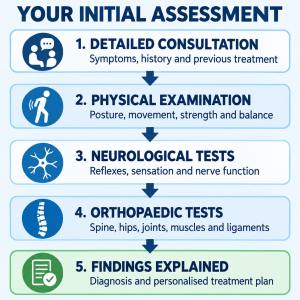
MRI is not routinely required for every episode of sciatica. It may be considered when symptoms are severe or persistent, neurological problems are developing, or the result is likely to change the treatment plan. This reflects current NICE guidance for lower back pain and sciatica.
Keep moving regularly
Complete rest may feel appealing during a painful episode, but prolonged inactivity can lead to stiffness, reduced muscle capacity and greater apprehension about movement.
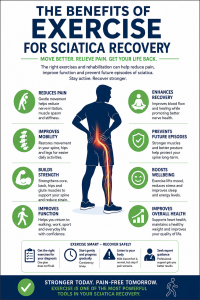
Gentle, regular activity is usually more helpful than alternating between long periods of rest and occasional bursts of strenuous exercise. Walking is often a useful starting point because its duration, speed and frequency can be adjusted easily.
Movement can be divided into manageable amounts throughout the day. For example, several short walks may initially be better tolerated than one long walk.
NICE recommends encouraging people with lower back pain or sciatica to continue normal activities wherever possible and to receive advice that supports self-management. Exercise should be selected according to the person’s needs, preferences and capabilities.
Build strength gradually
A good rehabilitation programme should prepare your body for the activities that matter to you. It may include exercises for:
- Abdominal and trunk muscles
- Gluteal muscles
- Hips and legs
- Spinal mobility
- Balance and coordination
- Lifting and carrying
- Cardiovascular fitness
There is no single “best” exercise for every person with sciatica. The correct programme depends on the cause of the symptoms, the stage of recovery and how your body responds.
Exercises should begin at a manageable level and progress gradually. Increasing the number of repetitions, resistance, walking distance and exercise frequency one step at a time makes it easier to identify what your body can tolerate.
Use pacing instead of avoiding activity
Fear of causing further injury can sometimes lead people to avoid bending, lifting, exercise or work long after the most painful stage has passed. This can reduce physical capacity and make ordinary activities feel increasingly difficult.
Pacing means finding a manageable level of activity and increasing it gradually. It does not mean permanently restricting movement.
A useful approach is to:
- Establish what you can currently do without causing a major or lasting increase in symptoms.
- Repeat that amount consistently.
- Increase one element at a time.
- Monitor how you feel during the following 24 hours.
- Adjust the next session if the response was excessive.
Some short-lived discomfort may occur as activity increases. However, a marked increase in leg pain, spreading numbness or new weakness should not simply be exercised through.
Reduce prolonged sitting
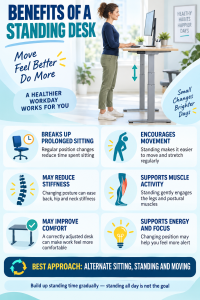
Sitting does not automatically damage the spine, but remaining in one position for a long time may aggravate symptoms in some people—particularly when a disc or nerve root is sensitive.
Try to:
- Change position regularly
- Stand or walk briefly throughout the day
- Arrange your screen and chair comfortably
- Avoid working from a sofa or bed for prolonged periods
- Alternate seated and standing tasks where possible
There is no perfect posture that must be maintained all day. Regularly changing position is often more practical than trying to hold one “correct” posture.
Return to lifting with confidence
Avoiding lifting forever is neither realistic nor normally necessary. The aim is to rebuild sufficient strength and confidence to lift safely.
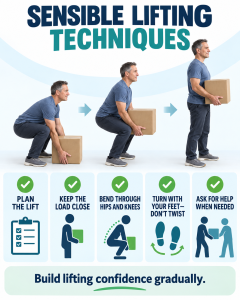
When returning to lifting:
- Begin with light, predictable loads
- Keep the object reasonably close to your body
- Use your hips and knees as well as your back
- Avoid rushing or twisting unexpectedly
- Increase weight and repetition gradually
- Ask for help with unusually heavy or awkward objects
Good lifting technique can reduce unnecessary strain, but physical preparation is equally important. A strong body that has practised lifting is generally better prepared than one that has avoided it completely.
Prepare for occasional flare-ups
A temporary flare-up does not mean that all previous progress has been lost. Having a simple plan can prevent a short-lived increase in symptoms from becoming a prolonged setback.
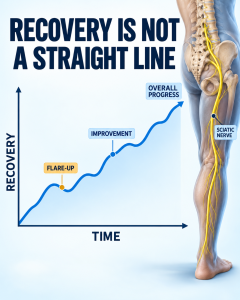
During a flare-up:
- Reduce aggravating activities temporarily rather than stopping everything
- Continue comfortable movement
- Use the exercises that have previously helped
- Break demanding tasks into smaller amounts
- Rebuild activity gradually as symptoms settle
- Arrange an assessment if symptoms are changing or not improving
Keeping a record of possible triggers, helpful movements and recovery times may make future episodes easier to understand.
Recognise warning signs early
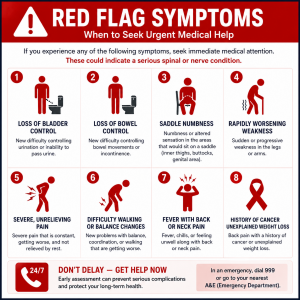
Seek professional assessment if sciatica is worsening, repeatedly returning or preventing normal daily activities. New or increasing leg weakness, difficulty lifting the foot, or progressive loss of sensation requires prompt medical assessment.
A personalised plan for lasting improvement
Long-term pain relief is rarely achieved through one exercise, one posture or one treatment alone. The most effective approach usually combines a clear diagnosis, appropriate treatment, progressive rehabilitation and confident self-management.
At Buxton & Bakewell Osteopathy Clinic, we assess the possible cause of your sciatica, check nerve function and develop a treatment and rehabilitation plan around your individual findings. Where clinically appropriate, this may involve osteopathy, exercise rehabilitation, IDD Therapy or referral for further investigation.
The objective is not simply to settle the present episode. It is to help you understand your condition, regain physical capacity and feel more confident managing your spinal health in the future.
To arrange an assessment, call Buxton & Bakewell Osteopathy Clinic on 01298 214994.
Why Choose Buxton & Bakewell Osteopathy Clinic?
We specialise in assessing and managing spinal conditions that commonly cause night-time sciatica, including herniated discs, spinal stenosis, degenerative disc disease and trapped nerves.
Every patient receives a detailed assessment to determine the source of their symptoms. Where appropriate, we can arrange private MRI referrals, explain the findings clearly and discuss suitable treatment options, including rehabilitation and IDD Therapy for carefully selected patients.
Patients travel to our clinic from Buxton, Bakewell, Matlock, Chapel-en-le-Frith, Whaley Bridge, Ashbourne, Macclesfield, High Peak and across the Peak District for expert assessment of persistent sciatica and nerve-related leg pain.