Why Does My Leg Feel Numb?
A good metaphor for numbness when you have sciatica is an electrical cable with a faulty power supply.
Your spinal nerve is very much like an electric cable carrying electrical signals from your central nervous system to your limbs.
Normal nerve:
🧠 ━━━━━━━━━ 🦶
Clear signal → normal sensation
Irritated nerve:
🧠 ━━━⚡〰⚡━━ 🦶
Disturbed signal → tingling and numbness
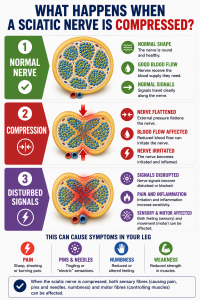
When a nerve root becomes irritated or compressed, electrical signals can become disturbed. The sciatic nerve is made up of both sensory (which innervate your skin) and motor fibres (which provide electricity to your muscles).
Sensory fibres allow us to detect temperature, touch, vibration and pain. If these fibres are affected by nerve compression they generate faulty signals and we feel this as pins and needles or, if the compression is more extreme, numbness. If the motor fibres are compressed we can experience weakness in our limbs.
Leg numbness can be an alarming symptom. Some people describe it as feeling as though their leg has “gone dead”, while others notice patches of skin that feel less sensitive or completely numb. In many cases, numbness is accompanied by tingling, pins and needles, burning sensations or pain travelling down the leg.
At The Sciatica Hub in Buxton, we specialise in assessing patients with leg numbness to identify the exact cause and determine the most appropriate treatment. Using a detailed neurological examination, combined with imaging where necessary, we help patients throughout Buxton, Bakewell and the Peak District understand why their symptoms have developed and how they can be treated without unnecessary surgery whenever possible.
What Does Leg Numbness Feel Like?
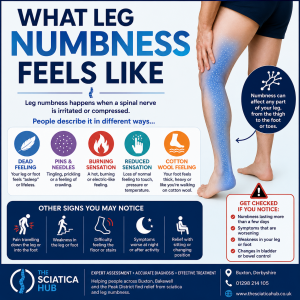
Sometimes the numbness affects only the toes.
Others notice the entire foot feels numb.
More severe cases may involve numbness extending from the buttock down to the foot.
How Does the Sciatic Nerve Become Compressed?
| Cause | Nerve effect and symptoms |
|---|---|
| 🔴 Herniated disc | Effect: Disc presses on nerve Symptoms: Leg pain, tingling, numbness, weakness |
| 🕰️ Disc degeneration | Effect: Nerve exits narrow Symptoms: Back pain, stiffness, tingling |
| 🚶 Spinal stenosis | Effect: Spinal canal narrows Symptoms: Heavy or painful legs when walking |
| ↪️ Spondylolisthesis | Effect: Vertebra moves forwards Symptoms: Back pain, sciatica, weakness |
| ⚠️ Trauma or injury | Effect: Disc or joint damage Symptoms: Sudden pain, sciatica, numbness |
| 🦴 Bone spurs | Effect: Nerve openings narrow Symptoms: Leg pain, tingling, stiffness |
| ⚙️ Enlarged facet joints | Effect: Less space around nerves Symptoms: Back and leg pain |
| 🔗 Thickened ligaments | Effect: Spinal canal narrows Symptoms: Heavy, numb or painful legs |
| 🍑 Piriformis syndrome | Effect: Sciatic nerve irritated in buttock Symptoms: Buttock and leg pain |
Which Part of My Leg Is Numb?
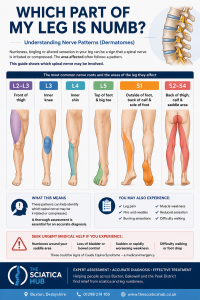
This pattern is known as a dermatome.
During examination your clinician can often determine which spinal nerve is involved.
Can Leg Numbness Occur Without Pain?
Yes.
Some patients have almost no pain at all.
Instead they experience:
- Numbness
- Weakness
- Balance problems
- Foot weakness
- Altered walking pattern
This can actually indicate a more significant nerve injury.
Pain fibres sometimes recover before sensory fibres.
Persistent numbness should therefore never be ignored.
Can Numbness Become Permanent?
It can.
If a nerve remains compressed for many months, permanent changes may develop.
Early assessment gives the best chance of recovery.
The longer compression continues:
- the slower recovery becomes
- the less complete recovery may be
Prompt diagnosis is therefore important.
What Other Symptoms May Occur?
Patients often experience:
- Lower back pain
- Buttock pain
- Pain down the leg
- Pins and needles
- Burning sensations
- Foot weakness
- Difficulty climbing stairs
- Difficulty standing on tiptoes
- Foot drop
- Muscle cramps
Is Leg Numbness Dangerous?
Usually not.
However certain symptoms require immediate medical assessment.
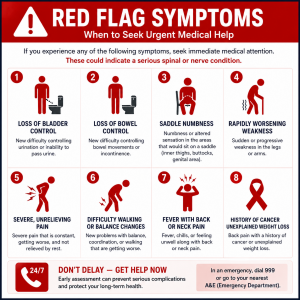
These may indicate Cauda Equina Syndrome, which requires urgent emergency assessment.
How Is the Cause Diagnosed?
At our clinic we begin with a comprehensive assessment.
This includes:
Medical History
We ask:
- When symptoms started
- Where numbness occurs
- What aggravates symptoms
- Previous back problems
- Previous injuries
Neurological Examination
We assess:
- Sensation
- Muscle strength
- Reflexes
- Walking pattern
- Balance
- Coordination
Orthopaedic Tests
Specific tests help identify nerve irritation.
These include:
- Straight Leg Raise
- Slump Test
- Femoral Nerve Stretch Test
MRI Scan
MRI remains the gold standard for assessing spinal nerve compression.
It clearly shows:
If clinically appropriate, we can arrange private MRI referrals to help confirm the diagnosis quickly.
Treatment for Leg Numbness
Treatment depends entirely upon the underlying cause.
Activity Modification
Temporary changes to sitting, lifting and walking often reduce irritation.
Hands-on treatment may help improve spinal mobility, reduce muscle spasm and support recovery where appropriate.
Exercise Rehabilitation
Specific exercises can improve spinal stability and reduce pressure on irritated nerves.
These should always be tailored to the individual rather than copied from generic online programmes.
For suitable patients with:
- Herniated discs
- Degenerative disc disease
- Chronic sciatica
- Trapped nerves
- Certain cases of spinal stenosis
IDD Therapy provides a gentle, computer-controlled spinal decompression treatment designed to reduce pressure on compressed spinal nerves.
Many patients report gradual improvement in:
- Pain
- Pins and needles
- Leg numbness
- Walking tolerance
- Function
IDD Therapy is always prescribed following a thorough assessment to determine whether it is appropriate for your condition.
When Should You Seek Professional Advice?
Arrange an assessment if:
- Numbness lasts more than a few days
- Symptoms are worsening
- Pain travels below the knee
- Walking becomes difficult
- You notice weakness
- Symptoms keep returning
- You have previously had a disc injury
Early diagnosis can often prevent long-term nerve damage and guide the most appropriate treatment.
Why Choose The Sciatica Hub?
At The Sciatica Hub, we focus on diagnosing and treating the underlying cause of leg numbness rather than simply masking symptoms. Patients from Buxton, Bakewell, the Peak District, High Peak and surrounding areas visit us for expert assessment of sciatica, trapped nerves, herniated discs and spinal stenosis.
Our comprehensive approach includes detailed neurological assessment, access to private MRI referrals when appropriate, personalised rehabilitation, osteopathic care and advanced treatments such as IDD Therapy for suitable patients. By identifying the exact source of nerve irritation, we aim to help you return to everyday activities with greater confidence and reduced symptoms.
If persistent numbness in your leg is affecting your work, sleep or quality of life, seeking an early assessment can make a significant difference to your recovery.
Frequently Asked Questions
Can sciatica cause numbness without severe pain?
Yes. Some people experience numbness, tingling or weakness with very little pain, particularly if sensory nerve fibres are more affected than pain fibres.
Is numbness a sign of nerve damage?
It can be. Persistent numbness often indicates that a nerve is irritated or compressed and should be assessed, especially if it is worsening.
Will leg numbness go away on its own?
Mild cases may improve as inflammation settles, but numbness lasting more than a few days or accompanied by weakness should be professionally assessed.
Which disc usually causes numbness in the foot?
Compression of the L5 or S1 nerve roots—commonly from an L4/L5 or L5/S1 disc problem—is a frequent cause of foot numbness.
Can a trapped nerve make my leg feel dead?
Yes. Compression of a spinal nerve can reduce normal sensation, making part of the leg or foot feel numb, heavy or “dead.”
When is leg numbness an emergency?
Seek immediate emergency medical attention if numbness is associated with loss of bladder or bowel control, numbness around the saddle area, rapidly worsening weakness or sudden foot drop.