Shockwave Therapy and Sciatica: How It Can Support Recovery
Buxton and Bakewell Osteopathy Clinic is the only clinic in Derbyshire (at the time of writing in 2026) to offer both cutting-edge non-invasive Focused Shockwave and Radial Shockwave.
Focused Shockwave treatment (a recent innovation) has been a game changer in the healthcare industry allowing the treatment of intricate orthopaedic conditions. It can be directed with great precision deep inside joint space (knee or shoulder or hip joint) or with a high level of accuracy onto tendons or ligaments.
Radial Shockwave, on the other hand, treats a broader shallower area, it is very effective for less stubborn superficial tendinopathies and ligament problems . Radial Shockwave, and especially Focused Shockwave, treatments are the most advanced treatment therapies that are available on the market for musculoskeletal issues allowing us to be a go-to destination for tendinopathies.
At Buxton & Bakewell Osteopathy Clinic, Shockwave Therapy is not generally used as a treatment to directly decompress a spinal nerve or repair a prolapsed disc. Instead, it may be considered when there is a significant muscular, tendon or soft-tissue component contributing to the patient’s symptoms or slowing their recovery.
For selected patients, Shockwave Therapy can therefore form part of a wider lower back pain treatment programme alongside osteopathy, rehabilitation and, where appropriate, IDD Therapy .
Who might be considered for treatment?
| Condition | When shockwave may be appropriate |
|---|---|
| 💪 Myofascial lower back pain | Persistent muscular pain and tenderness, where shockwave may help reduce symptoms alongside rehabilitation. |
| 🎯 Quadratus lumborum trigger-point pain | Helps relieve pain and tightness alongside rehabilitation. |
| 🚶 Chronic non-specific lower back pain | As an additional treatment when symptoms persist and assessment excludes a specific condition requiring different care. |
| 🍑 Gluteal tendinopathy or greater trochanteric pain syndrome | When a confirmed hip tendon problem contributes to pain around the buttock or outer hip. This is a separate diagnosis from spinal pain. |
| 🦴 Facet joint pain | Helps relieve muscle tightness and inflammation alongside rehabilitation. |
Can shockwave treat herniated discs sciatica?
This requires an important distinction.
Shockwave Therapy does not directly decompress a spinal nerve.
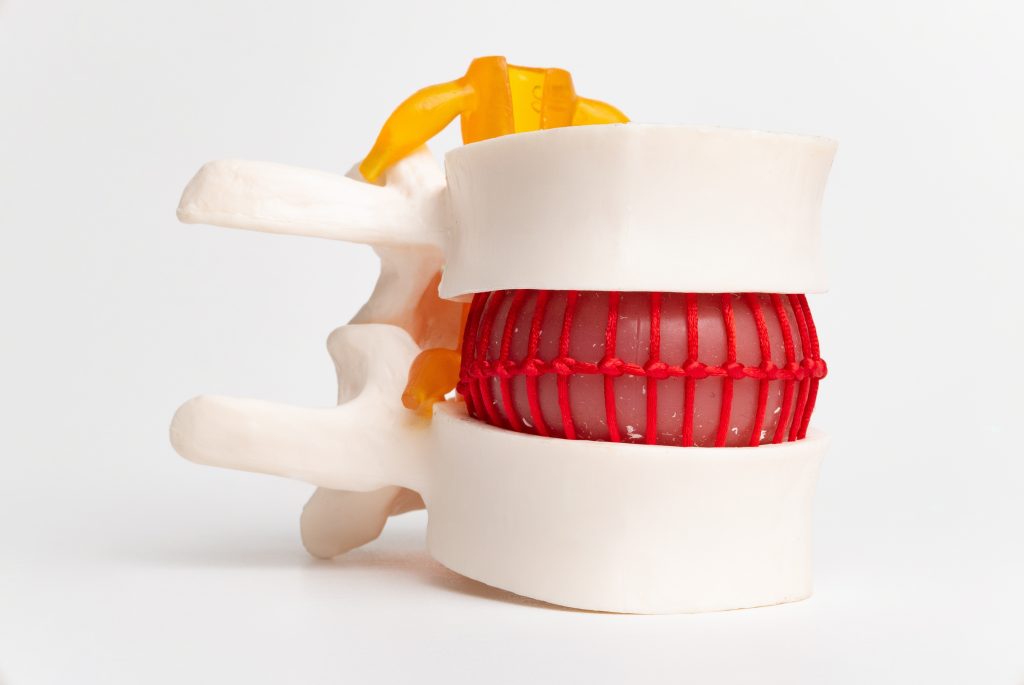
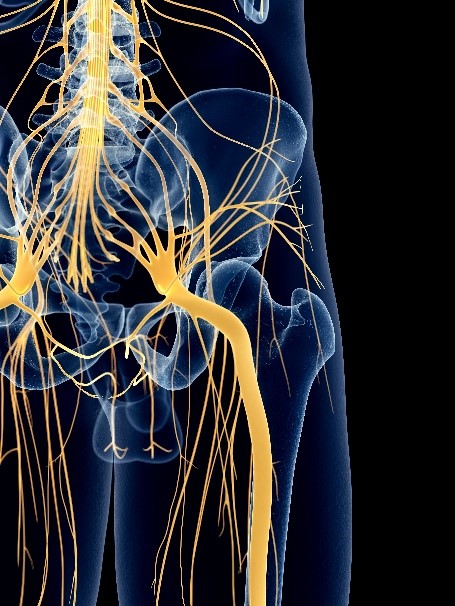
If sciatica is being caused by a prolapsed or bulging disc compressing a nerve root, firing shockwaves into the buttock does not remove that compression.
Its role is different.
Shockwave Therapy may be useful when muscles, tendons or other soft tissues are contributing to the overall pain picture alongside the sciatica.
This is why obtaining an accurate diagnosis is so important.
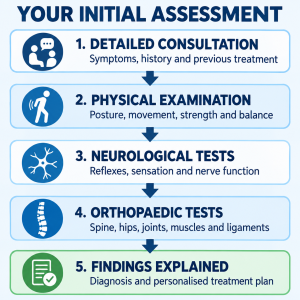
What happens at your first appointment when you come to see us ?
What does treatment feel like?
After discussing expected benefits we comfortably and apply ultrasound gel to the selected area. The applicator produces repeated pulses.
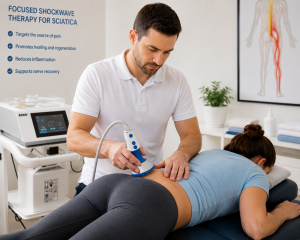
Treatment may feel uncomfortable over a sensitive region, but you can easily communicate throughout. The settings and treatment area should be constantly adjusted to suit you.
There is no single standard lower-back protocol suitable for everyone. Session length, spacing and whether further treatment is justified depend on the clinical target, equipment guidance, tolerance and response.
Why Rehabilitation Remains central
Pain relief is most useful when it helps you return to meaningful activity. Shockwave is not a replacement for a broader plan that includes rehabilitiation or a replacement for movement or self-management.
Depending on your assessment, rehabilitation may involve comfortable mobility work, strengthening, walking or modifications to daily tasks. Exercise choice should reflect your symptoms, preferences, other health conditions and recovery between sessions.
NICE guidance supports tailored self-management, continued normal activity and suitable exercise. Manual therapy can be considered as part of a package that includes exercise. Shockwave is not listed as a routine recommended treatment within that lower-back guideline.
What should you do between appointments?
Comfortable daily movement is best that is easy for you, while temporarily reducing an activity that aggravates your symptoms.
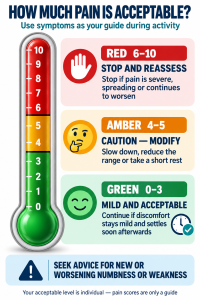
Follow the agreed plan and notice both your immediate response and how you feel later that day or the next morning.
An activity diary can help identify useful patterns: what you did, how long you did it and how symptoms responded. The aim is to find a sustainable level, not to force increases regardless of worsening symptoms or other health conditions.
How will we judge whether it is working?
You might sit longer, sleep more comfortably, walk further or complete household tasks with fewer interruptions.
If there is no worthwhile improvement, or symptoms change unexpectedly, we have to take that into account. That may mean changing rehabilitation, reviewing your diagnosis or arranging another opinion.
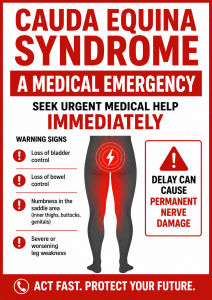
When back pain needs urgent medical help
Cauda Equina Syndrome it is quite rare but it is imporant to be aware of. It means your spinal cord is being severely compressed usually by a herniated disc
Questions worth asking before treatment
Will I need both focused and radial treatment?
Not necessarily. The choice should reflect the target tissues and clinical reasoning. A combination should not be recommended simply because both machines are available.
Can I have treatment during a flare-up?
That depends on the cause and severity. A recent, highly irritable episode may call for reassurance, gentler management or further assessment rather than shockwave. There is no requirement to treat every flare-up with the same approach.
What if my scan shows degeneration?
A scan finding does not determine treatment on its own. Your clinician should consider whether it fits your symptoms and examination. The presence of degenerative changes does not establish that shockwave will help or that those changes need targeting.
Should treatment continue indefinitely?
No. Agree a review point and assess whether benefits justify further sessions. Your ability to manage daily life is a more useful goal than relying on repeated treatment without a clear endpoint.
Shockwave therapy for lower back pain in Buxton and Bakewell
At Buxton & Bakewell Osteopathy Clinic, shockwave can be discussed as one possible component of care for an appropriately assessed problem. The decision should follow the clinical findings, your priorities and an honest conversation about likely benefits and limitations.
Whether your goal is gardening, returning to work or enjoying walks across the Peak District, the plan should focus on what matters to you. Osteopathy, suitable rehabilitation and practical advice may be sufficient; additional treatment should have a clear purpose.
To discuss persistent lower back pain and whether shockwave may be suitable, call 01298 214994 or visit our Shockwave Therapy page.