Physical Examination for Lower Back Pain: What to Expect in Buxton & Bakewell
Lower back pain affects people in very different ways. This is because the lower back has many moving parts and some of which contribute to anyone person’s pain.
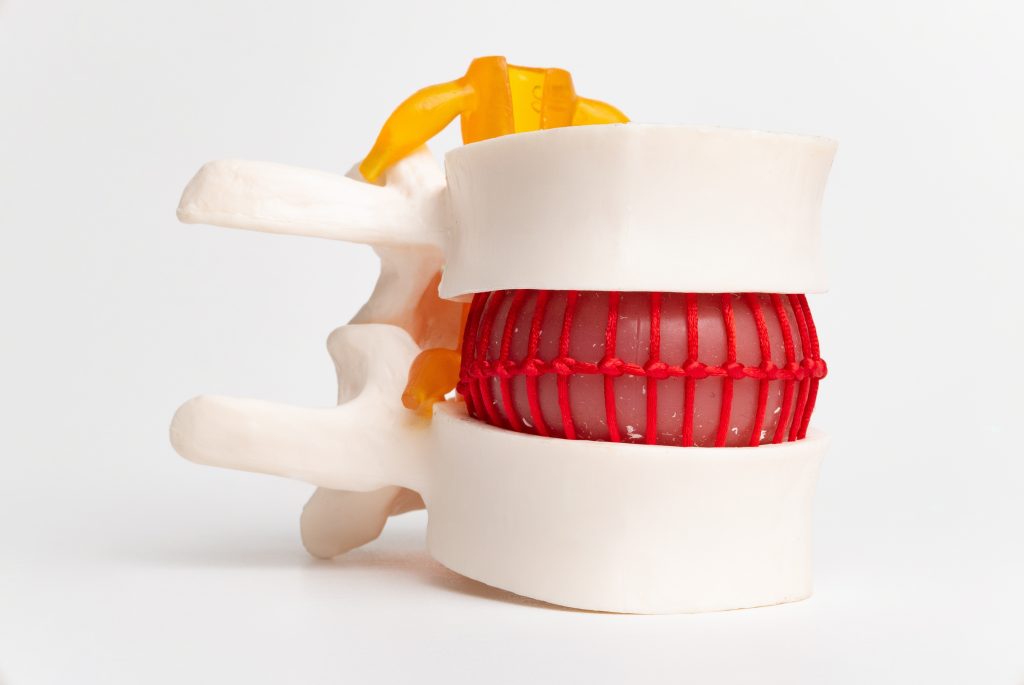
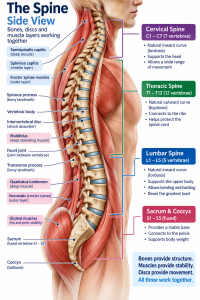
Your back contains many different structures vertebrae such as intervertebral discs, joints, ligaments, muscles and nerves. These structures work together whenever you bend, lift, walk or change position.
| Structure |  Number |
Main Job |
|---|---|---|
 Vertebral segments |
33 | Support & protection |
 Spinal discs |
23 | Cushion & absorb load |
 Muscles |
@120 | Movement & support |
 Ligaments |
@220 | Stability & control |
 Facet joints |
48 | Guide spinal movement |
 Spinal nerve pairs |
31 | Carry nerve signals |
 Spinal cord |
1 | Connects brain & body |
A physical examination helps turn your description of lower back pain into a clearer clinical picture. It allows us to observe movement, assess your function and check whether nerves may be involved.
At Buxton & Bakewell Osteopathy Clinic, examination follows a detailed discussion of your symptoms and medical history. We bring these pieces together to decide what is most likely happening and what should happen next.
The aim is not simply to find a painful spot. We want to understand how your symptoms affect you, identify findings that need medical attention and establish a useful starting point for care.
Whether you are struggling with sitting at work, gardening or walking in the Peak District, assessment should relate to the activities you want to regain.
What Does a Physical Examination Involve?
Your examination is tailored to your history. Someone with recent local back stiffness may need different checks from someone with leg numbness or changing muscle strength.
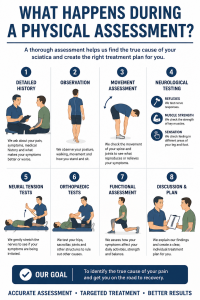
Not everyone needs every test. The examination may be shortened or adapted if you are very uncomfortable. We explain what we are checking and discuss any further investigation that may be appropriate.
Your Comfort, Consent and Preferences
Before starting, we ask for your consent.
Wear comfortable clothing that allows movement. Depending on the area being assessed, you may be asked to adjust or remove some clothing, with privacy and appropriate covering provided.
Tell us if you would like a companion or chaperone, need help changing position or prefer additional explanations.
1. Observing How You Walk and Move
Assessment often begins before you lie on the examination couch.
We may watch how you walk, turn, sit down and stand up. We look for limping, shorter steps, difficulty straightening or a tendency to protect one side.
Your posture and foot position provide context, but appearances alone do not establish the cause of pain. A slight asymmetry does not automatically mean something is misplaced.
We may ask whether your movement looks different from usual.
For example, a new tendency to catch your toes deserves closer assessment. Walking slowly because movement hurts may have a different explanation. Observation helps us decide which checks should follow.
2. Checking Forward Bending & Backward Bending, Side Bending and Rotation
You may be asked to perform particlar movements as far as feels manageable.
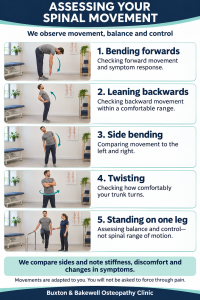
We observe the range, smoothness and distribution of movement through your back and hips. We also ask where you feel symptoms and whether pain spreads or changes.
Being unable to touch your toes does not prove that your spine is damaged. Flexibility varies, and pain, muscle guarding and confidence can all influence movement.
Similarly, pain during forward bending does not confirm a herniated disc.
We note stiffness, discomfort, hesitation and whether familiar leg symptoms change.
A movement that feels easier than expected can be useful too. It may identify a comfortable direction for everyday activity or rehabilitation.
These tests are not a simple code in which one painful direction identifies one structure. Disc, joint, muscle and nerve-related problems can produce overlapping responses. We interpret the overall pattern.
3. Examining the Hips and Surrounding Areas
Back pain assessment may also include the hips because symptoms and movement difficulties can overlap.
We may move a hip while you are lying down, compare sides and ask whether this reproduces your familiar pain.
Sometimes it is very hard to distinguish between hip pain or lower back pain. Sometimes poeple can have a prob;em in the hip and the back.
We may also assess relevant muscles around the pelvis, buttocks and thighs. Sometimes sacroiliac joint pain can mimic sciatica.
This can help distinguish between pain referred from the back and symptoms that may involve the hip or another nearby structure.
However, finding tightness or reduced flexibility does not automatically identify the main cause. The important question is whether a finding fits your symptoms and changes the advice or treatment we recommend.
5. Feeling the Back and Soft Tissues
Hands-on examination, sometimes called palpation, can help identify tenderness and muscular guarding.
We may gently feel the muscles beside the spine and other relevant areas, asking whether the pressure reproduces familiar discomfort.
This can help us judge sensitivity and choose a tolerable approach if manual treatment is appropriate.
Tenderness does not reveal everything happening beneath the skin. Touch alone cannot reliably confirm a disc prolapse, measure nerve compression or demonstrate that a vertebra is “out of place.”
We use these findings as supporting information rather than treating a tender spot as a complete diagnosis.
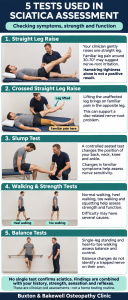
6. Testing Muscle Strength
When nerve involvement is possible, strength testing becomes particularly important.
You may be asked to move a joint while your clinician applies controlled resistance. Both sides are compared, taking account of pain and previous limitations.
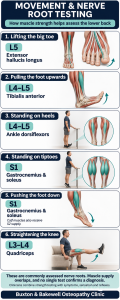
Muscles receive overlapping nerve-root supply. A single weak movement cannot precisely identify a trapped nerve.
Pain, fatigue, joint problems and effort can also affect performance. New or progressive weakness needs prompt medical assessment and may change the next steps.
7. Checking Knee and Ankle Reflexes
Reflex testing assesses an automatic response within the nervous system.
Using a reflex hammer, we may tap the tendon below the kneecap or the Achilles tendon behind the ankle.
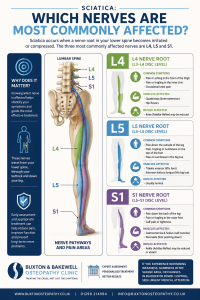
The knee reflex commonly helps assess the L3–L4 pathways, particularly L4. The ankle reflex commonly helps assess S1.
We compare sides and consider previous findings, age and the rest of the examination.
A reduced reflex may support nerve-root involvement, but it is not proof on its own. Equally, normal reflexes do not rule out every nerve-related problem. Their value comes from interpretation alongside strength, sensation and symptoms.
8. Assessing Skin Sensation
If you report numbness or pins and needles, we may compare feeling in different areas of your legs and feet.
We may use light touch or another appropriate sensory test and ask whether the sensation feels equal on both sides.
We record the distribution and whether it matches the pattern you described.
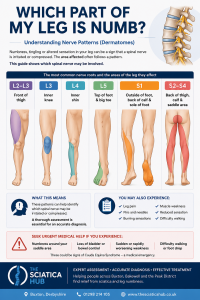
Sensory territories overlap and differ between people. A diagram of nerve supply is a guide rather than a perfect map for every patient.
9. Neurlogical Testing
What Can the Examination Tell Us?
The most useful findings are those that fit together.
For example, a particular pattern of leg pain, reduced strength and altered sensation may support nerve-root involvement more strongly than any single finding.
Other examinations suggest non-specific lower back pain, where one exact painful structure cannot be confidently identified.
This does not mean the pain is unexplained or unimportant. A useful plan can still focus on movement, function and symptom management.
Sometimes the findings suggest a different condition or do not fit the expected pattern. In that situation, reconsidering the explanation or arranging medical review is an important part of assessment.
When Might Imaging Be Appropriate?
An examination does not automatically lead to an MRI.
Routine imaging is not recommended for uncomplicated lower back pain. Imaging is considered when clinically indicated and when the result is likely to influence our management.
At our clinic, a private MRI referral begins with assessment by Phil. We explain the reason for the scan and how its findings may affect care.
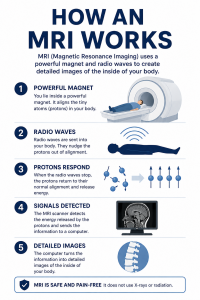
Scan results must be considered alongside symptoms and examination. A structural change on an image is not automatically the cause of pain.
Symptoms That Should Not Wait
Certain symptoms require emergency medical assessment rather than a routine osteopathy appointment.
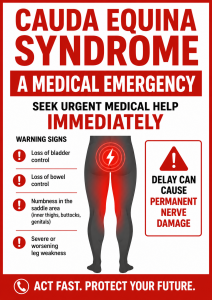
With back or leg pain, in rare cases, go to A&E or call 999 for new difficulty passing urine, loss of bladder or bowel control, numbness around the genitals or bottom, or severe or worsening weakness or numbness affecting both legs.
Do not wait to see whether manual treatment helps.
New or progressive weakness affecting one leg also requires prompt medical assessment. Back pain with fever, feeling generally unwell or rapid deterioration needs urgent medical advice.
A reassuring examination at an earlier appointment does not remove the need to act on new symptoms.
How Findings Guide Your Care
After the examination, your clinician should explain the main findings, the likely clinical picture and any remaining uncertainty.
For uncomplicated symptoms, care may include reassurance, advice about activity and a suitable exercise programme. Manual treatment may be considered as part of a plan that includes exercise.
We agree practical goals, such as sitting more comfortably, walking further or returning to gardening.
Relevant measures can then be reviewed over time. Changes in strength, sensation, walking or daily function may alter the plan.
At Buxton & Bakewell Osteopathy Clinic, assessment is an ongoing conversation. Patients across Buxton, Bakewell and the Peak District should understand what has been found and why the next steps make sense.
Visit buxtonosteopathy.co.uk to arrange your lower back pain assessment.