Lower back pain that gets worse with activity? Does your lower back start aching during a walk, tighten while gardening, or become painful after moving logs or hoovering?
You feel comfortable when resting, but symptoms return as soon as you become more active. Frustrating! Especially when there are things that need doing.
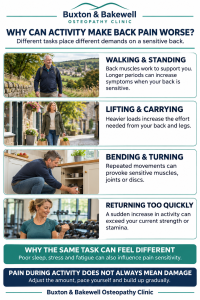
This can be really annoying, particularly when you enjoy your chosen sport and cannot wait to head off on your bike ride or take the dog for a walk or move those pots in the garden. Afterall we live in a National Park that is the wonderful Peak District. If we push ourselves to do these activities and it causes discomfort are we causing more damage?
Pain during activity does not automatically mean that you are aggravating things. However, persistent or worsening symptoms deserve an assessment.
At Buxton & Bakewell Osteopathy Clinic, we consider which activities provoke your symptoms, how quickly they develop and what helps them settle. These details help guide appropriate treatment, rehabilitation or referral.
🔎 Why Can Activity Make Lower Back Pain Worse?
Movement places changing demands on the muscles, joints, discs and other tissues supporting your spine.
Your back normally adapts to these demands.
It is worth remembering 24 to 72 hours after of an acute lower back injury or pain episode, the lower back muscles and spinal joints become weaker and take time to recover. Recovery can vary from several days to 2 weeks depending on the extent of injury.
After a bout of lower back pain the amount of activity you do matters alongside the specific movement itself. Bending once to pick something up is different from repeatedly lifting heavy bags throughout an afternoon.
Sleep, stress, general health and previous experiences of pain can also influence your response.
Understanding this wider picture helps explain why the same task may feel manageable one day and uncomfortable the next.
💪 Muscle Strain, Fatigue and Protective Tension
Muscles work continuously during lifting, walking, carrying and standing.
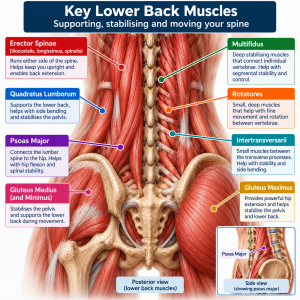
After an unfamiliar or demanding activity that your body is not used to, you can suddenly develop localised aching, tenderness or stiffness. This is a classic presentation and often occurs after stacking logs when they are delivered once or twice a year or when you trim a hedge on a step ladder and lean forwards for a sustained period of time in autumn.
Other common examples include returning to gardening after winter, moving furniture or beginning a new gym routine too quickly.
Pain may lead the surrounding muscles to tighten protectively. This can create a gripping feeling across the lower back and make bending or straightening uncomfortable.
It takes time to recover and for muscles to regain the function.
Assessment considers how symptoms began, the movements involved and whether other signs suggest a different explanation. Recovery may involve temporarily adjusting demanding tasks while maintaining manageable movement.
🦴 Spinal Joint Irritation
The small 48 facet joints (click here if you want to know more about spinal joints) at the back of your spine help guide movement .
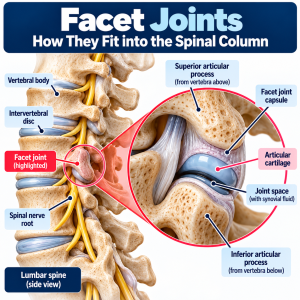
Irritation affecting these joints may accompany discomfort when standing for a long time, turning or leaning backwards. Some people notice aching beside the spine or into the buttock.
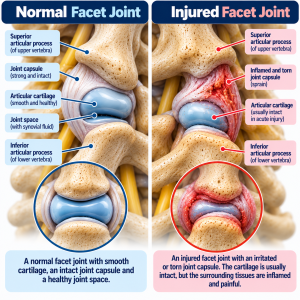
Age-related joint changes can also influence movement, although they do not always cause symptoms.
A painful movement cannot identify a particular joint by itself. Muscles, discs and other structures may produce overlapping patterns.
Having spinal osteoarthritis also does not mean that activity must stop. The aim is to establish what you can manage and build from there, while checking whether your symptoms require further investigation.
🧩 Disc-Related Pain and Bending Activities
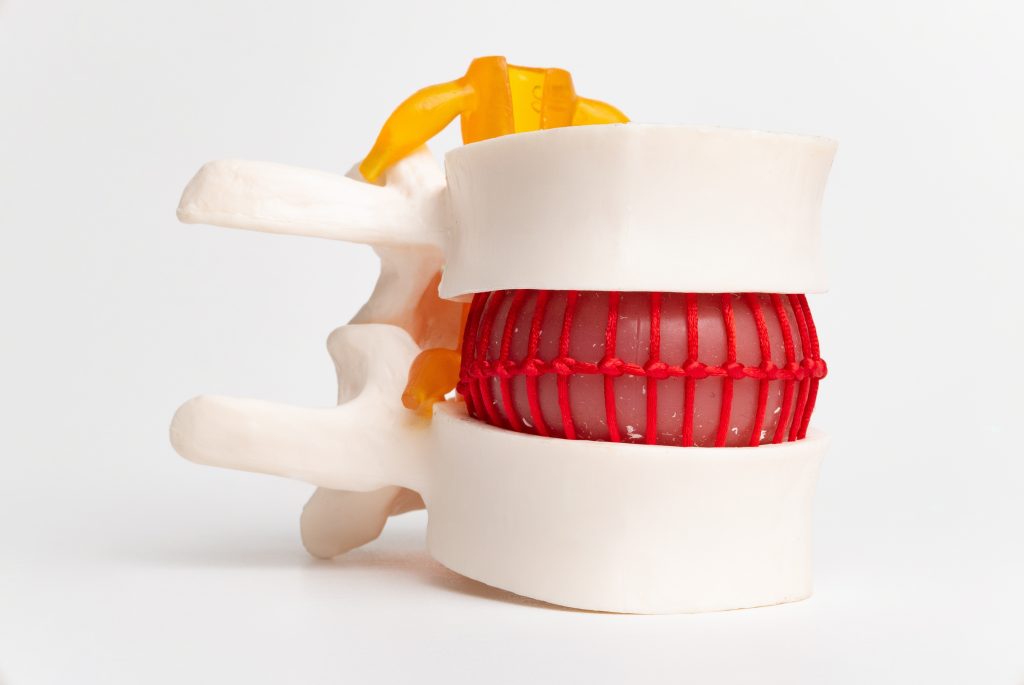
Spinal discs sit between neighbouring vertebrae and help distribute load.
Disc-related pain may make repeated bending, lifting or prolonged sitting uncomfortable. You might notice symptoms when unloading the dishwasher, picking up shopping or working close to the ground.
A herniated disc can sometimes irritate a nearby nerve root, producing symptoms into the leg.
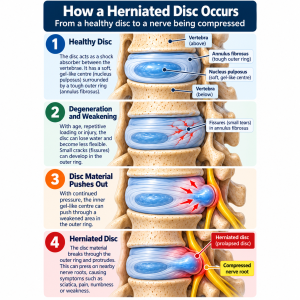
However, pain with bending does not establish that you have a disc injury. Many people with lower back pain cannot be given a reliable diagnosis involving one exact structure.
Likewise, disc changes on an MRI do not automatically explain your symptoms. Findings need to be interpreted alongside your history and examination.
When Activity Triggers Sciatica
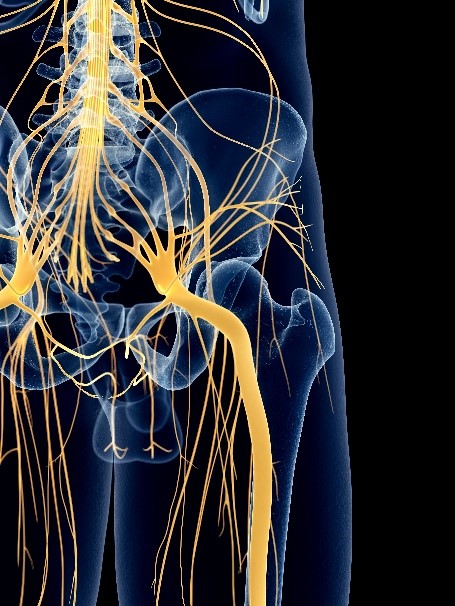
Sciatica describes symptoms associated with irritation or compression of a nerve supplying the leg.
You may experience shooting or burning leg pain, tingling, numbness or weakness. Back pain may occur alongside these symptoms, but the leg pain can be more troublesome.
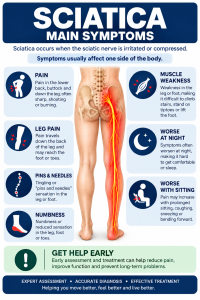
Some people find sitting or bending difficult; others notice symptoms during standing or walking.
The response varies, so exercises and activity advice should be tailored.
New or progressive weakness, including difficulty lifting the front of the foot, needs prompt medical assessment.
If you have leg symptoms, our Sciatica Hub explains possible causes, clinical assessment and the circumstances in which further investigation may be appropriate.
Walking and Standing: Could Spinal Stenosis Be Relevant?
Lumbar spinal stenosis involves narrowing of spaces around the nerves in the lower back.
When symptomatic, it commonly causes leg aching, heaviness, tingling or cramping during standing and walking. Sitting or leaning forwards may provide relief.
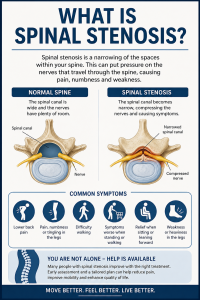
You might manage cycling more comfortably than walking, or notice that leaning on a shopping trolley helps.
This pattern deserves assessment, although it does not prove stenosis. Other problems, including circulation difficulties, can also affect walking.
Back pain alone, without leg symptoms, is less suggestive of symptomatic lumbar stenosis. Treatment decisions depend on your examination, daily limitations and overall health.
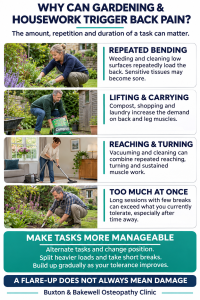
🌱 Why Gardening and Housework Can Cause a Flare-Up
Gardening combines bending, reaching, lifting, kneeling and sustained positions.
Housework can create similar demands, particularly when vacuuming, cleaning bathrooms or carrying laundry.
📋 What Different Activity Patterns May Tell Us
The pattern provides useful clues, although it cannot confirm a diagnosis.
| Activity or pattern | What you might notice |
|---|---|
| 🚶 Walking or standing | Back aching, or leg symptoms that limit distance |
| 🧺 Repeated bending | Increasing discomfort during housework or gardening |
| 🏋️ Lifting and carrying | Pain during the task or aching afterwards |
| 🔄 Turning or leaning back | Localised pain and restricted movement |
| 🪑 Rising after sitting | Stiffness during the first few steps |
| ⏱️ Prolonged activity | Symptoms building as fatigue increases |
| 🌙 After a demanding day | Aching later in the evening or the following morning |
Tell your clinician whether symptoms stay in your back or spread into the buttock or leg.
⚖️ Does Pain Mean You Should Stop Moving?
It is understandable to avoid an activity that hurts.
However, stopping all movement can make returning to everyday life harder. Your strength, stamina and confidence may decline if you remain inactive for an extended period.
For uncomplicated lower back pain, guidance generally encourages continuing normal activities where possible and avoiding prolonged bed rest.
This does not mean forcing yourself through severe pain. You may need to reduce the duration, intensity or frequency of a task.
Staying active means finding a manageable starting point. An assessment can help when you are unsure which symptoms are acceptable and which require a change of plan.
📈 How to Pace Activity Without Giving It Up
Pacing means organising activity so that it is more repeatable.
Suppose a long walk reliably leaves you struggling afterwards. A shorter route, with opportunities to rest, may be a better starting point.
For gardening, you could complete one section, change tasks and return later. At work, alternating duties may reduce long periods of the same movement.
Progress should reflect how you respond during the activity and afterwards.
There is no universal time limit or pain score that suits everyone. If symptoms repeatedly escalate or your recovery becomes slower, reduce the demand and seek advice.
The aim is steady participation, with gradual increases as your tolerance improves.
🏃 Building Strength and Confidence
Rehabilitation can help you prepare for the activities you want to do.
Depending on your needs, this may involve improving leg strength, trunk endurance, balance, hip movement or general fitness.
Exercises do not need to be complicated. Practising rising from a chair, stepping, carrying manageable loads or walking regularly may be useful components of a tailored programme.
Your starting level matters more than comparing yourself with somebody else.
We also consider whether you are holding your breath, bracing excessively or avoiding movements because you expect pain.
The goal is to make useful movement feel more manageable, with progress linked to everyday tasks rather than exercise performance alone.
👐 How Can Osteopathy Help?
Osteopathic care begins with understanding your symptoms and checking whether treatment is appropriate.
Hands-on approaches may include soft tissue techniques and joint mobilisation. For some people, these help ease discomfort and make movement more comfortable.
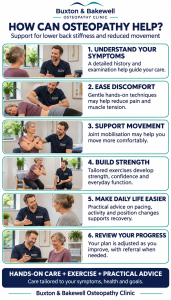
They should support a broader plan that includes exercise and practical advice.
At Buxton & Bakewell Osteopathy Clinic, this may mean combining treatment with a gradual return to walking, lifting or work duties.
We review whether care is helping you achieve meaningful goals and adjust the plan when needed.
🩺 What Happens During an Assessment?
We ask about the onset, location and behaviour of your pain.
Useful details include how far you can walk, which tasks provoke symptoms and how long discomfort takes to settle.
Your medical history, medication, previous injuries and general health also matter.
At Buxton & Bakewell Osteopathy Clinic, an osteopathy assessment is designed to identify the possible causes of your lower back pain, understand how your muscles and joints are functioning, and determine the most appropriate treatment approach.
| Assessment Stage | What Happens and Why |
|---|---|
| 🗣️ 1. Medical History | We discuss your symptoms, medical history, previous injuries and how your back pain affects everyday activities. |
| 📍 2. Understanding Your Pain | We establish where your pain occurs, when it started, what makes it worse and what provides relief. |
| 👀 3. Posture Assessment | We observe your standing and sitting posture, spinal alignment and pelvic position to identify possible contributing factors. |
| 🚶 4. Movement Testing | We assess bending, twisting, extending and side bending to identify stiffness, restricted movement or painful movements. |
| 💪 5. Muscle Assessment | We examine muscles supporting your lower back, including the erector spinae, quadratus lumborum and gluteal muscles, checking for tenderness, tension and functional weakness. |
| 🦴 6. Joint Assessment | We assess movement and tenderness in the lumbar spine, facet joints, pelvis and sacroiliac joints to identify possible sources of discomfort. |
| 🧠 7. Neurological Testing | Where indicated, we assess reflexes, muscle strength and sensation to investigate possible nerve irritation or compression. |
| 🦵 8. Special Orthopaedic Tests | Specific clinical tests may help assess suspected disc problems, nerve irritation, hip conditions or other causes of lower back pain. |
| 🩺 9. Diagnosis & Explanation | We explain our clinical findings, discuss the likely causes of your symptoms and whether further investigation, such as an MRI scan, is appropriate. |
| 🤝 10. Personalised Treatment Plan | We discuss suitable options, which may include osteopathy, rehabilitation exercises, IDD Therapy or other treatments where clinically appropriate. |
Why is a thorough assessment important?
Lower back pain does not always originate from the same structure. Muscles, ligaments, spinal joints, intervertebral discs and nerves can all contribute to pain, stiffness and restricted movement.
A thorough osteopathy assessment helps distinguish between these possible causes, identify signs requiring medical investigation and develop a treatment plan appropriate to your individual needs.
Our aim is not simply to identify where your back hurts, but to understand why it hurts and what can be done to help you recover.
🌄 Returning to Walking in the Peak District
Uneven paths, steep climbs and long descents place different demands on your body.
If you are returning after a flare-up, begin with a route that offers a manageable distance and an easy option to turn back.
Consider the whole outing, including travel, carrying a bag and the return journey. A comfortable outward walk can become difficult if fatigue builds before you head home.
Increase one aspect at a time, such as distance before adding steeper terrain.
For patients in Buxton, Bakewell and the wider Peak District, rehabilitation can be shaped around local walking goals and the activities that make outdoor life enjoyable.
🚨 When Activity-Related Symptoms Need Medical Attention
Arrange a medical assessment if pain persists, increasingly limits daily life or occurs with unexplained weight loss or persistent night pain.
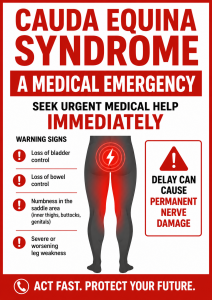
Go to A&E immediately for back pain with new bladder or bowel dysfunction, numbness around the genitals or anus, or severe or worsening weakness in both legs.
Pain after a serious accident also requires emergency assessment. Do not wait for a routine treatment appointment when these warning signs occur.
📍 Support for Activity-Related Back Pain in Buxton and Bakewell
You should not have to guess why walking, gardening or everyday movement has become difficult.
Understanding your symptom pattern can help you make sensible adjustments and identify the next step.
At Buxton & Bakewell Osteopathy Clinic, we provide assessment, appropriate osteopathic care and tailored rehabilitation to support your goals. Where necessary, we recommend further medical investigation.
Our Lower Back Pain Hub explores related symptoms, possible causes, diagnosis, treatment and recovery.
If activity regularly aggravates your lower back pain, contact the clinic to arrange an assessment and discuss a plan for returning to the activities that matter to you.