Detailed History: The First Step in Diagnosing Lower Back Pain in Buxton & Bakewell
Lower back pain can interrupt almost every part of daily life, from getting dressed to driving, gardening and sleeping comfortably. Yet two people describing “back pain” may have very different symptoms, concerns and treatment needs.

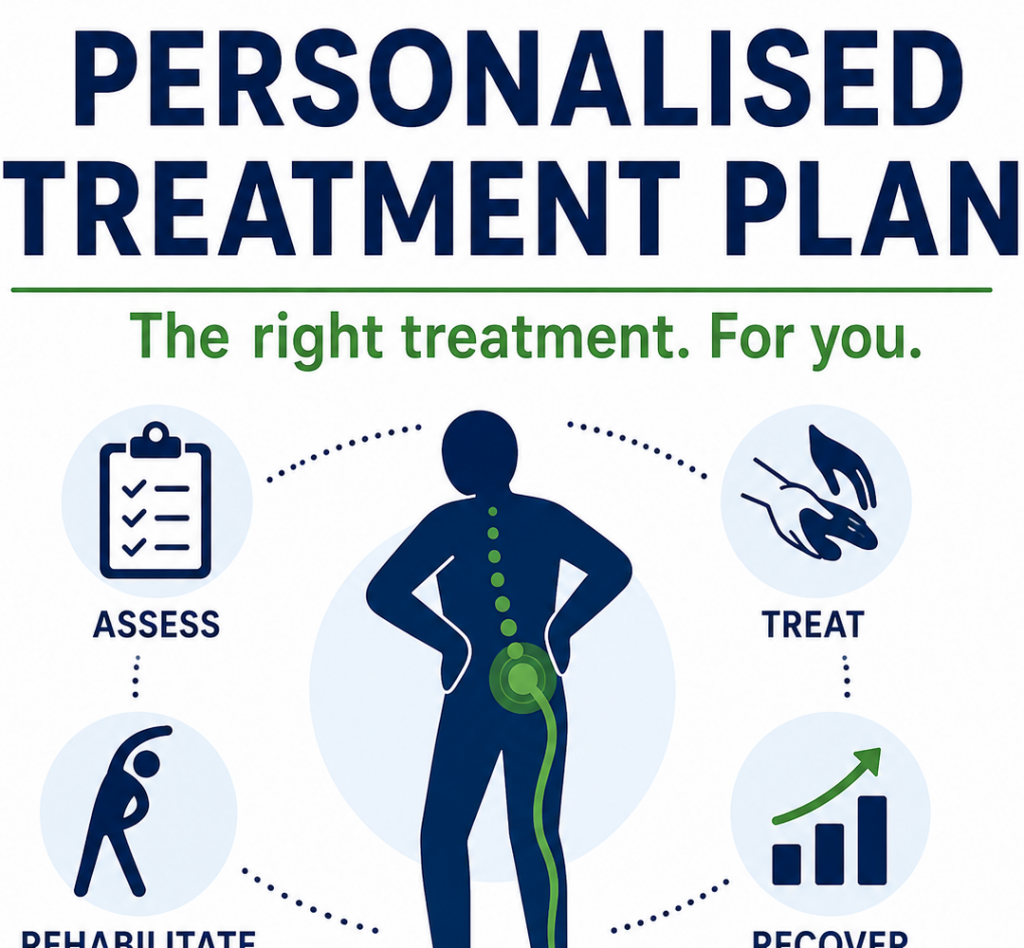
At Buxton & Bakewell Osteopathy Clinic, assessment begins with a detailed conversation. Before examining your spine, we want to understand what has happened, how you are feeling and what you hope to regain.
This is called taking a clinical history. It helps us identify patterns, recognise symptoms requiring medical attention and decide which examination findings will be most useful.
For patients across Buxton, Bakewell and the Peak District, this conversation provides the foundation for an individual assessment. Your experience matters: the diagnosis should reflect your symptoms and circumstances, rather than simply a label or scan report.
What Is a Detailed Clinical History?
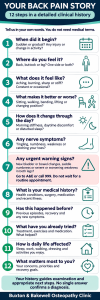
A clinical history is a structured discussion about your current symptoms, general health and everyday life.
We explore when the pain began, where you feel it, how it behaves and whether anything else has changed. We also ask about previous episodes, treatment, medication and medical conditions.
You do not need medical terminology or a perfectly remembered timeline. Describing the problem in your own words is helpful.
For example, “I can walk around the house, but my leg becomes numb on longer walks” tells us something different from “My back catches when I straighten after sitting.”
Neither description establishes a diagnosis by itself. Each helps us decide what to investigate during the examination.
1. When Did Your Back Pain Begin?
The starting point helps us understand the course of the problem.
Sometimes back pain can come our of nowhere without a dramatic injury. In reality, the spine and its supporting muscles and nerves are complex systems where microscopic stress or underlying issues can suddenly cross a threshold and trigger pain.
Sometimes symptoms appeared suddenly or gradually, and it might be your first episode or a familiar recurrence.
Did you fall over, lift a heavy pot in the garden, or did you have an unusually demanding day or do a new task that you are not used to? Did the pain start during an activity, later that evening or without an obvious trigger?
Back pain does not always have a single identifiable cause. Not remembering an injury is common and does not make your symptoms less real.
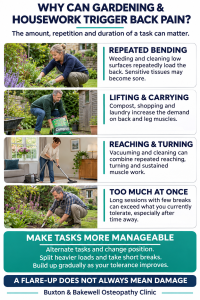
2. Where Do You Feel the Pain?
We ask you to show us the painful area specifically rather than relying only on a general description.
This is a useful clue but it is not a definitive diagnosis.
Pain location across the lower back often points to non-specific mechanical pain, such as a muscle strain, ligament sprain, or irritation of the local facet joints.
Pain travelling into the buttocksor legs or foot suggests a spinal nerve root issue
Pain can change with specific movements or postures. Knowing which movements and postures influence your pain is useful.
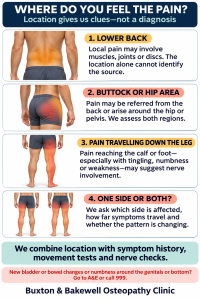
3. What Does the Pain Feel Like?
People use many words to describe discomfort: aching, pulling, burning, stabbing, throbbing or an electric sensation.
These descriptions help us understand your experience, particularly when combined with the location and timing of symptoms.
We may ask whether the pain is present constantly or comes in episodes. Does it feel superficial or deep? Is stiffness more troublesome than pain?
A pain score can provide a useful starting point, but it is only part of the picture.
Someone reporting moderate pain may be unable to sit through a working day. Another person with occasional sharper pain may still manage most activities. Both experiences deserve careful attention.
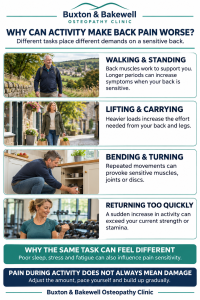
4. What Makes Symptoms Worse or Better?
The relationship between symptoms and activity is often informative.
We a use the Oswestry Pain Disability Index questionnaire. This has been designed to give us information as to how your back or leg pain is affecting your ability to manage in everyday life.
| Section | Area Assessed | What It Helps Measure |
|---|---|---|
| 1. Pain Intensity | Severity of pain | How significant the patient’s current pain is |
| 2. Personal Care | Washing, dressing and self-care | Whether back or leg pain interferes with basic daily activities |
| 3. Lifting | Lifting and carrying | How pain affects the ability to lift objects |
| 4. Walking | Walking ability | Whether symptoms restrict walking distance |
| 5. Sitting | Ability to sit comfortably | How long sitting can be tolerated before symptoms become limiting |
| 6. Standing | Ability to stand | Whether prolonged standing increases symptoms |
| 7. Sleeping | Sleep disturbance | How much back or leg symptoms interfere with sleep |
| 8. Social Life | Social and leisure activities | How symptoms affect normal social participation |
| 9. Travelling | Car and other journeys | Whether pain limits the ability to travel comfortably |
| 10. Employment / Homemaking | Work and everyday responsibilities | How symptoms affect normal occupational or household activities |
5. How Do Symptoms Change Throughout the Day?
The daily pattern adds another layer of information.
We may ask about stiffness on waking, discomfort after work, symptoms during rest and how long it takes to become comfortable after getting up.
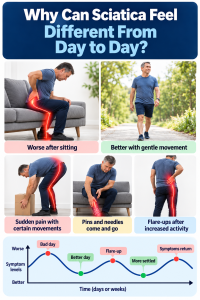
Morning stiffness is useful to discuss in detail. Does it last briefly, or persist? Does movement help? Are other joints affected?
Night symptoms also need context. Is pain brought on by turning over, or does it continue regardless of position? Are you otherwise feeling well?
Night pain has several possible explanations. We consider the whole history rather than treating one symptom as proof of a serious condition.
6. Are There Signs of Nerve Involvement?
If you describe leg symptoms, we ask specifically about tingling, numbness and weakness.
Practical examples are often especially useful: catching your toes, struggling to lift the front of your foot, difficulty rising onto your toes or feeling that a leg gives way.
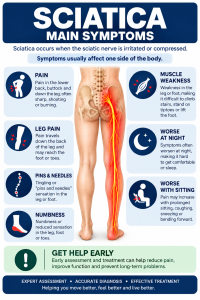
We want to know when these changes began, whether they are worsening and whether one or both legs are affected.
Pain can make movement feel difficult without true loss of muscle power. That is one reason reported weakness needs appropriate examination rather than assumptions.
Where indicated, a neurological assessment checks muscle strength, sensation and reflexes to build a clearer picture.
7. Which Symptoms Need Urgent Attention?
Some questions may seem personal, but they are important for identifying possible serious nerve compression.
We ask about new difficulty passing urine, changes in bladder or bowel control, and altered feeling around the genitals, anus or inner thighs. These changes are quite rare but they do not need to be screened for.

New or progressive weakness in one leg also needs prompt medical assessment.
Asking these questions is a routine part of safe assessment; it does not mean we expect everyone to have a serious problem.
8. What Is Your General Medical History?
Your wider health can influence what we do and the safest next step.
We may ask about significant issues that might be relevant to you such as osteoporosis, inflammatory conditions, previous fractures, infections, surgery and past significant illnesses or conditions.
This can also influence our treatment choices
Recent fever, unexplained weight loss, feeling generally unwell or a substantial change in symptoms should also be mentioned.
Medication matters too. Please tell us about prescribed medicines, over-the-counter products and supplements. Long-term steroid treatment and blood thinners are examples that may influence clinical decisions.
9. Have You Had Similar Problems Before?
Previous episodes can provide useful context, especially if the current symptoms feel familiar.
We ask how often flare-ups occur, how long they last and whether you return to your usual activities between them.
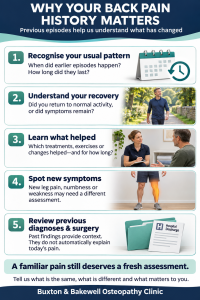
A previous diagnosis is helpful information, but it should not replace a fresh assessment. New leg symptoms or weakness may need a different approach from an earlier episode of local back stiffness.
We also discuss previous spinal surgery and any lasting changes in sensation or strength.
Knowing what is normal for you helps us recognise what is genuinely new and monitor it accurately.
10. What Treatment Have You Already Tried?
Please tell us about exercises, manual treatment, medication, injections and other approaches you have used.
We want to understand the response, not simply collect a list. Did treatment help you sleep, walk further or return to work? Did relief last, or were symptoms unchanged?
It is also useful to know whether anything caused a significant flare-up.
If you have tried exercises, describe the movements, frequency and how your symptoms responded afterwards.
This discussion helps us avoid repeating an approach without a clear reason. It also identifies strategies you found useful and any practical difficulties that made a previous plan hard to follow.
13. What Are Your Concerns and Recovery Goals?
We ask what worries you most and what you believe may be happening.
You may fear that movement will cause damage, feel anxious about a scan report or worry about being unable to work. These concerns deserve an explanation, not dismissal.
We also discuss sleep, stress, support at home and the practical demands on your time. These factors can affect how manageable a care plan feels.
Talking about them does not suggest that pain is imaginary.
Your goals might include returning to gardening, managing the drive to work or sleeping with fewer interruptions. Agreeing priorities helps make treatment decisions more useful and collaborative.
How Does the History Guide Examination?
The conversation helps us choose which physical checks are most relevant and how gently to begin.
Depending on your symptoms, examination may include observing walking, checking spinal and hip movement, testing strength and assessing reflexes or sensation.
We compare what you report with what we find. If the findings do not fit the expected pattern, we reconsider rather than forcing them into a familiar diagnosis.
Sometimes the most appropriate description is non-specific lower back pain: the assessment does not identify one particular structure as the definite cause.
A useful clinical explanation can still guide care without claiming certainty that the evidence does not support.
Does a Detailed History Replace an MRI?
No. History, examination and imaging answer different questions.
However, most uncomplicated lower back pain does not require routine imaging.
An MRI is considered when there is a clear clinical reason and the result is likely to influence management.
A scan can show structural changes, but those findings need to fit your symptoms and examination.
At our clinic, MRI referral begins with an assessment by Phil. If a private MRI scan is appropriate, we explain the clinical question and how the result could affect the next steps.
Emergency symptoms require hospital assessment rather than a routine private scan pathway.
How Can You Prepare for Your Appointment?
A few notes can help, particularly when symptoms have been present for some time.
Bring an approximate timeline, your medication list and relevant reports from previous investigations. Note any changes in walking, sensation, strength or bladder and bowel function.
Think about two or three activities you most want to improve.
You can also describe what you have already tried and what happened afterwards. There is no need to repeatedly provoke symptoms or perform difficult tests before attending.
Tell us if you need extra time, written explanations, a companion or another adjustment to make the appointment easier.
A History That Continues as You Recover
History-taking does not end after the first appointment.
At follow-up visits, we review changes in symptoms, daily function, exercise tolerance and any neurological concerns. New information may alter the working diagnosis or indicate a need for further investigation.
At Buxton & Bakewell Osteopathy Clinic, listening carefully is part of making informed decisions about your care.
Whether you live in Buxton, Bakewell or elsewhere in the Peak District, a detailed history helps us understand your individual problem, explain the findings and agree appropriate next steps.
To arrange an assessment, visit buxtonosteopathy.co.uk.