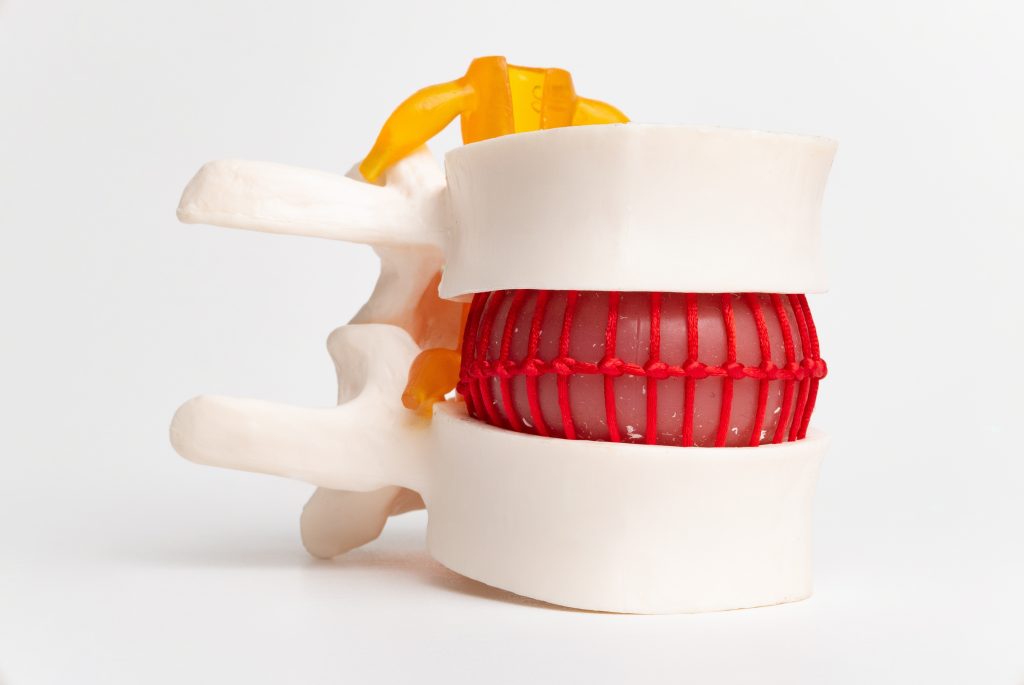
Osteoporosis, Modic Changes and Vertebral Compression Fractures: Understanding Bone-Related Lower Back Pain
When we get lower back pain, we often assume it’s a tight muscle, an injured or worn joint or a disc. This is certainly not always the case
It is easy to forget that the foundation stones that give our spines its structural can also crack, erode, and become a hidden source of pain. There are three important architectural threats to our spines that deserve a closer look: osteoporosis, Modic changes, and vertebral compression fractures.
While each weakens the structural strength of our skeletal scaffolding in different ways, they all can trigger a deep, persistent lower back pain.
At Buxton & Bakewell Osteopathy Clinic we know identifying the exact root cause of your spinal pain is vital before starting any treatment. For our patients across Buxton, Bakewell, and the Peak District, we know when back pain is generated from a minor rebellion in your surrounding muscles or discs. We also know when it isn’t. Stripping back the mystery of these conditions empowers you to recognize the warning signs, understand when to seek deeper diagnostic scans, and confidently navigate your road to recovery.
Understanding the Vertebral Bones
Inside each of our 24 vertebra there is a network of fine, interconnected bony struts known as trabecular bone which provide a honeycomb like structure. This internal framework provides strength without making the bones excessively heavy. Osteoporosis causes this honeycomb network to deteriorate making the bones susceptible to compression fractures.
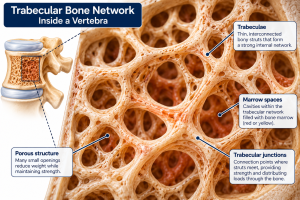
The vertebral bodies are also closely connected to the intervertebral discs through thin layers of bone and cartilage called vertebral endplates
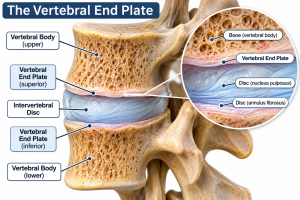
Vertebral endplates can become damaged and inflammed over time and are called Modic changes. Modic changes were first described by Dr Michael Modic in 1988.
Osteoporosis: When the Spinal Bones Become Weaker
Osteoporosis is a condition in which bones become less dense and structurally weaker, increasing their susceptibility to fractures.
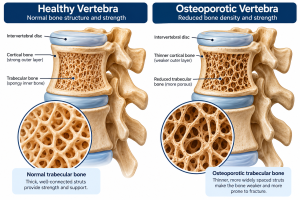
Healthy bone is constantly renewed through a continual remodeling process. Older bone tissue is removed and replaced with new bone.
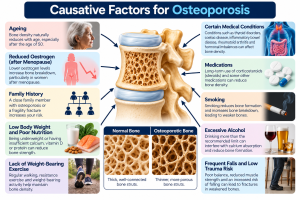
As we age, this balance can change. Bone may be broken down faster than it can be replaced, gradually reducing bone density and strength.
Osteoporosis becomes more common with increasing age, particularly in women after menopause, although men can also develop the condition.
What causes osteoporosis?
Does osteoporosis cause lower back pain?
One important distinction is that osteoporosis itself does not usually cause pain.
Many people are unaware that their bones have weakened until they sustain a fracture.
However, when osteoporosis leads to a vertebral compression fracture, people can develop sudden or persistent lower back pain.
Other possible signs of vertebral fractures include a reduction in height, increasing curvature of the upper back and difficulty standing upright.
For patients in Buxton, Bakewell and the surrounding Peak District, recognising these signs is particularly important as early investigation can help prevent further fractures.
How is osteoporosis diagnosed?
A DEXA scan is commonly used to measure bone mineral density and assess whether a patient has osteoporosis. We can help organise you a DEXA scan.
Vertebral Compression Fractures: When a Spinal Bone Collapses
A vertebral compression fracture occurs when one of the bones in the spine becomes compressed or partially collapses.
These fractures commonly develop in people with osteoporosis because weakened vertebral bodies are less able to withstand normal mechanical forces.
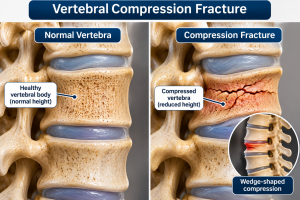
In a healthy spine, vertebrae can tolerate considerable loading. However, when bone strength deteriorates, even minor things like turning over in bed or a sudden twist may occasionally produce a fracture.
Some patients develop compression fractures following a fall, while others experience symptoms after bending, lifting or even coughing.
What happens during a compression fracture?
The vertebral body loses some of its normal height, often becoming wedge-shaped.
This changes the distribution of forces through the spine and can place additional strain on surrounding muscles, ligaments and joints.
When several vertebrae become compressed, the spine may gradually develop an increased forward curvature, known as kyphosis.
This can affect posture, balance and the ability to perform everyday activities.
Common Symptoms of Vertebral Compression Fractures
| Symptom | What patients may experience |
|---|---|
| 🔴 Sudden Back Pain | Sharp or intense pain following a minor movement or fall. |
| 🎯 Localised Tenderness | Pain around the affected vertebra. |
| 🧍 Pain When Standing | Discomfort when the spine bears weight. |
| ↪️ Difficulty Bending | Increased pain with certain movements. |
| 📏 Height Loss | Gradual reduction in overall height. |
| 🚶 Postural Changes | Increasing forward curvature of the spine. |
| ⚡ Muscle Spasms | Protective tightening of surrounding muscles. |
🩺 Important: Vertebral compression fractures can sometimes occur with surprisingly little pain, particularly in patients with osteoporosis. Sudden back pain following even a minor movement in someone with weakened bones should prompt medical assessment.
Treatment for vertebral compression fractures
Treatment depends on fracture severity, symptoms and your overall health and requires medical assessment. Osteoporosis requires bone-strengthening medication to reduce the risk of further fractures.
Modic Changes: Changes Within the Vertebral Bones
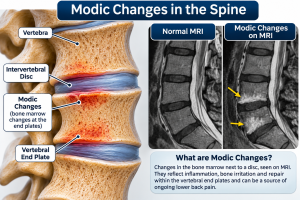
Although disc degeneration receives a great deal of attention, the vertebral endplates and adjacent bone marrow can also be involved in lower back pain.
Modic changes are particularly interesting because they demonstrate how degenerative spinal problems can involve the bone itself, not simply the disc.
What causes Modic changes?
The precise mechanisms are still being investigated.
One important theory involves mechanical stress and damage to the vertebral endplates.
As an intervertebral disc degenerates, its ability to absorb and distribute forces evenly may change. Increased mechanical stress can contribute to endplate damage and alterations in the adjacent bone marrow.
Inflammatory processes may also contribute, particularly in Type 1 Modic changes.
However, it is important to understand that Modic changes do not automatically mean a person will experience pain. They can also be identified in individuals without significant symptoms.
The three types of Modic changes
| Type | Changes within the vertebra | Clinical significance |
|---|---|---|
| Type 1 | Bone marrow oedema-like and inflammatory changes | More strongly associated with lower back pain in some studies |
| Type 2 | Fatty replacement of normal bone marrow | Often associated with more established degenerative changes |
| Type 3 | Increased bone hardening or sclerosis | Less common; associated with chronic structural changes |
What symptoms can Modic changes cause?
| Symptom | What Patients May Experience | |
|---|---|---|
| 🔴 | Persistent Lower Back Pain | Deep, aching pain in the lower back that may persist for weeks or months. |
| 🌅 | Morning Stiffness | Stiffness and discomfort when first getting out of bed, sometimes improving with gentle movement. |
| 🪑 | Pain When Sitting | Increased discomfort during prolonged sitting, particularly when bending forwards. |
| 🏋️ | Pain When Bending or Lifting | Lower back pain aggravated by activities that place additional mechanical stress on the spine. |
| 🌙 | Pain at Night | Some patients experience discomfort when lying down or changing position in bed. |
| 🚶 | Reduced Mobility | Difficulty bending, twisting or performing everyday activities because of pain. |
| ⚡ | Episodes of Increased Pain | Fluctuating symptoms, with periods of increased discomfort followed by improvement. |
| 📍 | Localised Lower Back Pain | Pain concentrated around the lumbar spine, occasionally extending into the buttocks or hips. |
Can Modic changes be treated?
Treatment generally focuses on improving function, reducing pain and addressing contributing mechanical factors.
Depending on the individual, this may include supervised exercise, progressive strengthening, activity modification and appropriate pain management.
Osteopathy may help some patients manage associated muscular or joint-related symptoms, although it has not been shown to reverse Modic changes.
At Buxton & Bakewell Osteopathy Clinic, we place particular emphasis on understanding MRI findings alongside the patient’s symptoms rather than assuming every abnormality seen on a scan is responsible for their pain.
How Do These Three Conditions Differ?
Although osteoporosis, Modic changes and vertebral compression fractures all involve the vertebral bones, they represent different processes.
| Condition | Main problem | Relationship to pain |
|---|---|---|
| Osteoporosis | Reduced bone strength | Usually painless unless a fracture occurs |
| Modic changes | Alterations in the vertebral endplates and adjacent bone marrow | May be associated with persistent lower back pain |
| Compression fracture | Partial collapse of a vertebral body | Can cause sudden or persistent pain |
Understanding these differences is essential because the most appropriate treatment for one condition may be unsuitable for another.
For example, a patient with Modic changes and persistent mechanical back pain may benefit from progressive rehabilitation, while someone with a recent osteoporotic fracture may require medical management and a more cautious approach.
When Should Lower Back Pain Be Investigated?
Not every episode of lower back pain requires an MRI scan or other imaging.
However, further investigations may be appropriate when symptoms or clinical findings suggest a fracture, significant bone disease or another serious underlying condition.
A DEXA scan helps assess bone density, while X-rays, MRI or CT may be used to investigate suspected vertebral fractures depending on the clinical circumstances.
MRI is particularly useful for examining vertebral marrow changes, including Modic changes, and may help distinguish recent fractures from older injuries.
Protecting Your Spinal Health as You Age
Maintaining strong bones and healthy spinal muscles becomes increasingly important with age.
Regular weight-bearing exercise, resistance training, adequate dietary calcium and vitamin D, and avoiding smoking can all support long-term bone health.
For people with osteoporosis, exercises should be tailored to individual fracture risk. Strengthening the back muscles and improving balance can be particularly valuable.
The 2024 UK osteoporosis guideline supports progressive muscle strengthening, including back extensor exercises, following vertebral fractures as part of appropriate rehabilitation.