As we age, it’s common to notice more stiffness, soreness, or discomfort in the lower back. But while back pain is frequent in later life, it isn’t something you have to accept as inevitable. At Buxton & Bakewell Osteopathy Clinic, we specialise in helping older adults stay mobile, comfortable, and confident — using safe, effective, and evidence-based treatments.
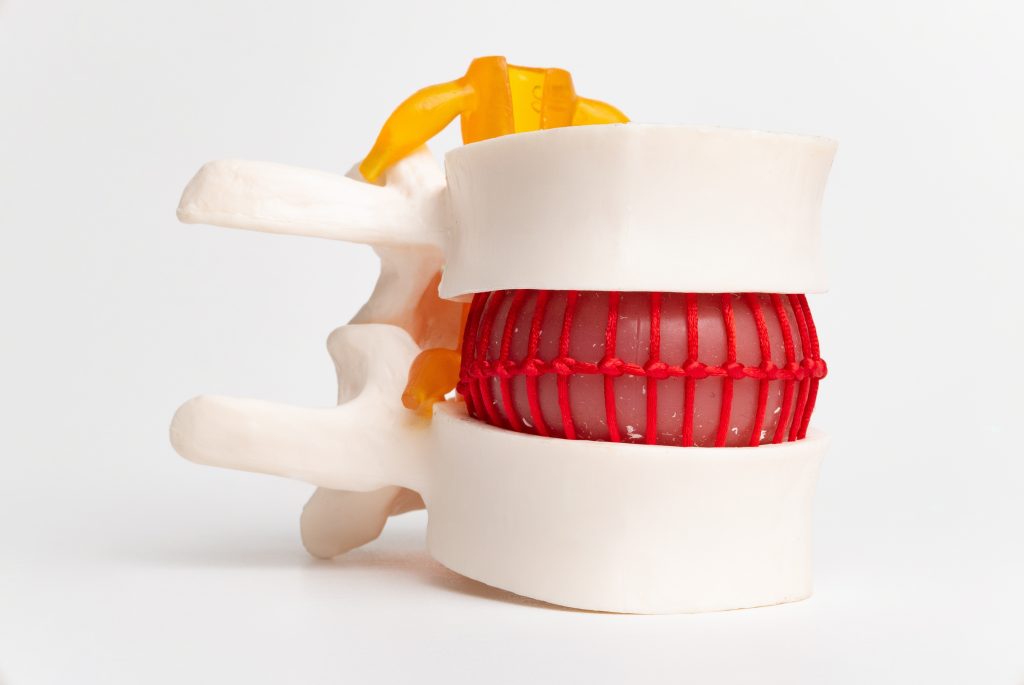
Back pain in older adults often develops because of gradual changes in the spine and joints. Over time, the intervertebral discs lose hydration and elasticity (degenerative disc disease) , the facet joints can become arthritic, and ligaments stiffen and muscles weaken, reducing core support. These natural ageing processes can cause pain, stiffness, or nerve irritation — especially after sitting or standing for long periods.
Wear and tear in spinal facet joints, intervertebral discs and spinal liagments can cause other issues such as spinal stenosis or a spondylolisthesis.
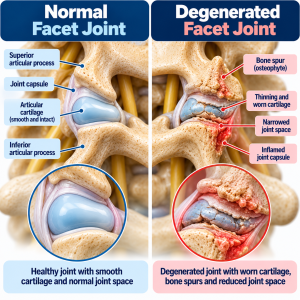
Spinal Facet Joints
Facet joints wear out over time. As our intervertebral discs change over time and loose height and dessicate, there is more loading of our spinal joints.
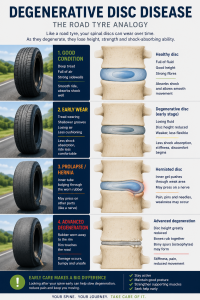
Our 23 intervertebral discs are roughly circular with a nucleus that is surrounded by rings of tough fibrocartilage called annulus fibrosis.
An intervertebral disc is analogous to a car tyre that loses air and wears over time.
When we are young our spinal discs are inflated just like new thick tyres. They act as perfect shock absorbers that give us a smooth ride.
As the thousands of miles roll on, our tyres naturally loose a bit of air and in the same way our 23 discs gradually lose their ability to hold water. Our discs slowly shrink, flatten out, become more brittle and do not absorb stress as well as they used to.
Constant stress from hard work, materials handling, lifting, repetitive tasks and bad posture wears the tough annulus fibrosis causing tiny micro-tears.
At some point our tyre may hit an unexpected large pothole (not difficult these days!) and the inner tube can bulge through the tyre wall (a great metaphor for a herniated disc). If the tyre goes completely flat the metal rims begin to contact the road surface ( a metaphor for a shrinking degeneraive disc ) this is when the spine grows bony spurs to protect itself from friction caused by the loss of disc height. This is because of increased load and mechanical stress. This causes pain and stiffness.
Living with degenerative disc disease can be frightening. Persistent lower back pain, sciatica, numbness, tingling or weakness in your legs can make everyday activities feel impossible. Many people worry that disc degeneration automatically means they will eventually need surgery.
The good news is that this is rarely the case.
Common Symptoms of a Degenerative Disc
As intervertebral discs gradually lose water content, height and flexibility, they become less effective at distributing loads through the spine. Although disc degeneration is a normal part of ageing and often causes no symptoms, some people develop persistent back pain, stiffness or nerve-related symptoms.
| 🔍 Symptom | 📋 Description |
| 🦴 Lower Back Pain | Aching or discomfort in the lower back, sometimes persistent. |
| 🪑 Pain When Sitting | Discomfort that may increase during prolonged sitting. |
| ↘️ Pain When Bending | Pain when bending forwards, lifting or twisting. |
| 🌅 Morning Stiffness | Stiffness or reduced flexibility after sleeping. |
| 🔄 Pain When Changing Position | Discomfort when rising from sitting or turning in bed. |
| ⚡ Buttock Pain | Pain that may spread into one or both buttocks. |
| 🦵 Referred Leg Pain | Aching extending into the thigh, sometimes without nerve compression. |
| 🚶 Pain During Activity | Symptoms that may increase with certain movements or repeated loading. |
| 💪 Muscle Tightness | Protective muscle guarding or spasms around the lower back. |
| 📉 Reduced Flexibility | Difficulty bending, twisting or moving comfortably. |
| 🔁 Flare-Ups | Periods of increased pain followed by improvement. |
| 🛌 Pain After Rest | Discomfort or stiffness when moving after inactivity. |
⚡ When Degenerative Changes Affect a Spinal Nerve
If disc height loss, a herniation or associated narrowing compresses a nerve, additional symptoms may include:
| ⚡ Sciatica | Shooting or radiating pain into the leg. |
| 📍 Pins and Needles | Tingling in the leg or foot. |
| 🦶 Numbness | Reduced sensation in part of the leg or foot. |
| 💪 Muscle Weakness | Reduced strength if a spinal nerve is affected. |
💡 Important to Understand. A degenerative disc does not necessarily cause pain. Many people have significant disc degeneration on an MRI scan without experiencing any symptoms.
When symptoms do develop, they can overlap with those caused by facet joint arthritis, muscular strain, spinal stenosis or a herniated disc. A thorough clinical assessment is therefore important.
Stiffening Spinal Ligaments (Ligamentun Flavum Hypertrophy)
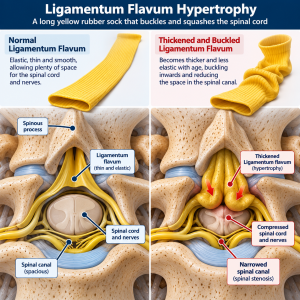
The ligamentum flavum is a strong, elastic ligament that connects neighbouring vertebrae along the back of the spinal canal. Its main role is to support spinal stability, control movement and help the spine return to its normal position after bending forwards.
What Is Ligamentum Flavum Hypertrophy?
As we age, the ligamentum flavum can gradually become thicker, stiffer and less elastic. This process, known as ligamentum flavum hypertrophy, occurs partly because the ligament’s elastic fibres deteriorate and are replaced by tougher fibrous tissue.
Degenerative disc disease can also contribute. As spinal discs lose height, the ligamentum flavum may buckle inwards, further reducing the space available for spinal nerves. This can squash the spinal cord and cause spinal stenosis.
Spinal stenosis
A great metaphor for spinal stenosis is the scenario of the shrinking tunnel. This is caused by worn facet joints and degenerative disc and stiffening ligaments.
The road running through the tunnel is your spinal cord and actual the tunnel is made up of all spinal architecture that surrounds it.
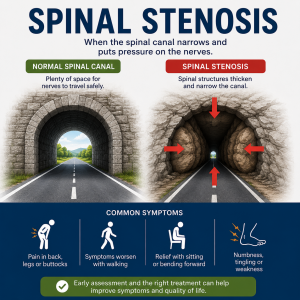
The traffic running through the tunnel comprises the signals that run down the spinal cord from the central nervous system (or our brain). Normally, in a healthy spine, the tunnel is wide and the traffic runs freely.
What Causes Spinal Stenosis?
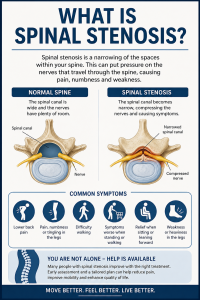
Spinal stenosis occurs when spaces within the spine become narrower, potentially placing pressure on the spinal cord or spinal nerves. It most commonly develops gradually through age-related degenerative changes affecting the discs, facet joints, ligaments and vertebrae.
| 🔍 Cause | 🦴 How It Narrows the Spine |
| 🦴 Facet Joint Arthritis | Enlarged, arthritic joints can narrow the spinal canal or nerve passages. |
| 🪨 Bone Spurs (Osteophytes) | Extra bone growth can extend into spaces around spinal nerves. |
| 📉 Degenerative Disc Disease | Loss of disc height can reduce the space available for exiting nerves. |
| 💿 Bulging or Herniated Disc | Disc material can protrude into the spinal canal or nerve passages. |
| 🔗 Ligamentum Flavum Thickening | Thickened or buckled ligaments can narrow the spinal canal. |
| ↔️ Spondylolisthesis | A vertebra slips forwards or backwards, potentially narrowing nerve spaces. |
💡 Important: Spinal stenosis often develops through a combination of degenerative changes rather than a single cause. For example, a worn disc, enlarged facet joints and thickened ligaments can collectively reduce the space available for spinal nerves.
Three Main Types of Spinal Stenosis
| Type | Where Narrowing Occurs |
| 🦴 Central Canal Stenosis | Narrowing of the main spinal canal, potentially affecting the spinal cord or nerve roots. |
| ⚡ Lateral Recess Stenosis | Narrowing where a spinal nerve travels before exiting the spine. |
| 🔍 Foraminal Stenosis | Narrowing of the opening through which a spinal nerve exits. |
Degenerative Spondylolisthesis
A spondylolisthesis is when a vertebra loses secure contact with the block above and below, becomes unstable. Worse still is that because it has slipped forwards it narrows the gap for spinal nerves to exit the spinal cord. This can be a reason for sciatic pain.
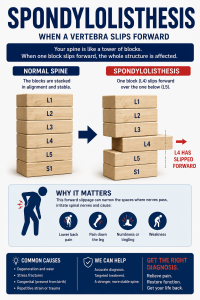
For some people this causes very little discomfort (it may be stable) , while for others it can lead to persistent lower back pain, sciatica, nerve compression and difficulty walking.
The amount of movement can vary considerably. Some slips measure only a few millimetres and never become problematic, whereas larger slips can narrow the spaces where nerves travel, leading to irritation or compression.
The condition most commonly affects the lower lumbar spine, particularly:
- L4-L5
- L5-S1
These are the most mobile segments of the spine and therefore experience the greatest mechanical stress during everyday activities.
Causes of Spondylolisthesis
Spondylolisthesis occurs when one vertebra slips forwards or backwards relative to the vertebra beneath it. Several factors can contribute, including age-related degeneration, joint arthritis, repetitive stress and spinal injuries.
| 🔍 Cause | 🦴 How It Causes Vertebral Slippage |
| 👴 Ageing | Discs lose water, ligaments change and facet joints wear, reducing spinal stability. |
| 📉 Disc Degeneration | Discs lose height and structural support, allowing vertebrae to shift. |
| 🦴 Facet Joint Arthritis | Worn and enlarged facet joints may become less effective at maintaining spinal alignment. |
| 🏋️ Repetitive Stress | Repeated backward bending can cause stress fractures in the pars interarticularis, particularly in young athletes. |
| 💥 Trauma | Falls, fractures or accidents can damage spinal structures and cause instability. |
Important: Spondylolisthesis has several different types. Degenerative spondylolisthesis is more common in older adults and is associated with disc and facet joint degeneration. Isthmic spondylolisthesis is associated with a defect or stress fracture in the pars interarticularis, sometimes caused by repetitive spinal extension.
Not everyone with spondylolisthesis experiences pain. However, when vertebral slippage narrows the spaces around spinal nerves, it can contribute to lower back pain, sciatica or spinal stenosis.
This compact, emoji-enhanced table is suitable for your Lower Back Pain Hub and Spinal Stenosis Program.
Why Does a Spondlolisthesis Cause Sciatica?
This is one of the most important questions patients ask.
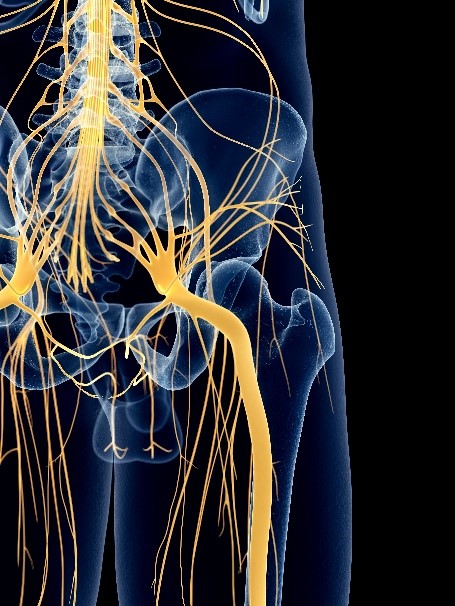
Sciatica develops when the sciatic nerve—or one of the nerve roots that forms it—becomes irritated or compressed.
With spondylolisthesis, the forward movement of one vertebra can narrow the openings where nerves leave the spine, known as the foramina. At the same time, age-related changes such as disc degeneration, thickened ligaments or arthritic facet joints may further reduce the available space.
As a result, the nerve root can become compressed, producing symptoms such as:
- pain travelling into the buttock
- pain down the back or side of the leg
- pins and needles
- numbness
- burning pain
- weakness
- altered reflexes
Because the sciatic nerve is formed from several nerve roots in the lower spine, compression at the L4-L5 or L5-S1 levels can create the classic symptoms many people recognise as sciatica.
Unlike ordinary back pain, nerve pain often travels below the knee and may even reach the foot or toes.
Our experienced osteopaths take a whole-body approach, identifying not only where your back hurts but why. Through gentle hands-on treatment, soft tissue release, and tailored rehabilitation exercises, we restore natural movement and reduce pain.
We also offer advanced technology to enhance recovery:
✅ IDD Therapy – a precise, non-surgical spinal decompression system that relieves pressure on discs and nerves.
✅ Focused & Radial Shockwave Therapy – a cutting-edge treatment that stimulates healing, reduces inflammation, and improves mobility.
The lower back (or lumbar spine) enables most of our daily duties and is therefore the focus of trauma too. Unfortunately these demands understandably impose considerable demands on the lower back and all its accompanying structures
Your upper body is approximately two thirds of your body weight and as you lean forwards simple physics dictates that large forces will be generated. Because of these effects accumulated over time the lower back is a common focal point for wear and tear (more often referred to as lumbar spondylosis).
As we grow older, the effects of ageing and everyday use cause wear to the vertebra, facet joints, discs and soft tissues that make up the spine. So, what are the most common effects?