Muscle and ligament pain in the spine is of course one of the most frequent causes of ongoing back discomfort. Whether it appears suddenly after lifting or builds gradually from poor posture, this type of pain can affect movement, sleep, and daily life.
Our spines rely on a network of muscles to provide strength, stability, flexibility and movement. Each muscle group plays an important role in keeping your back healthy.
| 💪 Muscle Group | 🎯 Main Function |
| 🏋️ Erector Spinae | Keeps your back upright and helps you bend backwards. |
| 🛡️ Multifidus | Stabilises individual vertebrae. |
| 🔄 Rotatores | Assist spinal rotation and control. |
| 🔗 Interspinales | Help stabilise neighbouring vertebrae. |
| ↔️ Intertransversarii | Support side bending and stability. |
| 🙆 Semispinalis | Helps extend and rotate the neck and spine. |
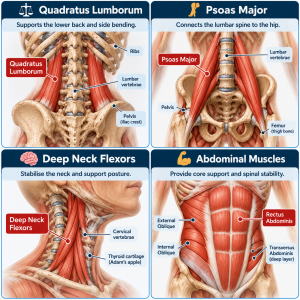
| ⚖️ Quadratus Lumborum | Supports the lower back and side bending. |
| 🦵 Psoas Major | Connects the lumbar spine to the hip. |
| 🧠 Deep Neck Flexors | Stabilise the neck and support posture. |
| 💪 Abdominal Muscles | Provide core support and spinal stability. |
💡 Did You Know?
Your deep spinal muscles work continuously to help stabilise your vertebrae, even during simple activities such as standing, walking and sitting.
🦴 Your Spine – An Amazing Network of Bones, Muscles and Ligaments
👶 Did you know that we are born with approximately 33 vertebrae? As we grow, some of these bones gradually fuse together, leaving us with 24 individual movable vertebrae in adulthood, plus the sacrum and coccyx.
💪 But your spine is much more than a collection of bones! It is supported by an extraordinary network of muscles, tendons and ligaments that work together to provide strength, flexibility and stability.
🔗 Your spinal muscles and ligaments vastly outnumber your vertebrae. Hundreds of individual muscular and ligamentous connections help control movement, support your posture and protect your spinal structures.
⚡ With so many muscles working together, it’s hardly surprising that muscular strains are a common cause of back pain. In fact, research suggests that up to 80% of people experience lower back pain at some point in their lives.
Deep Spinal Muscles
Helping you understand your spine, manage back pain and keep moving comfortably.
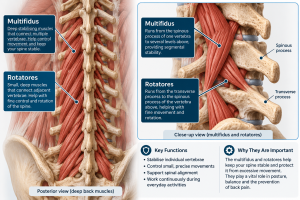
The deepest layers of our spinal muscles—the rotatores and the multifidus—are tiny microscopic structures often just bridging the gap across just one single vertebra. Their job is to act as stabilisation network for our spine and keep us standing up. These tiny muscles don’t do the heavy lifting but they adjust constantly without us ever thinking about it to keep.
Intermediate Layer of Muscles
The deeper land intermediate layers of our back muscles work together like a sophisticated, complex girdle, providing strength, stability and support for your spine.
One of the most important muscle groups is the erector spinae, made up of three main muscles: the iliocostalis, longissimus and spinalis. These extend along much of your spine, helping you maintain an upright posture, bend backwards and control everyday movements.
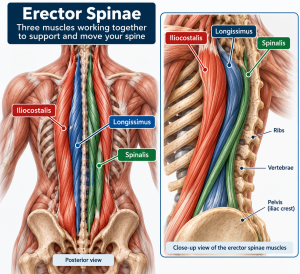
Core Stabilising muscles
Our core stabilizing muscles help maintain our posture. These provide structural support, spinal alignment, and postural stability rather than just generating large movements. They constantly work against gravity to keep our spine aligned and stable.
🏥 Buxton & Bakewell Osteopathy Clinic
Helping you move better and understand your spine.
This version keeps the two-column, mobile-friendly layout, with emojis to help patients quickly recognise the different functions of their spinal muscles.
At Buxton & Bakewell Osteopathy Clinic, our experienced osteopaths specialise in diagnosing and treating the underlying causes of back muscle and ligament pain. Using a combination of hands-on osteopathic care, targeted rehabilitation, and advanced technology such as Shockwave Therapyand IDD Therapy, we help patients across Derbyshire regain comfort, mobility, and confidence in their spine.
Understanding Back Muscle and Ligament Pain
Your back is supported by a network of muscles, tendons, and ligaments that keep the spine stable and allow fluid movement. When these soft tissues become strained, torn, or inflamed, they can cause significant pain — often without obvious injury.
Common causes include:
-
Overstretching or sudden twisting movements
-
Poor lifting technique
-
Long hours of sitting or postural imbalance
-
Repetitive strain or overuse
-
Weak core or gluteal muscles
How Muscle and Ligament Pain Affects the Spine
When muscles or ligaments become injured, they may tighten to protect the area — leading to stiffness and limited movement. Over time, this protective tension can disrupt normal spinal alignment, compress joints, and cause pain to spread into the neck, shoulders, or hips.
At Buxton & Bakewell Osteopathy Clinic, our approach goes beyond symptom relief. We assess how the whole body moves to identify where the imbalance begins, then use osteopathic treatment to restore natural spinal function.
Lower Back Muscles Explained
Briefly there are three groups of muscles in the lower back. These, quite simply, allow us to bend forwards, backwards and side to side.
The main spinal muscles allowing us to bend forward movement are the flexor muscles in the lower back. These attach to the front of the spine and enable bending forward, lifting, and arching the lower back. The key muscle in this category is the psoas muscle. Essentially the psoas helps pull the vertebra at the bottom of your back forward and down.
Our psoas muscle is very important because it helps to create the curve in your lower back. This curve helps absorb and transfer weight from the lower to your upper limb as you walk by absorbing stress. Many injuries are sustained by lifting and these injuries can involve the psoas as it has a key role.
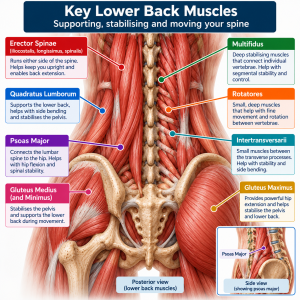
One of the main muscle groups allowing us to bend backwards are the extensor muscles. The erector spinae and the multifidis muscle groups are attached to back of the spine and have key roles in maintaining our posture.
As we lean forwards they elongate and stretch under load eccentrically and contract and shorten as straighten up (or concentric contraction). They are often involved in acture strains.
The Quadratus Lumborum (QL) muscle has a vital role in side bending your spine. The QL is a deep muscle that runs on both sides of the lower back. The QL is responsible for stabilising the lower back while upright and has a role in side bending. This muscle is often injured or strained if lifting includes rotation (i.e. bending and twisting).
Mid-back Muscles Explained
The most common cause of mid-back pain comes from muscular related issues or other soft tissue structures. These problems can arise from different scenarios ranging from poor posture, such as prolonged sitting at a work station, heavy lifting or traumatic incidents in contact sports.
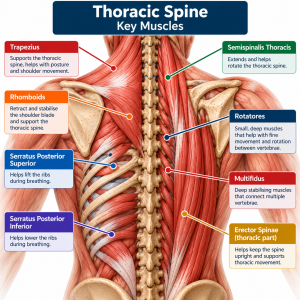
The correct term for the middle of the spine is the thoracic spine and this comprises twelve vertebrae and twelve sets of ribs. Allied to these structures is the shoulder blade which acts in unison with shoulder movement. This is because the main shoulder socket (called the glenoid) has a bony connection with the shoulder blade and is actually part of the same structure.
Not many of us realise that the shoulder blade does not attach to the skeleton (apart from one tiny joint that joins the collar bone). The shoulder blade is therefore, out of necessity, surrounded by and encapsulated in heavy musculature. This enables it to serve as an anchor when the muscles contract, so we can move our arms freely when required (many of these muscles are seen in the diagram below). The most important muscles in this group include the Rhomboids (on the inside of the shoulder blade), the Trapezius muscle (seen in red below) and Latissmus dorsi.
The shoulder blade is integral to any shoulder movement involving throwing or lifting. Many of the muscles associated with these movements can generate what can feel like spinal pain.
Another important point is that muscles responsible for rotation/movement in the neck can also be a source of pain to the upper back.
Lastly, it is also worth remembering that soft tissue symptoms in this area can also be allied with rib or spinal joint pain (refer spinal joint pain).
Key Back Ligaments Explained
A ligament is a tough band of tissue that restricts excessive movement and connects two bones. The spinal ligaments obviously connect the vertebrae of the spine together and provide stability for posture and spinal movement of our spines. They also help connect the spine to the pelvis.
There is no doubt that ligament damage contributes to lower back pain. However, it is very hard to diagnose ligament pain specifically because there are no conclusive valid tests to achieve a diagnosis.
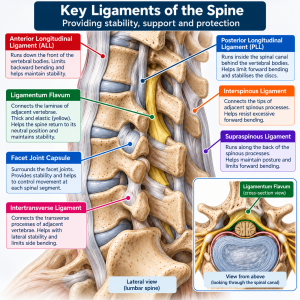
The strongest ligament in the lower back is the iliolumbar ligament, which anchors the bottom vertebra in position. Some preliminary studies demonstrate a 10-14% involvement in typical presentations relating to lower back pain. However, much of the current data remains inconclusive.
In the pelvis itself, the sacrum and the iliac bones (ileum) are held together by an extensive collection of strong ligaments. These can be damaged and are a potential source of lower back pain. Some studies suggest that the prevalence of SI joint pain accounts for up to 20% of chronic back pain presentations.
One of the most significant ligaments in the spine is the ligamentum flavum (flavum means yellow and this is really is the colour of this specific ligament). The ligamentum flavum is a short but thick ligament that connects vertebrae together. Its elasticity serves to preserve our upright posture.
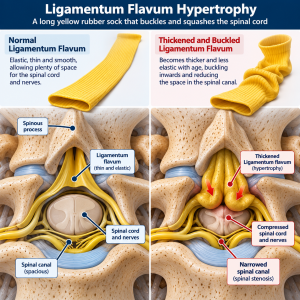
This ligament however can become inflamed due to stress on the spine and this often occurs in people over the age of 50 due to the natural degeneration process of the spine. As the structures in the spine degenerate stress increases on the ligamentum flavum.
When this happens cells in the ligament become inflamed (hypertrophy) and begin to ossify or thicken. This increase in size and decrease in elasticity occasionally combine to reduce the area available for nerve roots and the spinal cord to pass (spinal stenosis).
This ligament however can become inflamed due to stress on the spine and this often occurs in people over the age of 50 due to the natural degeneration process of the spine. As the structures in the spine degenerate stress increases on the ligamentum flavum.
When this happens cells in the ligament become inflamed (hypertrophy) and begin to ossify or thicken. This increase in size and decrease in elasticity occasionally combine to reduce the area available for nerve roots and the spinal cord to pass (spinal stenosis).